CHAMPIONS AGAIN!
🏆 Celtic are crowned Champions of Scotland for the FIFTH season in a row!
Huge congratulations to Martin O’Neill and the Bhoys
#Champion5 | #CelticFC🍀🏆
🚨 𝗡𝗲𝘄 𝗽𝗿𝗲𝗽𝗿𝗶𝗻𝘁!
I'm excited to share our new manuscript exploring the gut virome during pregnancy and early life in the Lifelines NEXT cohort.
@GroMicrobiome@researchumcg
🔗 𝗣𝗿𝗲𝗽𝗿𝗶𝗻𝘁:
https://t.co/entdknhUFg
Excited to share my first @biorxivpreprint since joining the @SashaZhernakova lab!
We investigate prophage dynamics and stability in Bifidobacterium longum subspecies (including the novel BL. nexti) across the first year of life in LLNEXT infants. 🦠🧬
https://t.co/O1K9nvCw0J
To turn spatial data into a 3D object, check our protocol (open source, napari plug-in). @GuignardLab@adrianobolondi@IBDMmarseille
For example, if you have spatial RNA-seq as sections, you can align them automatically to analyse directly in 3D.
https://t.co/av7VNiGj3T
Happy to share that my postdoctoral work is now out in @ScienceMagazine. We show that the RNA-programmable bridge recombinase ISCro4 can insert, delete, or invert multi-kilobase DNA fragments at defined genomic sites in human cells.
Study link: https://t.co/CFBOiQvhAf
CRISPR-Cas has transformed genome editing, but many diseases involve diverse patient-specific mutations within the same gene. A mutation-agnostic alternative is to insert a healthy gene copy at a defined genomic locus, but gene-sized, site-specific insertions remain a major challenge.
Main findings of our work:
(1) ISCro4 is highly active in human cells and can be delivered by plasmid or all-RNA formats
(2) Proof-of-concept programmable multi-kb insertions, deletions, and inversions
(3) Structural insights into the basis of enhanced ISCro4 activity
(4) Specificity and off-target characterisation
(5) A framework to support future development and adoption of bridge recombinases
The work was made possible through a close collaboration between the Jinek Lab, @schwanklab, and @jcornlab. I am deeply grateful to all of my co-authors for the team spirit, hard work, and dedication that went into this publication: @talasandris, Javier Fernández Carrera, @nicopmat, Lilly van de Venn, Charles Yeh, @p_kulcsar, @marquark, @YanikWeber, @SaskiaGerecke, Isabelle Harvey-Seutcheu, Dominic Mailänder, @MorPfl, and @ChrisChanez89. Special thanks to my supervisor, Prof. Martin Jinek, for his outstanding mentorship, and to Prof. Gerald Schwank and Prof. Jacob Corn for their generous support throughout. Finally, I would like to thank everyone in the Jinek lab for creating a supportive work environment, and @EMBO for funding my postdoctoral work.
In parallel, independent work led by @ntperry13, @SKonermann and @pdhsu also reported ISCro4 activity in human cells, reinforcing the robustness and momentum of this direction.
Please reach out if you would like to test the system or discuss potential applications. Relevant plasmids are now available via @Addgene.
One week left to apply for the postdoc position at MRC-LMB in Cambridge. Join our team for an exciting project on transcription-coupled splicing to understand human gene regulation 🧬
#postdoc#cryoEM#biochemistry
Announcing our preprint: Predicting evolutionary rate as a pretraining task improves genome language model representations: https://t.co/9ULPccgUyU
Genome language models (gLMs) have the potential to further understanding of regulatory genomics without requiring labeled data...
Our paper is out today in Nature Physics! 🎉 https://t.co/cdDVIgtREc
It was highlighted by Brown News: https://t.co/MTWpQJIs5Y
Huge thanks to my amazing co-authors @hyuntae_jeong and @carles_falco, and deepest gratitude to my mentor @ianywonglab
for leading this journey. 🧵
🔬 We’re hiring again!
Looking for 1 #PhD student to join the #MSCA-DN TRANSCEND network 🧬
Project on unconventional #Tcells in #MultipleSclerosis with research exchanges in
🇩🇰 Eyer’s lab, Aarhus
🇳🇴 @victorgreiff’s lab, Oslo
⏳ Deadline: Feb 28
👉 https://t.co/0R0snxGKrx
🔊 Job Opportunity: Postdoctoral Research Fellow in Bacterial Evolution.
Looking to recruit a postdoc to join a UKRI FLF-funded project on antibiotic resistance evolution in the microbiome 🦠
3 years funding, deadline 26th Jan, please share!
https://t.co/AExYFZPRZk
When planning your bulk RNAseq experiments for 2026, make sure they're not under-powered. If they are, >50% of your positives will be false, and you'll miss >50% of truly perturbed genes.
https://t.co/gKBVy3BJfq
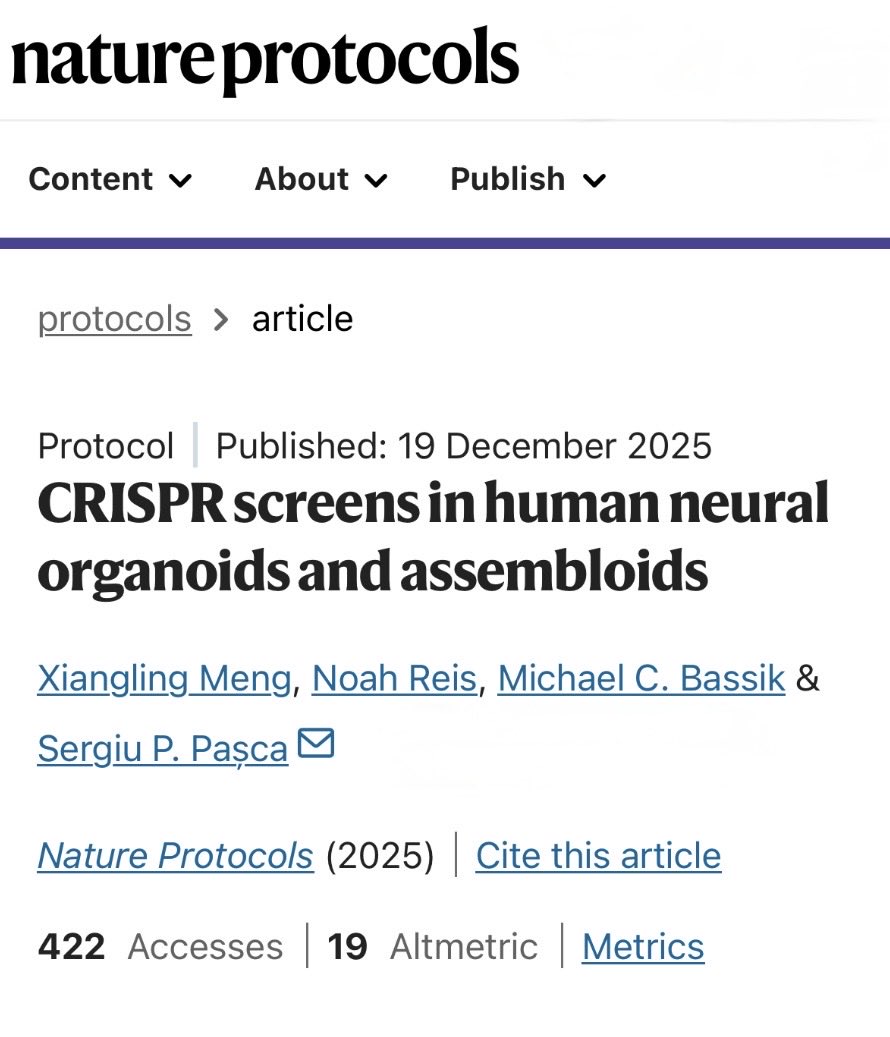
In our most recent publication in @NatureProtocols, we outline detailed methods for performing CRISPR screens in human neural #organoids and #assembloids.
The integration of these screening approaches with human models is becoming increasingly powerful for uncovering human biology and gaining mechanistic insights into disease.
This is the 4th article in our series of detailed protocols describing the generation of regionalized neural organoids and of assembloids, and their transplantation, and it serves as a foundation for our hands-on course in our Stanford @BrOrganogenesis.
Work led by XiangLing Meng (now running her own lab at Baylor) with Noah Reiss!
Excited to share our new study on antifungal drug tolerance in the human fungal pathogen Candida albicans.
This work highlights a link between between drug tolerance and cytoplasmic fluidity.
Short summary👇(1/10)
https://t.co/KBRaqQ46jv
#Science#Microbiology#CellBiology
Very happy to see our work published! Thank to the editor and the reviewers for all the very helpful comments!
👇🏼 Summary of the preprint version
https://t.co/5saiuBSe57
Thrilled to share that my paper is out today in Science @ScienceMagazine !
So grateful to everyone involved, and excited to continue this work in my own lab at the University of Iowa @uiowa.
https://t.co/Wg26axxrvl