🎵Once all dreams were worth dreaming ....🎶Enya-Tall Timbers
If it's something we wouldn't have tolerated on Sept 12th, 2001, why are we tolerating it today?
🚨 ELON MUSK RESPONDS to Secretary Duffy's excuse for not using Starlink that @elonmusk offered to FAA FOR FREE LAST YEAR: "🤦♂️"
It would've saved BILLIONS UPON BILLIONS of taxpayer dollars, and probably would've been nearing completion.
Now, we're being told $50 BILLION is needed for wired upgrades.
Per Duffy, Duffy even said Starlink is being used by FAA in Alaska. Why can't we spread it here?
Not to mention the US MILITARY is routinely relying on Starlink for communications that can't be knocked out by adversaries.
Give Elon a shot and let him deliver.
TV Tuesday: In a 1961 Candid Camera prank, a disguised Buster Keaton sits at a diner counter and baffles unsuspecting patrons—caught between sheer disbelief and polite silence.
#oldhollywood#classictv
BREAKING: SpaceX CFO Bret Johnsen says Starlink is targeting 5G quality service from space in early 2028.
“We’re going to fly those satellites next year with the goal in the first half of 28 of turning on a true 5G quality service from space to your cell phone, no change required to the hardware. … We have all the pieces in place from a regulatory perspective in the United States for that. … Working with regulators in countries around the world and providers, existing providers, so that we could bring the first global wireless capability to the world.”
On July 9, 1962, the United States detonated a 1.4-megaton nuclear bomb 250 miles above the Pacific Ocean in a test known as Starfish Prime. It remains the largest nuclear explosion ever carried out in space. Scientists expected valuable data, but the blast produced effects far beyond their predictions.
The explosion generated a massive electromagnetic pulse that knocked out about 300 streetlights in Hawaii, nearly 900 miles away, damaged communications equipment, and triggered burglar alarms across the islands. The blast also created brilliant artificial auroras that lit up the skies over Hawaii and were visible as far away as New Zealand.
The test also flooded Earth's magnetosphere with high-energy particles, creating an artificial radiation belt that disabled or damaged several satellites over the following months, including Telstar 1, the world's first commercial communications satellite, and Ariel 1, Britain's first satellite.
Chilling historical photos: https://t.co/5nIVtOBX72
In 2001, an American submarine sank a Japanese high school training ship off Hawaii.
Nine people died. Four of them were 16 and 17-year-old students.
Then the U.S. Navy spent 60 million dollars to lift the entire ship off the ocean floor, 2,000 feet down, and bring them home.
The submarine was the USS Greeneville. The ship was the Ehime Maru, from Ehime Prefecture. Along with the four students, two teachers and three crewmen were lost.
When the grieving Japanese mothers and fathers begged to have their sons brought home, commercial salvage experts around the world said it could not be done. No one in maritime history had ever lifted a five-hundred-ton steel hull from two thousand feet down, and critics argued that the staggering 60-million-dollar price tag was too high for a recovery mission.
The United States Navy looked into the eyes of those Japanese parents and decided that keeping a promise of honor has no price limit.
Spending 60 million dollars of its own budget and engineering custom deep-sea lifting cables aboard the vessel Rockwater 2, the U.S. Navy slowly raised the entire 500-ton ship from the crushing 2,000-foot abyss and towed it seventeen miles to shallow water.
Then sixty-six U.S. Navy divers worked in pitch-black, fuel-soaked compartments for weeks alongside Japanese divers, treating every room like a sacred shrine until they recovered eight of the nine missing souls, along with the students' school nameplates, family photos, and personal keepsakes, returning them to their parents with full military honors.
Mistakes can happen in the fog of this world, but spending sixty million dollars to conquer the impossible for grieving parents is how a great nation proves its word is sacred.
America's first Japanese prisoner of war was a 23-year-old naval officer who washed up on a beach in Hawaii the morning after Pearl Harbor.
His name was Kazuo Sakamaki. On December 7, 1941, he was one of ten men sent into Pearl Harbor in five tiny two-man submarines.
His gyrocompass was failing before he even started. His sub ran in circles, hit coral reefs, and took fire from the destroyer USS Helm.
Battery fumes filled the cabin and knocked out both men. When they woke up, they were drifting off Waimanalo, on the east side of Oahu.
They set a charge to destroy the sub and swam for shore. The charge failed, and his crewman, Kiyoshi Inagaki, drowned.
Sakamaki crawled onto the sand and passed out. A Hawaiian soldier named David Akui found him.
He woke up as a prisoner. To a Japanese officer of his time, that was worse than death.
He burned his own cheeks with a cigarette before his prison photo was taken. He begged an officer at the camp to let him die.
"Please kill me."
"You won't be killed."
Back in Japan, the navy turned the nine dead men into national heroes, and their photos ran in the newspapers.
Sakamaki's name was erased.
His family was told he had died, then told he might be alive and to tell no one. His little brother wondered why there were nine heroes when each sub held two men.
Inside American camps, Sakamaki slowly chose to live. He got newspapers, a pencil, and a dictionary, and he taught himself English.
He went home in 1946 believing in peace. Strangers sent him letters telling him to "immediately perform ritual suicide and apologize to the public."
He joined Toyota instead. His English took him to Brazil, where he became president of Toyota's company there in 1969.
He almost never talked about the war, even at home. He once handed his son his book and said, "Read this book if you want to know."
His son later wondered if his own name, Kiyoshi, honored the crewman who drowned that morning.
His son remembered one line his father always held to. "History must be conveyed accurately."
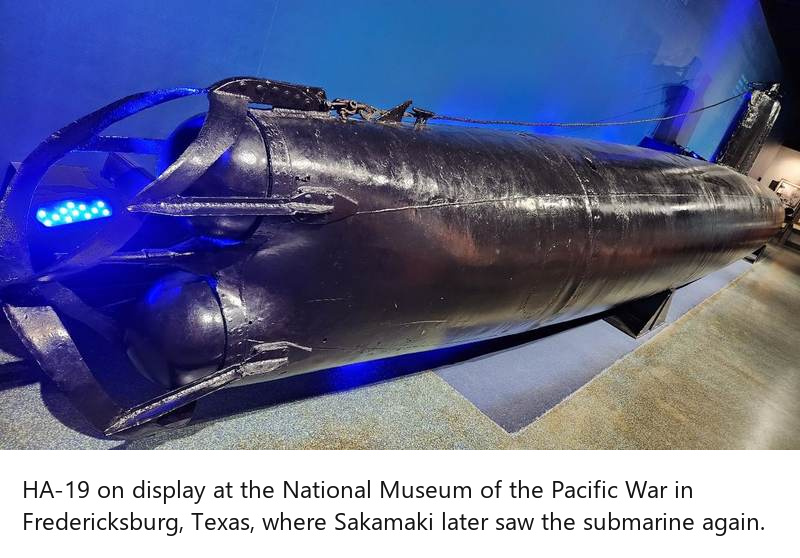
In 1991 he flew to a history conference in Fredericksburg, Texas. His old submarine was there.
He saw it for the first time in 50 years, and he wept.
It is still there today, in the National Museum of the Pacific War, deep in the heart of Texas.