🇫🇷 Poll for the second round of the presidential election :
Le Pen 52% - Philippe 48%
Le Pen 54% - Attal 46%
Le Pen 56% - Retailleau 44%
Le Pen 58,5% - Glucksmann 41,5%
Le Pen 67,5% - Mélenchon 32,5%
Source : Elabe for BFMTV
Yesterday, we made GPT-5.6 Sol Ultra generally available. Today, we're sharing that it produced a proof of the 50-year-old Cycle Double Cover Conjecture using 64 subagents in just under one hour. We're sharing the prompt and proof below. We're excited to see what you all do with Ultra!
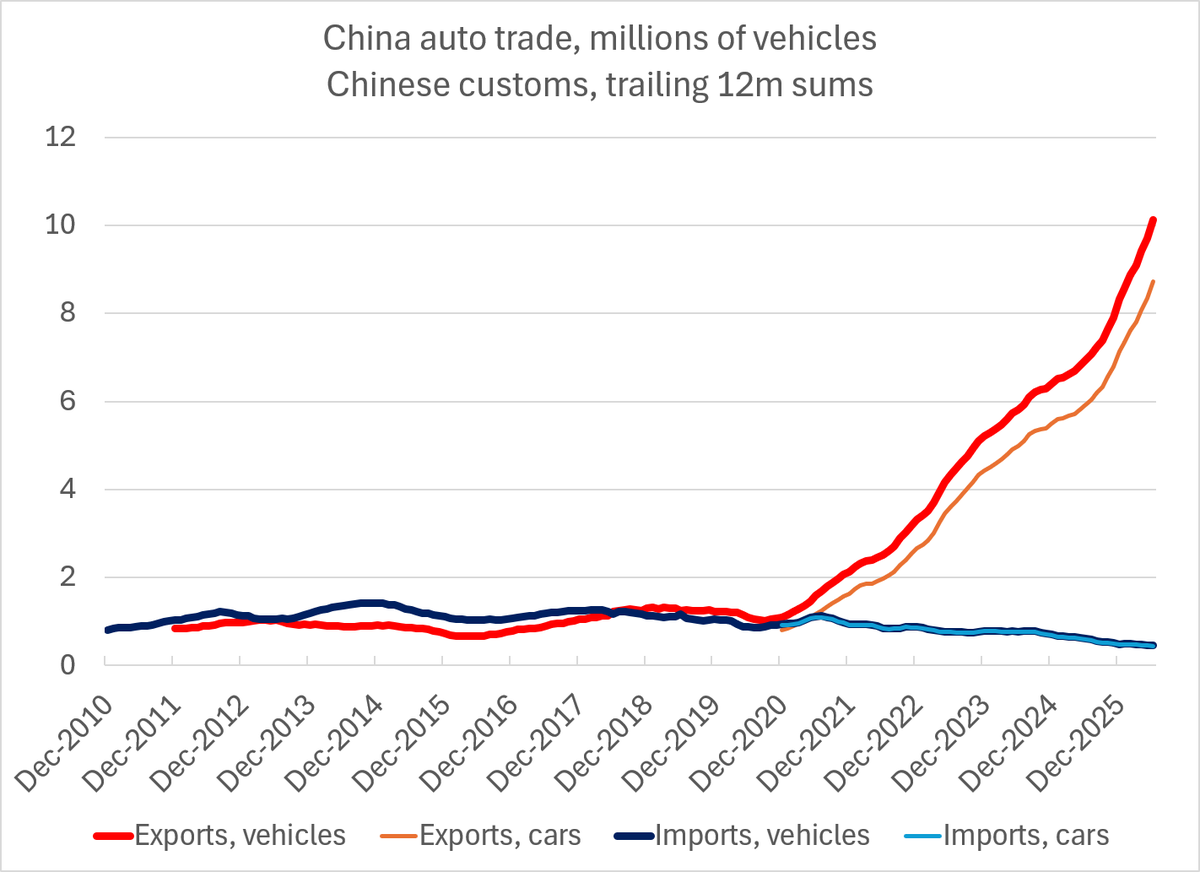
Stunning auto export numbers from China. Over 1 million vehicles in June (12m annual pace), with car exports tracking at an annual pace of 11m and EV exports reaching a 6m annual pace
1/
The objections to this from environmental protesters is quite something to behold. 75% of UK gas consumption either comes from exactly the same basin (Norway) or imported in the form of LNG at a higher total carbon footprint than UK-sourced gas supply. All we are doing is adding more carbon to the atmosphere, weakening the UK's Balance of Payments, reducing UK tax revenues, and increasing imported UK inflation. Top work folks....
The OBR warns that Britain's economy is on an unsustainable footing as an ageing population puts ever more pressure on the public spending. Much of it is driven by the triple lock
* Health spending is projected to rise from 8% of GDP in 2030/31 to 13% of GDP by 2075-76
* State pension spending is projected to rise from 5% of GDP to around 9% of GDP by 2075-76
* Education spending is expected to fall from 4.3% of GDP to 3.4% of GDP because there are fewer children
* The baseline scenario forecasts that spending will rise from 40% of GDP to 49% of GDP
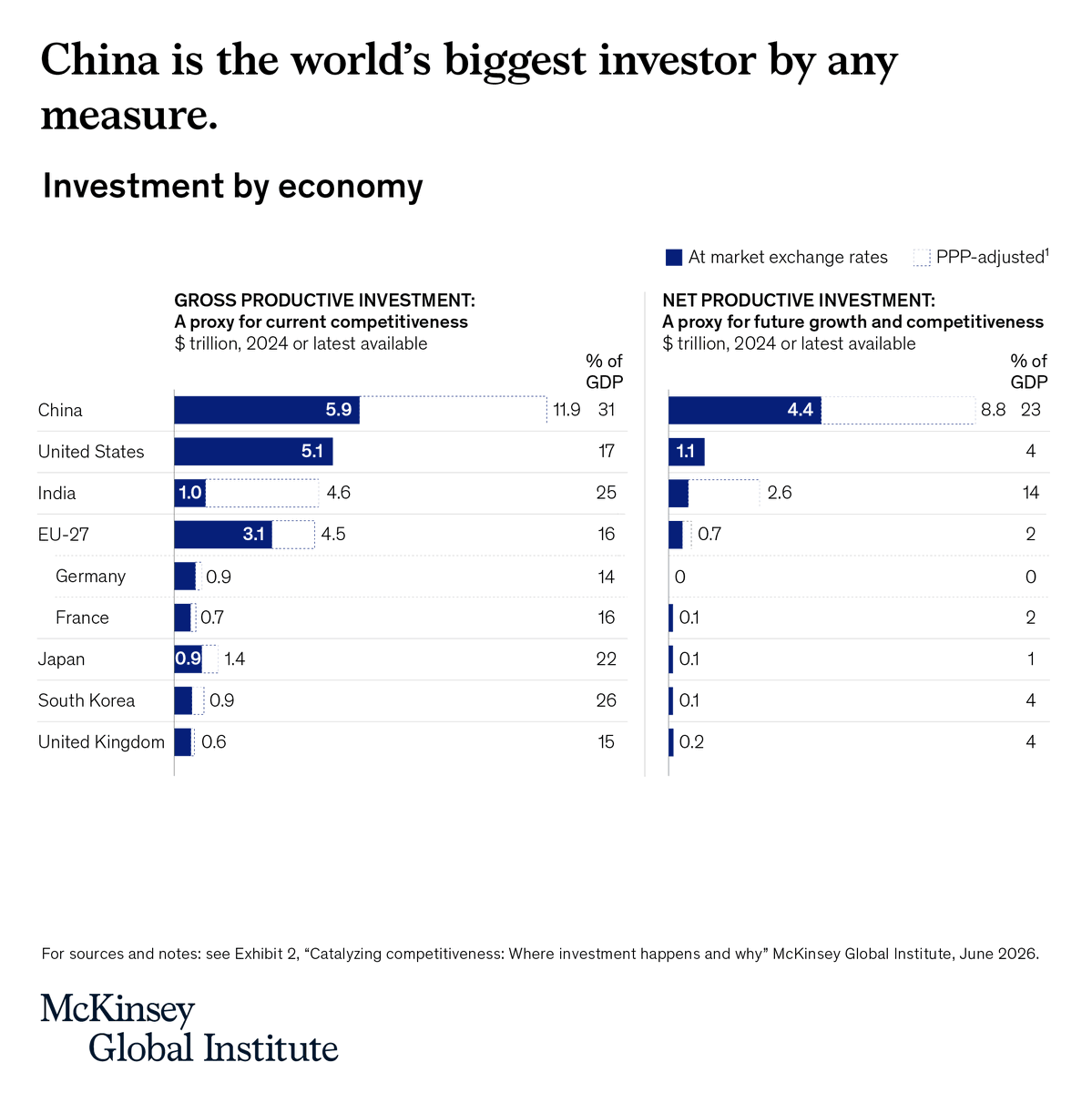
China’s gross investments total $5.9T annually – ~30% of its GDP. The US invests $5.1T. The EU invests $3.1T.
In net terms, China attracts 3x–5x more productive capital each year than the US and Europe combined.
Where productive investment is happening: https://t.co/kW24qZkHC3
I asked Dario 3 years ago why AIs haven't been able to use their vast knowledge across so many fields to connect two known ideas into a new discovery.
It seems like AI did exactly this in the way it disproved Erdos' conjecture aobut the unit distance problem by cleverly onnecting together ideas in discrete geometry and algebraic number theory.
Now that AI has been able to use its knowledge across multiple fields to come up with new ideas, what is the next benchmark?
@3blue1brown proposed one during our interview:
"Good mathematicians prove theorems, great mathematicians come up with conjectures, and the greatest mathematicians come up with definitions."
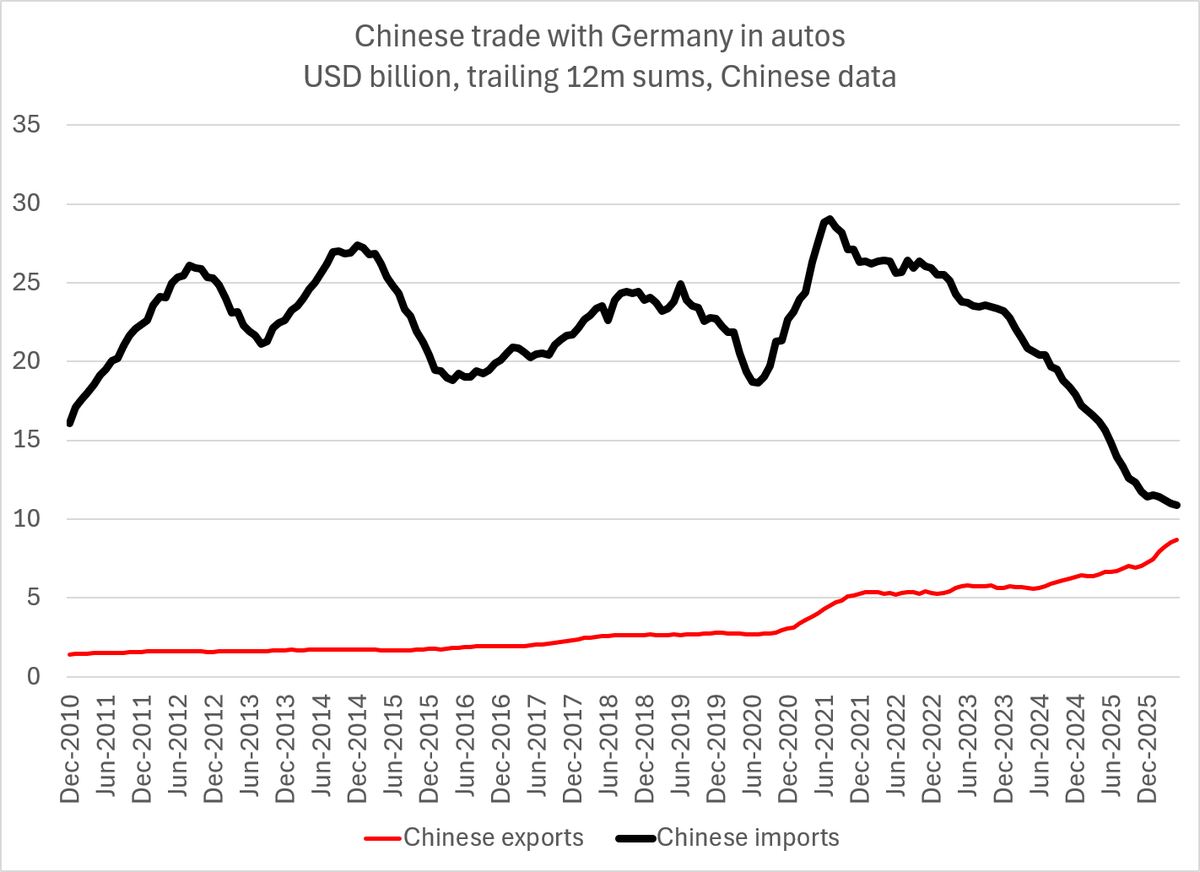
The story is that one of the world's largest economies lost half of one of its biggest export markets in one of the world's most traded products in a 24m period from end 23 to end 25 ...
1/2
1) Harry Kane!
2) I'd note the contrast here between France's rating improving by +50 points since the start of the World Cup while England is a -2.
3) That next game against Mexico at Azteca might be the match of the tournament.
Homing pigeons orient themselves by the Sun’s position under sunny skies and rely on their magnetic sense when it is cloudy.
Under overcast conditions, homing pigeons with their normal liver macrophages had little issue flying a 19-kilometer route for which they had been trained.
When injected with clodronate liposomes that knocked out the liver macrophages, the pigeons could navigate the route without issue when it was sunny.
Under overcast skies, however, homing pigeons with depleted liver macrophages struggled mightily to find their way home—suggesting the immune cells play a role in the birds’ magnetic sense.
Learn more: https://t.co/7TmzQAvvnu
Global oil trade, including oil, condensate and refined products, is expected to rise by nearly 25% by 2050.
Interregional crude and condensate trade stood at around 37.3 mb/d in 2025. By 2030, it is expected to increase to 41.8 mb/d, supported by rising oil demand in major consuming regions. After 2030, the rate of growth slows markedly but volumes still rise to a level of 47.8 mb/d by 2050.
⏬Download a copy ➡️ https://t.co/OReMATWrAx
There is only one “change” that will work for Burnham. A genuine, relentless focus on growth.
Two decades without earnings growth. That’s why electorate is fed up.
Only growth will repair contract between generations and allow social ills to be tackled
https://t.co/2H68i2d0JG
Europe cannot rent its way to AI sovereignty.
TLDR, here's my take I shared with frontier AI lab leadership this week. When Washington can disable a model overnight, the question is not whether AI is safe but who controls it:
A week ago the United States government ordered Anthropic, the world's most valuable AI startup, to shut off its most capable model, Fable, for every foreign national on earth - whether they worked for Anthropic or not. This was not an export ban on a weapon sold to an adversary. It was an instruction to disable a commercial product, four days after its release, after officials acted on a claim - which Anthropic disputed as narrow and unproven - that its safeguards could be jailbroken to expose cyber-offense capabilities.
I have spent my career around this technology, first as a graduate student and for the past decade as an investor @airstreet. In that time I have watched AI move from recommending movies to driving cars, speaking with a human voice, and editing the genome. I have also watched the debate about its risks settle on only half the question.
That debate is mostly about capability: how powerful these systems are becoming, and whether one might escape human control. Those are real questions. But they are not the only ones, and the Anthropic episode exposed the half we have neglected: access and control. The most advanced AI is built by a handful of American companies, on American soil, under American law, and what the rest of us are allowed to do with it can change on a Friday afternoon. The risk that matters today is not only that AI goes rogue, but that we do not control access to it at all.
Consider what "renting intelligence" now means in practice. A European hospital triaging scans, a bank screening fraud, a defense ministry planning for a conflict: increasingly each runs on an American AI system that's governed by its export regime. A single directive in Washington cascades, instantly, through every institution wired to that model. We have built core economic and public infrastructure on a supply that a foreign government can shut off. And while there are open-source alternatives, they're either Chinese or not at the frontier, and building European infrastructure on Chinese open weights trades one dependency for a thornier one.
And these systems are starting to improve themselves. As they do, AI stops being one industry among many and becomes the input to all the others - writing the code, running the research, designing the products, and, increasingly, generating the growth itself. Once intelligence is the engine of an economy, a country without a frontier model of its own does not lose a sector; it loses control of the inputs to everything else, and the independence that depends on them. Worse, the gap compounds: capability that improves itself gets harder to chase with every month it runs ahead. This is not a race Europe can plan to enter in a decade. The window to be a builder rather than a buyer is measured in the time it takes to stand up a cluster, not a career.
This should sting, because Europeans invented much of modern AI. DeepMind was founded in London and sold to Google in 2014, and a great deal of the talent that followed now lives in California. Today Europe faces a company worth almost $1 trillion and American tech giants spending an estimated $450 billion a year on AI infrastructure. Its answer has been the EU AI Act and a capital commitment that is a rounding error by comparison. A single American site, xAI's Colossus in Memphis, runs more than half a million GPUs. Europe has nothing remotely at that scale. The instinct to govern this technology is right, but we're off on the ambition by orders of magnitude.
It is fair to object that regulation is itself a form of power. But a rulebook is not a substitute for the thing it governs. You cannot regulate, or be cut off from, an industry you do not have.
Europe's instinct, when it is cut off, is not to build but to ask. We saw it within the week. The G7 convened in Evian and floated a "trusted partners" scheme to win back the access it had just lost, while Emmanuel Macron feted Donald Trump beneath the gilt of Versailles, the palace where France once helped midwife American independence. Two and a half centuries on, the dependency has reversed, and the posture is courtship.
None of this means Europe can match the American frontier dollar for dollar. With today's capital, it cannot, and pretending otherwise only wastes the little it has. But the goal is not parity, it is leverage. A country does not need the best model in the world to be sovereign; it needs a credible one of its own, on its own soil, good enough that being cut off is survivable rather than catastrophic. That is the difference between negotiating your access from dependence and negotiating it with an alternative in hand. The point is not to win the race. It is to make sure no one else can end it for you.
Sovereignty of that kind is something you build, and Europe has done it before. The Financial Conduct Authority's regulatory sandbox, launched in 2016, let startups test products with real customers under supervision instead of waiting years for authorization. The pro-innovation culture it signaled helped make London the fintech capital of Europe, home to Revolut, Wise, and Monzo. Government should be AI's most demanding early customer rather than writing rules for systems it has only ever imported.
Industry has to stop behaving like a tenant. Too many European companies rent the entire stack from American providers and build a thin product on top. That earns a margin and owns nothing: when the lab that supplies you decides to compete with you, or its government decides to cut you off, you have no ground to stand on. Where it counts, build and hold your own models and compute.
And our universities, which should be the source of all this, still work against it. I have argued here before that Europe's spinout system is broken, and it remains so. Too many institutions treat the companies their research creates as something to extract value from, rather than as the vehicle through which a discovery reaches the world. The best research should leave the building as a company, in addition to a paper.
We keep framing AI safety and AI ambition as a tradeoff, as though a country must choose between governing this technology and building it. It is not a choice. The safest position is not the most heavily regulated one. It is the one where the model runs on your terms, in your jurisdiction, and no one on the far side of an ocean can reach over and turn it off. Right now that finger is not ours. Until it is, every other conversation about AI risk is one we are having with someone else's permission.
---
END
This is a super exciting release - Claude Fable 5 is the same underlying model as Mythos but with added safeguards. The benchmarks are great and it's SOTA on everything by a margin but I'll add that *qualitatively* also, this is a major-version-bump-deserving step change forward (imo of the same order as Claude 4.5 was in November), peaking especially for long problem-solving sessions on very difficult problems. You can give it a lot more ambitious tasks than what you're used to, the model "gets it" and it will just go, and it's never felt this tempting to stop looking at the code at all (but don't do this in prod!). The model still has quirks that people will run into and the safeguards are configured to be a little too trigger happy for launch, which can hopefully be tuned over time.
I feel a lot of things changing as working software increasingly comes out on a tap. The Jevon's paradox kicks in and I feel my own demand for software growing substantially. You can ask for anything - explainers, visualizers, dashboards, bespoke single-use apps (e.g. a full wandb that is hyper-specific just for your project), you can 10X your test suite, auto-optimize code, run giant research projects with custom HTML for the results, anything! "Free your mind" (Matrix ref). Really looking forward to all the things people build!
Introducing Claude Fable 5: a Mythos-class model that we’ve made safe for general use.
Its capabilities exceed those of any model we’ve ever made generally available.
Fable 5 is the same underlying model as Mythos 5, but with cybersecurity and biology blocks. Mythos is the first model that's made me feel that we've entered the next phase of model progress.
For years, we've talked about cybersecurity / self-improvement / autonomy / model-dominated coding / biology implications of model progress. Some of these are issues to defend against; some are areas to advance. Mythos has made me & our team feel like we've seen the earliest glimpse of the world we've been talking about.
Also, we published a lot of cyber eval results in the system card, including some evals we designed recently, as well as details of safeguards. In most cases, Mythos 5 ~= Mythos Preview. We found it ticked up on the new ExploitBench eval, and we opted to put that in the eval table so people can calibrate/update on advances in cyber capabilities to be prepared for. (We don't want to compete on offensive capabilities and don't try to.) But overall, Mythos 5 is an efficient model, about equal to Mythos Preview in most cases. I'd really like more people to design new security evals! The better models get, the more our limited evals only see a small part of the picture.
In terms of where we go from here, here are some current thoughts:
1/ It's important we get Mythos cyber capabilities to defenders. We just have to do it safely and cautiously. We're working on an expanded trusted access program. We're working with government and industry to do this. I sort of envision the next 1-2 years being a large scale effort to make the world resilient + design & implement new approaches to security.
2/ I think cybersecurity will start merging with AI security and alignment. Let's say you're a defender and you want to use a model -- will it break out of its sandbox? Will it stop where you tell it to stop? This is one reason I'm excited about working on cybersecurity. In the limit, it's the same thing as AI security.
3/ I really want people to develop new evals for... defensive cybersecurity, hardware security, autonomously running a business, advanced biology, and other parts of national security. Our internal eval ship rate is way, way up because Mythos makes it easy to iterate, especially on the engineering aspect of building evals. (Sometimes, we ask new hires to make a new eval on their first day, and another on the next).
I’m excited we’re making this available as Fable 5, because I think the world spending time with the model is the most important way to calibrate.
Ten years ago, AlphaGo’s legendary match in Seoul heralded the start of the modern era in AI. Its famous ‘Move 37’ signaled to us that AI techniques were ready to tackle real-world problems in areas like science - and ideas inspired by these methods are critical to building AGI