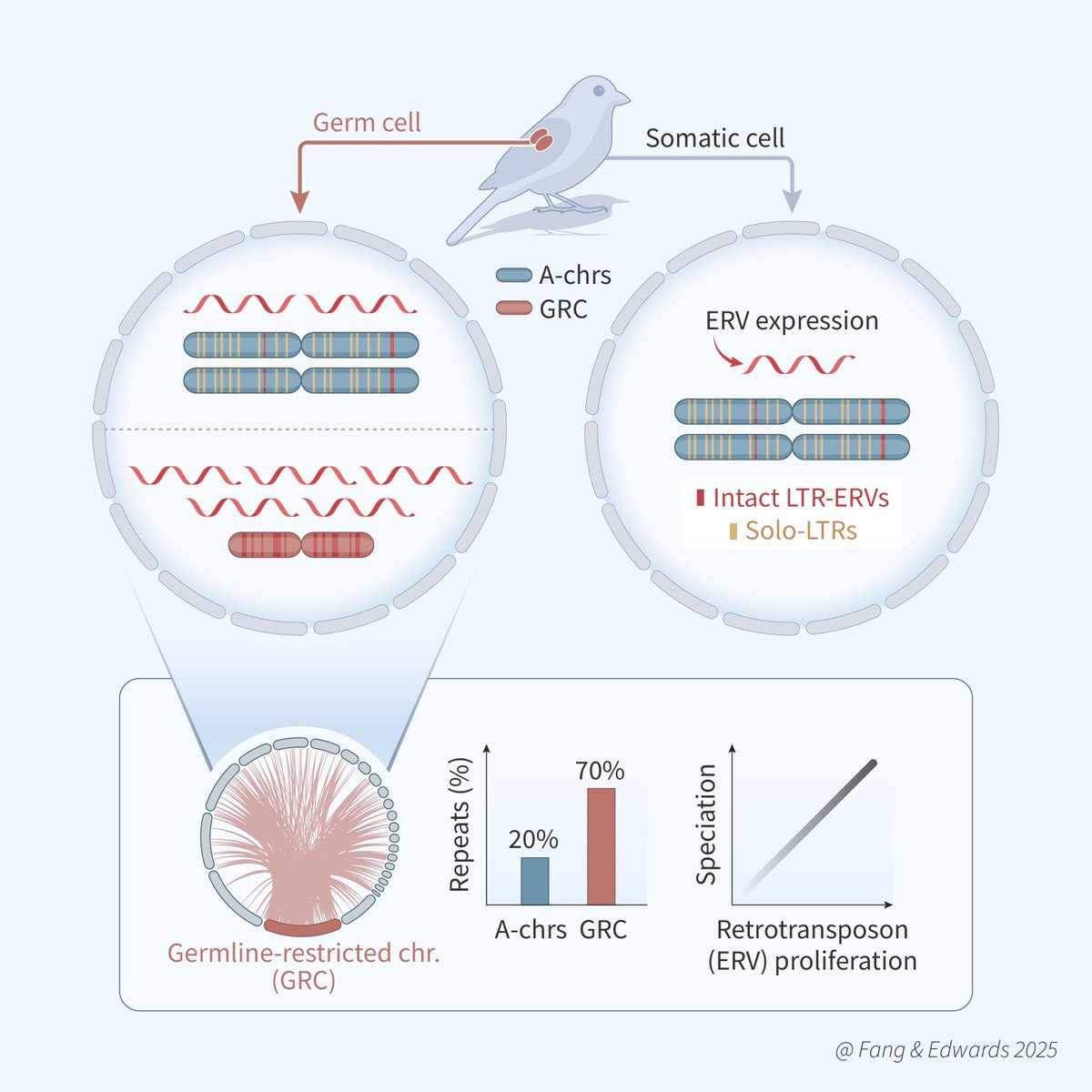
Our new preprint @ScottVEdwards1🧬🐦 Long-read genomes show songbird germline-restricted chromosomes (GRCs; expelled from somatic cells) are 70 % repeats and packed with active LTR retroviruses. A hidden reservoir for TE-driven innovation/diversification! https://t.co/TzW4QOz50C
How and why does #SexualSelection vary geographically? @ra_barber@ja_tobias &co study 10,671 #bird species, revealing that avian sexual selection varies latitudinally, is explained by temperature seasonality & other #climate-related factors #PLOSBiology https://t.co/JTgE7ndIDG
it comes with an webpage showing how to conduct phylogenetic multilevel meta-analysis for how to do #MetaAnalysis for this kind of multi-species data set collected across the globe - https://t.co/jRZH7KKCWe
"The importance of epistasis in the evolution of viral pathogens" (w/@NathanGrubaugh, others)
We review a broad virus literature w/respect to the sort of epistasis identified.
We argue that epistasis should be a central feature of genomic epidemiology.
https://t.co/UvFlNenvi8
The chronospace R package is now published!! I hope it'll provide useful tools for visualizing and exploring sensitivity in estimates of divergence times. A really fun project with lifelong friend @millacarmonia
https://t.co/bf3teu0ina
Excited to share our new paper @NatureComms.
https://t.co/RsRQ5F02Bt
Single-nucleosome imaging reveals that condensins act as molecular crosslinkers, locally constraining nucleosomes to organize mitotic chromosomes. Nucleosome-nucleosome interactions constrain whole chromosomes.
"Here, we report a broad survey of plasmids from hundreds of academic and industrial labs worldwide. We show that nearly half of them contained design and/or sequence errors."
Trust nothing; validate everything.
https://t.co/B1wn3GLte5
Published today:
Finding the truth in science
In a ‘publish or perish’ culture, some scientists may resort to questionable research practices or even fraud.
https://t.co/9cxlB4VXnk
The first paper from my PhD work is out: Never-before-seen transcripts emerged in a Long-Term Evolution Experiment by recruiting existing promoters (in as little as 2 years).
It’s been an absolute honor to see scientists whom I’ve looked up to for years retweeting this!