Altimeter Partner working with software businesses at the earliest stages of product market fit. Dad to 4 amazing kids. No investment advice, all views personal
We're very excited for @attestable to come out of stealth today. We @AltimeterCap co-led their seed round with @TLV_Partners, and believe they're building a crucial layer in the AI stack.
It's clear two things are happening simultaneously - AI systems are making more consequential decision while their risk is going up (see Hugging Face incident). An existential questions becomes "how can you prove a model did what it was supposed to do?"
Attestable is building this exact integrity and verification layer for AI, using zero-knowledge proofs to verify the right model ran on the right inputs and called the right tools. As agent workloads become longer running, verifying each step becomes even more important.
The technical breakthroughs the Attestable has made to get here are incredible. Zero-knowledge proofs used to carry a 1,000,000x compute overhead, making them completely impractical for AI. The Attestable team has gotten this down many orders of magnitude, making ZK for AI something that can actually be deployed. We'll need this kind of integrity / security solution in a post-quantum world :)
From securing model weights, to proving open models are backdoor-free, to giving agents verifiable identity - Attestable is building the integrity layer for an AI-powered world. As co-founder @Yogi_Brn puts it: every token should be a proven token.
More below from my conversation with Yogi
LiveKit Connectors are generally available today.
They bring calls from @twilio Programmable Voice and @WhatsApp Business Calling into a LiveKit room as a regular participant, so your agent can answer there with no SIP trunk to provision and nothing new to host.
Read the full article: https://t.co/Yvj1Crwg3r
The story of ClickHouse is truly insane.
Started as an open-source project; scaled into the fastest-growing database product ever.
Year 1: $0
Year 2: $12M
Year 3: $50M
Year 4: $200M
Year 5 (not complete): My bet is $450M.
My notes from our discussion with @ceo_clickhouse below 👇
1. Are Large U.S. Enterprises Scared to Work With Frontier Model Providers?
Large enterprises remain skeptical of “zero data retention” claims and wary of sending proprietary source code to frontier labs due to IP indemnification and data leakage concerns. Rather than exposing production code, companies may limit frontier model usage to less sensitive workflows like code review while turning to open-weight alternatives for critical data.
2. How Do You Assess Defensibility and Moat in Companies That Scale Faster Than Ever Before?
When an application scales from zero to $100M in ARR in a single year, investors must rigorously question its underlying moat. Hypergrowth without high switching costs leaves companies vulnerable to rapid churn as customers move effortlessly to the next model or tool that leapfrogs the incumbent.
3. How Does This AI Cycle Compare to Prior Technology Shifts and Transitions?
Unlike the gradual adoption curves of the internet and mobile eras, the current AI wave is accelerating at an unprecedented pace. Agentic experiences are maturing rapidly, driving explosive revenue growth and placing historically unique performance demands on underlying data infrastructure.
4. What Job Does Not Exist Today That Will Be Very Prevalent in Five Years?
A critical new corporate role could be an AI finance function dedicated entirely to managing token consumption and resource allocation across the enterprise. But the role may ultimately be short-lived as autonomous AI agents increasingly manage their own infrastructure spend and budget execution.
5. What Should Investors Be Worried About Today That They Are Not?
The biggest overlooked risk in AI today is revenue durability. While infrastructure software benefits from high switching costs, agentic applications can have exceptionally low barriers to switching, raising questions about long-term retention as models and products continually leapfrog one another.
6. Why Revenue Concentration Is a Real Concern
Operators and investors should treat revenue concentration as a critical risk, with any single customer or vertical accounting for more than 10% of revenue representing significant exposure. Sustainable enterprise value requires a diversified customer base so losing one account never threatens the company’s overall growth trajectory.
(links in comments)
Data centers helped resurrect Quincy, Washington.The poverty rate fell from 29.4% to 6.2%.
Tech tax revenue funded a new high school, hospital, library, police and fire stations, while residents’ property tax rates decreased.
Build data centers in communities that want jobs, investment, and economic revival!
Castelion is designing products for scaled production and affordability without compromising on capability.
Simple in concept, but requires exceptionally difficult and complex engineering execution.
Always comes back to the team. Special talent and leadership are required!
We're hiring at Elorian. We're solving a problem that's still wide open: teaching AI to think about the visual realm the way humans do. If you want to join a focused, highly selective team and help define what's next, we'd love for you to join us: https://t.co/fub1k6JZCs
🫡 AgentX 1.0 from @SemiAnalysis_ has been months in the making, and the @inferact team did amazing work pushing @vllm_project to become the leading inference system for agents: KV offload, PD disaggregation, and production-grade reliability — all without compromising accuracy!
More data than open-source AI is taking share from OpenAI and Anthropic. Open source has gone from 28% token share to 62% token share @vercel over the last 2 months. Chart from @rauchg
Super impressive given that the sum of OpenAI and Anthropic accelerated in July. So net token/AI infra demand accelerated even more than the acceleration we saw at the frontier. And suspect Grok growing even faster than open-source and we saw some of this in the @tryramp data.
Open-source AI taking share is positive for AI infrastructure demand as it lowers margins at the model layer and an open-source token costs just as much compute to produce as a frontier token. Nothing about open-source AI inference is “free.”
Most likely end state IMO is that closed, frontier tokens are 60-90% of economic value but only 15 to 25% of tokens.
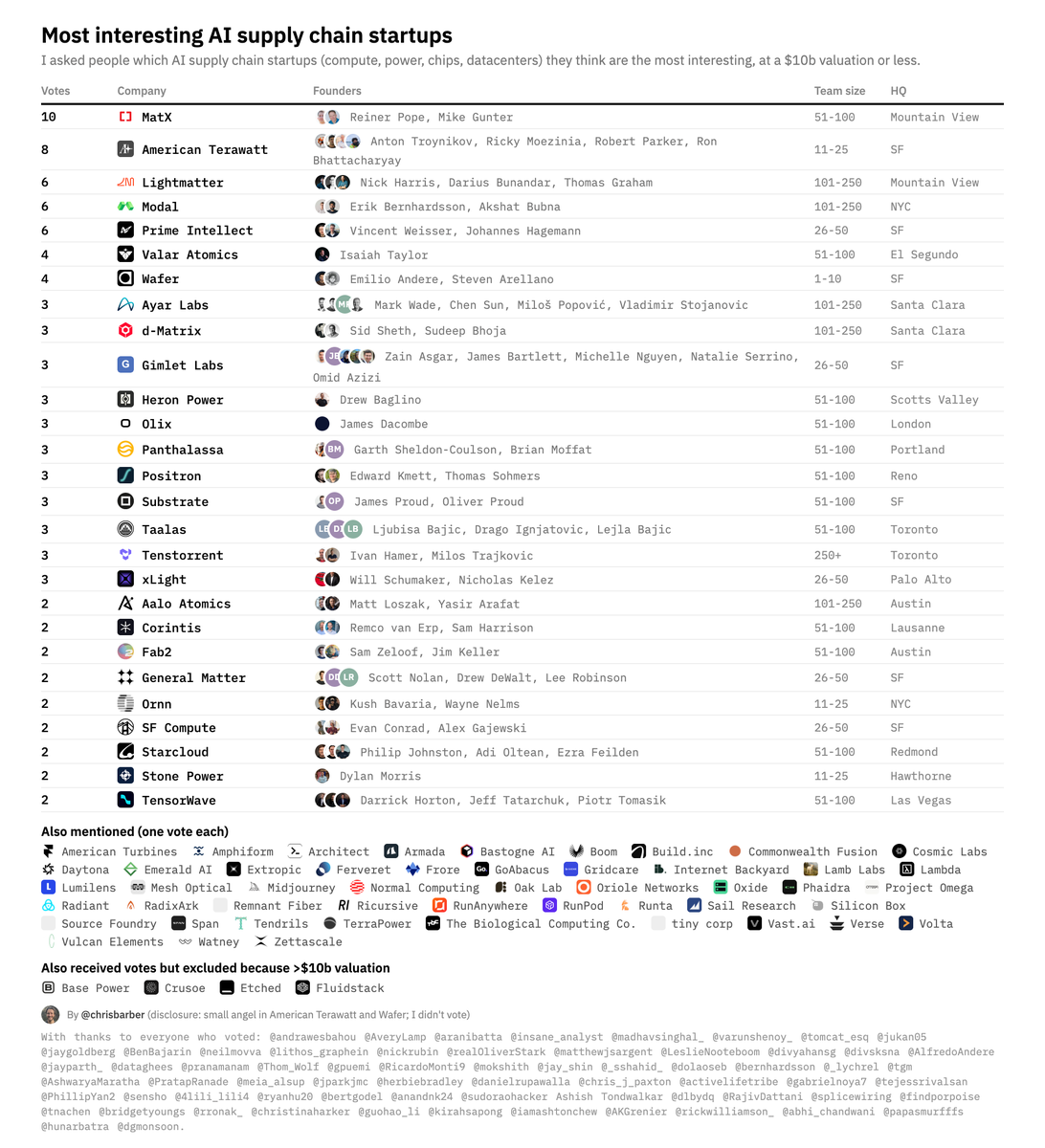
I asked people: "which AI supply chain startups (compute, power, chips, datacenters) valued at $10b or less are most interesting?"
10 votes: MatX
8: American Terawatt
6 each: Lightmatter, Modal, Prime Intellect
4 each: Valar Atomics, Wafer
3 each: Ayar Labs, d-Matrix, Gimlet Labs, Heron Power, Olix, Panthalassa, Positron, Substrate, Taalas, Tenstorrent, xLight
2 each: Aalo Atomics, Corintis, Fab2, General Matter, Ornn, SF Compute, Starcloud, Stone Power, TensorWave
1 each: 49 more startups, see image and below
People also voted for Base Power, Crusoe, Etched, and Fluidstack but those are over the valuation limit.
Disclosure: I'm a small angel in American Terawatt and Wafer. I didn't vote.
Couple themes that seem obvious
AI is accelerating usage of leading data infra platforms (Clickhouse, Databricks, Snowflake, etc)
You either die an AI looser, or live long enough to become a neocloud. Everyone is becoming a neocloud! In addition to the many independents
The biggest mistake made by almost everyone who claims that curing every disease within a decade, or accomplishing other insanely difficult things like reversing aging in such a short time, is impossible, is assuming that progress over the next 10 years will look something like the past 20 years, perhaps just a little faster. Yet, it will be radically different: the next decade will bring more technological progress than the entire past century. Just think of all the progress we had since 1900 to today happening in the next 10 years or so.
That means many things people assume are still 100 or 200 years away could become possible within the next 10–15 years. By 2050, we will likely see more scientific and technological advancement than humanity experienced during the previous 5,000 years of civilization combined!
This is the essence of the technological singularity: progress stops feeling linear and becomes so rapid, compounding, and transformative that the future becomes extraordinarily difficult to extrapolate from the past. And that is precisely why the concept is so difficult for people to comprehend, or accept, and also why some of us have such a conviction to keep claiming the impossible!
Our founders sat down with the @WSJ for an exclusive look at our Series C fundraising round and the three low-cost, mass-producible weapons systems we’re building.