Kamino Earn Vaults give depositors access to curator-managed stablecoin strategies, with capital deployed across isolated markets targeting risk-adjusted yield.
DeFi made easy on Kamino.
Interesting setup, hopefully this isn't just retail exit liquidity for insiders who'd rather skip the IPO.
Had this existed before the AI hype boom, retail wouldn't be entering at these valuations.
How much alpha is actually left for this to still count as venture?
Announcing: USVC
AngelList exists to power the innovation economy.
To date, we have powered $125 billion in assets, 25,000+ funds, and 13,000+ startups.
Today, we’re opening it for retail access.
@usvc_ is a regulated fund that holds stakes in promising private companies.
There are no accreditation requirements and anyone can get started with as little as $500.
Early portfolio includes xAI, Anthropic, OpenAI, Sierra, Vercel, Crusoe, and Legora.
Own a stake in the companies defining the future.
Learn more: https://t.co/5zqSuqpVU8
🚨 Venus Protocol has zero exposure to rsETH and incurred no bad debt. However, as a precautionary measure following the advice of our risk manager @Allezlabs, we have temporarily set the collateral factor of the following assets to 0:
USDe, sUSDe, SolvBTC, xSolvBTC, USD1, XAUM
Users can still repay and withdraw these assets directly via the Venus UI.
To reiterate, Venus was not affected by the hack and all user funds remain safe. We will provide updates when the collateral factor of these assets returns to normal.
Kamino can confirm that it is unaffected by the ongoing situation with rsETH on Ethereum.
Out of an abundance of caution, Kamino has paused all interactions with LayerZero tokens across all core markets: USDS, LBTC, FBTC.
These reserves are now in reduce-only mode — users are able to withdraw their assets and repay debt, but any deposits and borrows are currently disabled.
Kamino is in contact with the LayerZero team, and users will be notified once normal operations resume across these reserves.
To reiterate, Kamino and its users have not been affected. All actions taken are preemptive.
@zmanian DD is far from just quantitative as most recent exploits show and agents are not at a stage where they could handle qualitative aspects reliably
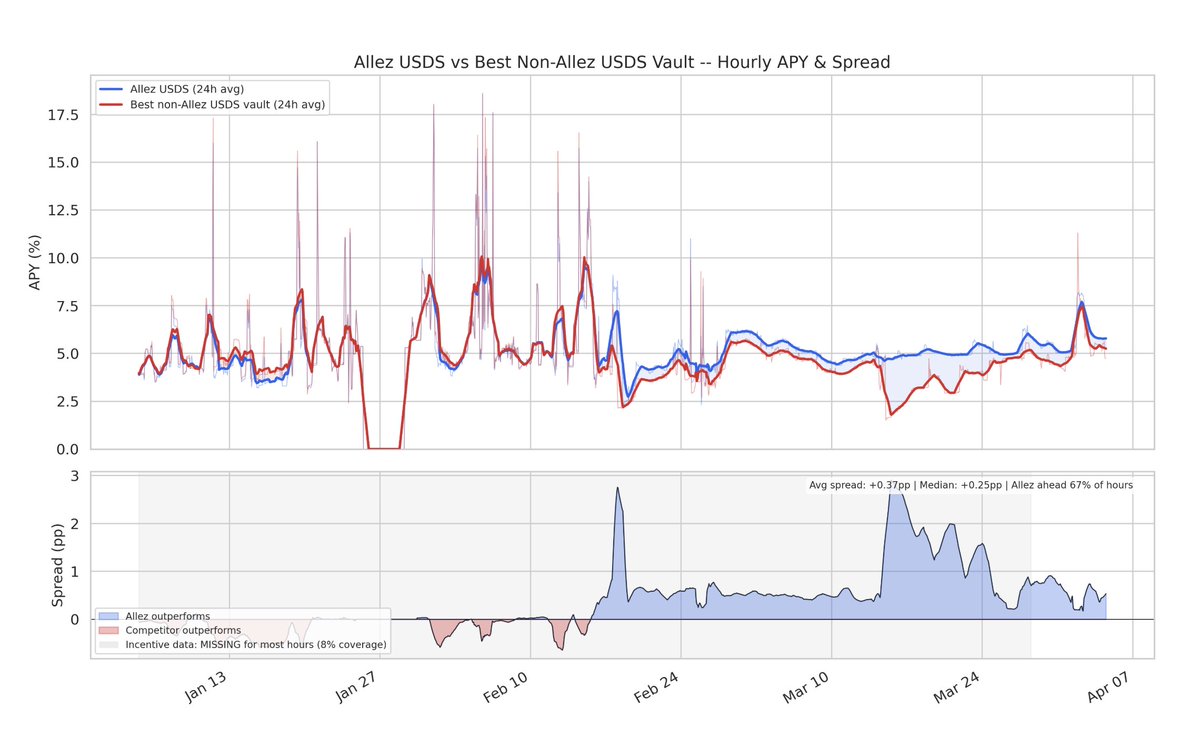
USD Vaults on Kamino are outperforming the DeFi Dollar Benchmark !
Wanted to take this opportunity to give another framework for suppliers entering market.
Generally users look at the yield, do I recognize the curator's logo, hit the supply button.
The yield is not the full picture, getting the best instant yield is an engineering issue. However when there's significant AUM your primary concern should be capping exposure to specific markets.
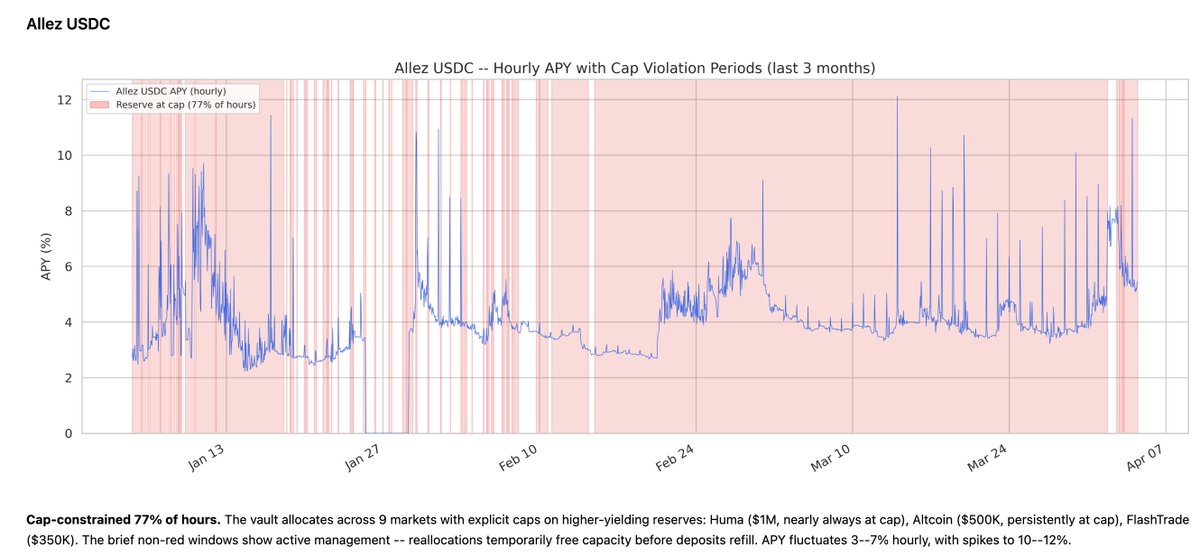
At a certain size you can run after the best instant yield and get out of any market any time, see the difference between Allez USDC and Allez USDS.
1- Allez USDC has hit a reserve's cap 77% of the time in the past 3 months, i.e. the algo could get better yield by allocating more but we've set a cap to limit exposure
2-3- Allez USDS has been unleashed around february, by far the one that outcompetes any other curator, small size, no caps, best yield all the time on USDS
4- Allez USDC's concentration vs other curators of similar size, Allez is the least concentrated, i.e. where the raw number of the vault yield is X%, your curator might be 100% in one market
interesting charts included :)
Update for our LPs:
Our @Kamino lending vaults are functioning as designed with no exposure to @DriftProtocol.
All positions remain healthy and operating normally with zero impact to suppliers. We continue to monitor the situation closely.
We are in Cannes for @EthCC
Catch us at:
→ TheGate by @Rockaway_X
→ @Chainlink VIP Dinner
→ RWA Summit by @centrifuge
→ The Clearing House by @MidasRWA
→ OpenClaw Events
→ @Ethereum_France Apéro
→ Vault Brunch by @DeFiFounders
And we're hosting Tuesday come through 🍷
Update for our LPs:
Our @Kamino lending vaults are functioning as designed with no exposure to @ResolvLabs USD (USR). All positions remain healthy and operating normally with zero impact to suppliers. We continue to monitor the situation closely.
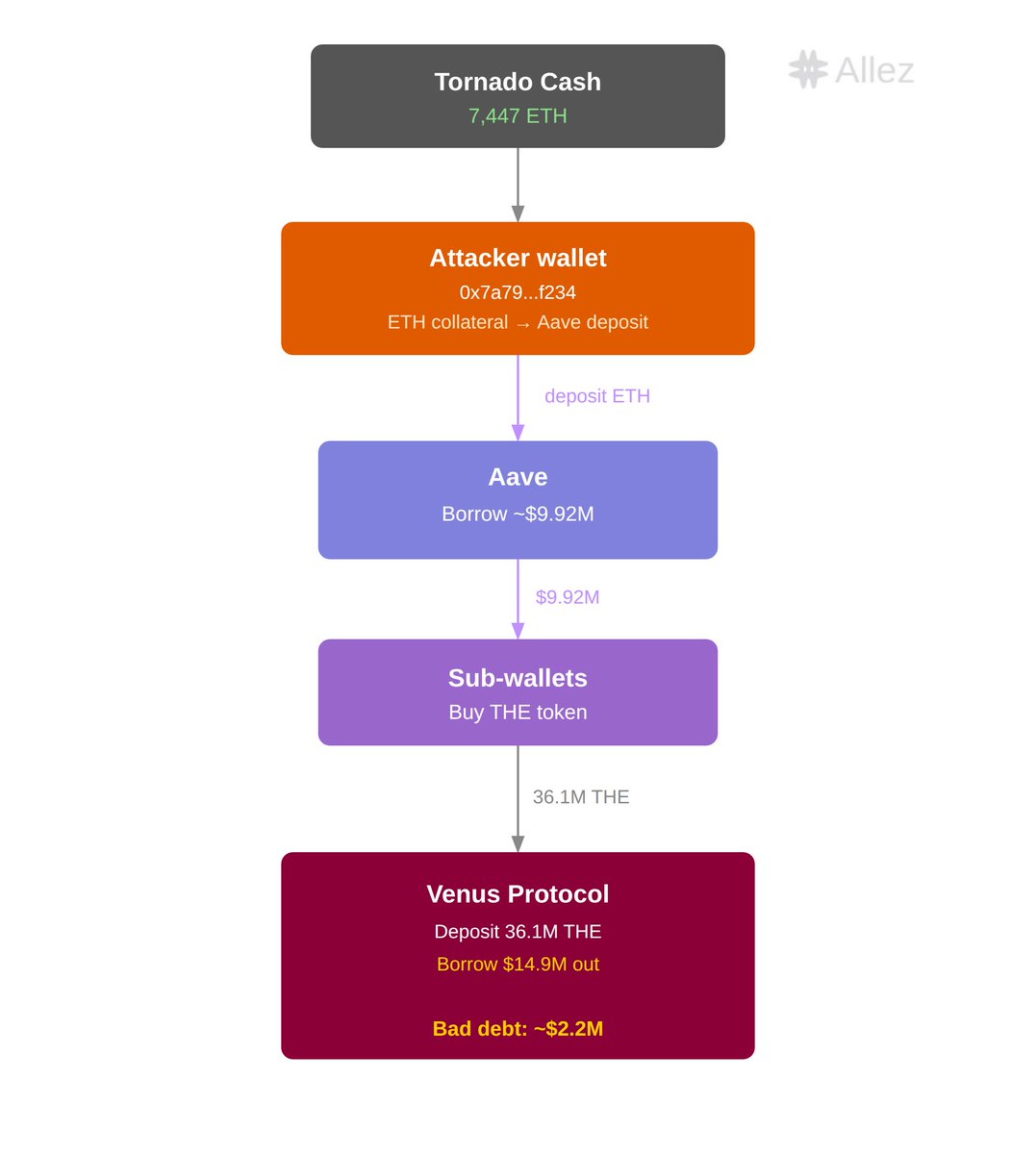
We've published the post-mortem on the March 15 THE market incident on @VenusProtocol.
~$2.15M in bad debt, isolated to THE and CAKE markets. No smart contract compromise.
Here is the full breakdown: preparation, attack mechanics, root cause, and remediation 🧵
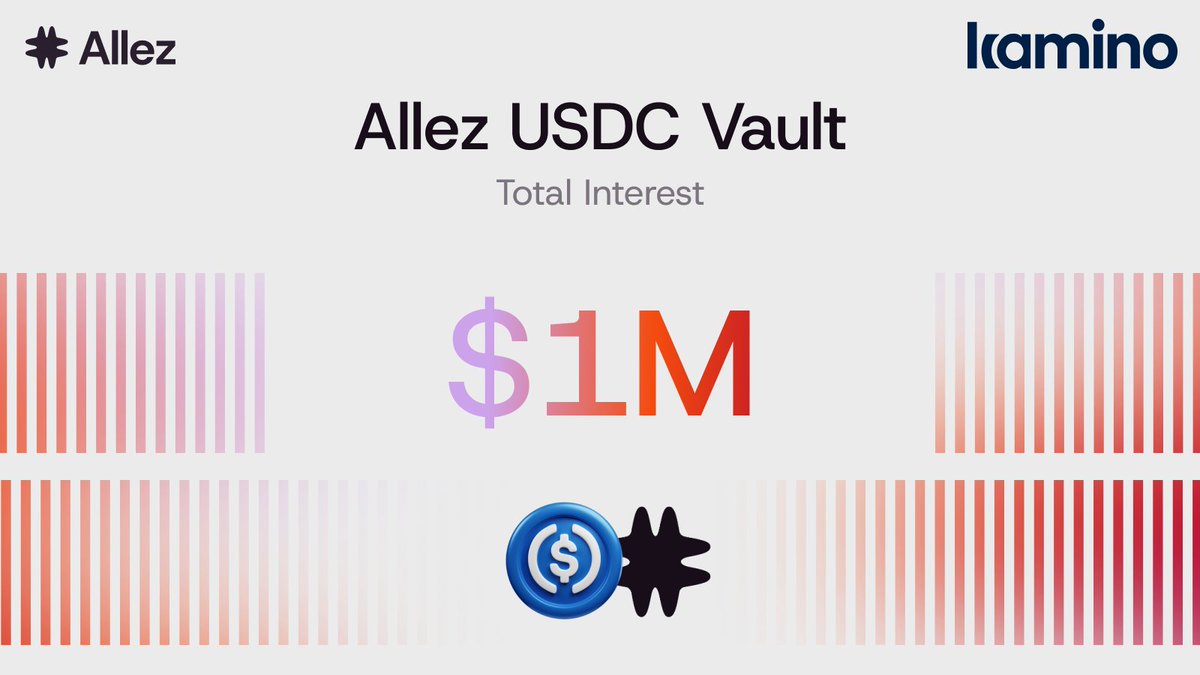
Allez USDC @kamino vault just crossed $1M in interest paid to depositors 💰
How it works:
→ Allocates across Kamino Core, RWA and Other Markets
→ Caps max exposure to each specific market
→ 7.4% APY over the last 90 days
Yield with guardrails 🛡️
RWA markets have reached 35% market share on @Kamino with over $1B supplied.
Users want yield and they’re taking advantage of real world yield options to earn up to 20% APY with Kamino Multiply.
🥇 Prime Market by @Figure and @HastraFi
🥈 @maplefinance Market
🥉 @onrefinance Market
Today we open source Nomos 1. At just 30B parameters, it scores 87/120 on this year’s Putnam, one of the world’s most prestigious math competitions.
This score would rank #2/3988 in 2024 and marks our first step with @hillclimbai towards creating a SOTA AI mathematician.
Anarcho-capitalism is a wonderfully abstract ideal that can inspire innovation. It helped inspire me to help invent cryptocurrency.
But real-world cryptocurrencies are not trustless -- they are trust-minimized. Each cryptocurrency has a legal attack surface, representing the kinds of ways governments and/or private entities can practically use law to disrupt their operations. The layer 1 of a good trust-minimized cryptocurrency like Bitcoin can withstand much more interference than centralized technologies could or can, but the technology still has its limits.
The kinds of attacks that come from financial law have largely proven to be manageable, due to a combination of the trust-minimized (not trustless) technology, which requires diligent attention from developers motivated to keep it a trust-minimized form of money, and a large army of cryptocurrency industry lawyers who specialize in financial law.
The legal attack surface from arbitrary data is far larger and far less predictable. The crypto industry does not have the legal expertise to deal with it.
Thinking that Bitcoin, or any other cryptocurrency or blockchain protocol, is a magical anarcho-capitalist Swiss army knife that can withstand any kind of governmental attack in any legal area is insanity.
Explored a more philosophical/somatic side of freediving in a new essay. Worlds away from crypto data science, yet strongly complementary.
Had a blast writing it, hope it’s half as engaging to read:
https://t.co/6GAlIaoMlx
Introducing a new Stablecoin Rates Dashboard - Sphere 🔮.
Aimed to be a neutral, go-to dashboard for borrowers to check all relevant data before opening a CDP in the DeFi lending protocols.
Now in one place, you can:
- Find currently the lowest borrowing rates in DeFi ✅
- Simulate borrow rate impact (e.g. for borrowing $10M) ✅
- Check stablecoin historical borrow rates across DeFi blue-chip protocols ✅
- Check additional per-pool parameters (max leverage, LTVs, utilization) ✅
- Simulate potential slippage in case of unwinding in one tx [SOON] ⏳
Dashboard: https://t.co/SE7qx9Fl0b
Core Vaults represent over 45% ($5.38 billion) of the collateral backing within the @SkyEcosystem.
This thread provides an overview of Core Vaults and Collateral Auctions, along with a step-by-step guide on how to explore these features using the Sky Risk & Analytics Dashboard.















![BlockAnalitica's tweet photo. Introducing a new Stablecoin Rates Dashboard - Sphere 🔮.
Aimed to be a neutral, go-to dashboard for borrowers to check all relevant data before opening a CDP in the DeFi lending protocols.
Now in one place, you can:
- Find currently the lowest borrowing rates in DeFi ✅
- Simulate borrow rate impact (e.g. for borrowing $10M) ✅
- Check stablecoin historical borrow rates across DeFi blue-chip protocols ✅
- Check additional per-pool parameters (max leverage, LTVs, utilization) ✅
- Simulate potential slippage in case of unwinding in one tx [SOON] ⏳
Dashboard: https://t.co/SE7qx9Fl0b](https://pbs.twimg.com/media/GehiWVCWYAEPzMj.jpg)