I couldn’t be happier to partner with @OwnYourDataNow Brittany Kaiser @BDeath75@logantoday and all of the AlphaTON team to bring green AI Compute to the awesome Telegram community!
We are pleased to announce a strategic partnership with @AlphaTONCapital, @Cudo_Compute and Vertical Data to accelerate the development and deployment of Telegram's Cocoon AI network. Learn more: https://t.co/IWE49oWMc9
Earlier today, Jensen Huang's @NVIDIAGTC Paris keynote highlighted us as a leader in NVIDIA #AI infrastructure for the UK. 🇬🇧🌐
We're celebrating by networking over cocktails and hosting panel discussions with @ASI_Alliance on what's next for us and decentralised #AGI.
Watch our COO, @JanetAdamsAI, discuss the combined values of AI and blockchain, OpenCog Hyperon, our compute infrastructure, and how decentralized AI creates new possibilities for humanity: https://t.co/54PYObEb52
I’m proud to celebrate the ASI Alliance, working with brilliant partners to take forwards our combined and shared mission and values. And super excited for what’s to come!
Exactly One Year Ago, the ASI Alliance took a Bold Leap Foward
A strategic token merge of @Fetch_ai@SingularityNET & @oceanprotocol (& later @CUDOS_!) positioned to reshape AI for good
Today, we reflect on the achievements made, the boundaries pushed, & the future being built
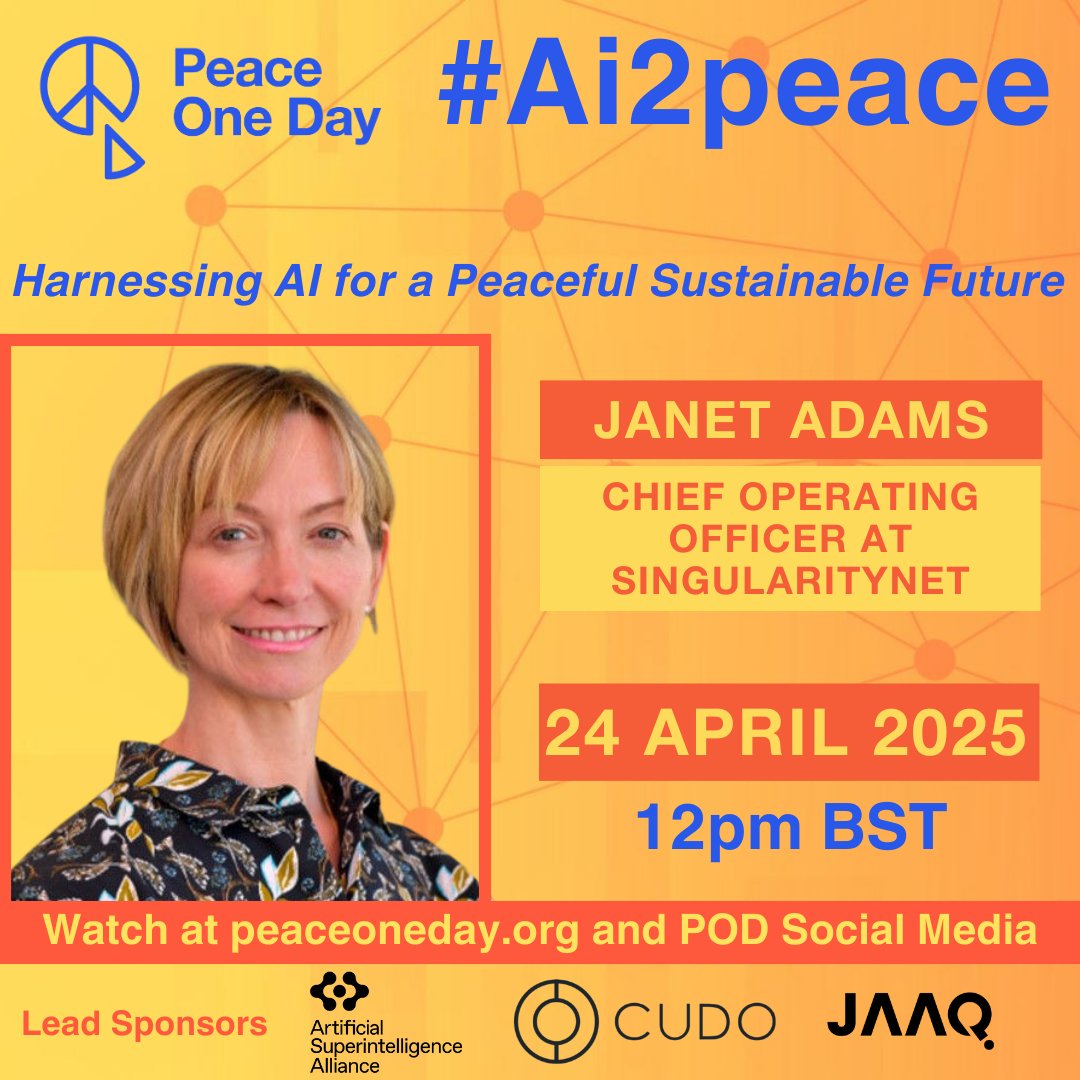
Peace One Day is proud to announce that Janet Adams, Chief Operating Officer at SingularityNET, will be participating in #Ai2peace, broadcasting on the 24th of April.
Visit https://t.co/oX70UgnacL for more info.
@ASI_Alliance@CUDOS_ @JAAQOFFICIAL
Hmmm....
Not having played with the o3 model myself yet, I don't want to say too much that's super definitive...
My experience with previous models is, at first when I try them I'm like "Whoa! Incredible! This is super smart! Look what it can do!" ... then after trying to use it in practice I end up being like "Hmm well actually in some ways it's weirdly stupid... but once I learn the right way to use it's still super useful..." .... I am guessing o3 will be the same way... but maybe it really does solve significant aspects of coding more compellingly. I certainly hope so!
However, that is still a quite different thing from AGI.
Sam Altman says with models like this, the concept of AGI becomes less useful, but I don't actually think so. I think the concept of AGI becomes less useful for OpenAI, because they seem to be launching amazing and valuable stuff that is not AGI. I also think it's clear that tremendous economic and practical value can be gotten from these super large scale narrow-AIs (whose narrowness is a sort of halo around their incredibly huge training dataset), regardless of the fact that they're not AGI....
The theory of AGI is subtle and the concept of human-level AGI is ambiguous ... but: Basically until we have an AGI that can invent and create and build and communicate autonomously and creatively, based on its own values and inclinations, at the level of a smart innovative human ... we are not to HLAGI yet.
We may well be almost there in a historical sense, could be just a couple years off, but that's still different than having it in hand... and still leaves lots of room for innovation in getting to the finish lin
Also, it's important to point out that, even though I don't think LLMs are the path to AGI, I do think o3 and any further developments in that direction are very encouraging regarding my own team's quite different AGI efforts...
Consider: o3 is probably clever enough to reliably map English into uncertain predicate logic expressions. And while it may be ahead of OSS models now, that won't last, the rhythm of the LLM world is that the OSS models don't lag the proprietary models by thaaaat long.... So before too long we'll have an OSS model that can reliably map English into uncertain predicate logic expressions...
Then we can take whatever the best LLMs output (in response to any query or situation) and feed it into the scaled-up version of our Hyperon Atomspace (running spread across our decentralized networks...). We can use Hyperon's logical reasoning to go beyond what LLMs can do in terms of abstraction and generalization ... and we can use Hyperon's evolutionary and algorithmic-chemistry methods to do creative invention beyond what LLMs can do... fueled by the input from LLMs themselves, and using LLMs for guidance of the Hyperon method wherever helpful...
We will be using the f**k out of the best OSS LLMs, but not letting them run the show, rather using them as a resource within a decentralized network leveraging Hyperon for advanced reasoning and creativity, and also for running the basic cognitive cycle of values, goals/motivations, perceptions, plans and actions...
Hyperon doesn't need LLMs to do its thing. But it can certainly use them as accelerants ;)
These next couple years are going to be insanely fascinating... What a time to be alive and working in the AGI space !! Wow !!
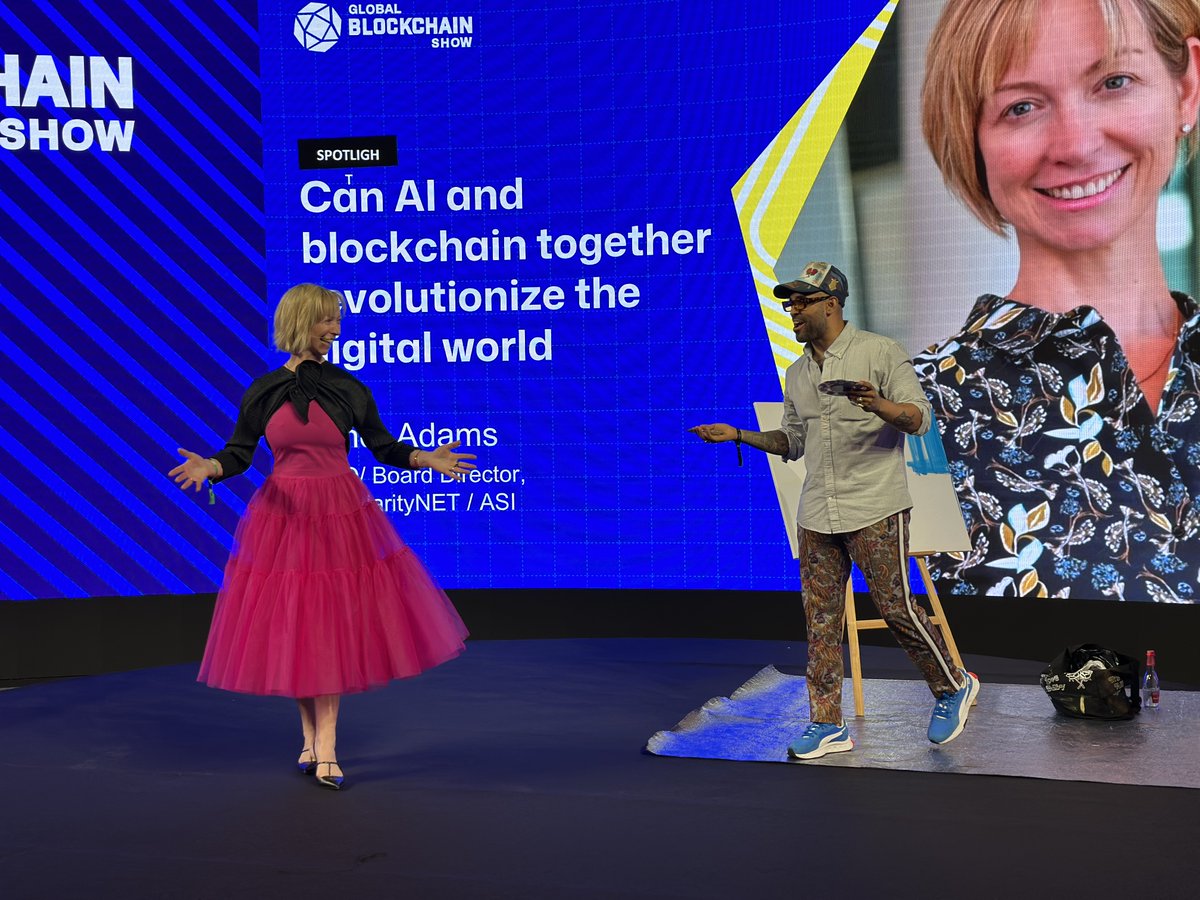
It was a pleasure and honour to speak at the Global Blockchain Show @0xGBS in Dubai yesterday big thanks to all the team for excellent organisation & warm experience. Huge thanks to Robin Reyes who flew in from NYC to paint on stage with me and what a beautiful artwork ☀️
Can AI and Blockchain Together Revolutionize the Digital World?
Our COO, @JanetAdamsAI, took the stage today at the Global Blockchain Show @0xGBS in Dubai alongside Robin Reyes, Founder of Heal Through Art, to discuss the combined values of AI and blockchain and how these frontier technologies can work in synergy to address global development priorities and create new possibilities for humanity.
Janet began with an assessment of contemporary AI, specifically highlighting the challenges of big tech domination and addressing the industry's focus on LLMs. Despite their capabilities, these models demonstrate significant constraints: they are very closed-ended systems tied to their training data, poor at original multi-step logical reasoning, and incapable of radical creativity.
As Janet mapped out a path toward beneficial AGI, Reyes' artwork emerged in the background, offering an artistic counterpoint to the discussion of technological advancement. Where current systems are pre-trained on large data sets and respond only as programmed or prompted, AGI systems will reason and learn from experience with strategic thinking and decision-making. While current AI remains limited to its original scope and struggles in complex dynamic environments, AGI will adaptively work with nuance and complexity.
The technical core of Janet’s keynote focused on the philosophy behind and the components of the OpenCog Hyperon framework for open-ended, beneficial AGI development. Hyperon serves as the infrastructure for the PRIMUS Hybrid Cognitive Architecture, integrating metagraph meta-representation, deep neural nets, logical reasoning, and evolutionary learning. Through this system, different cognitive processes — from perception hierarchies to language comprehension — work together within the Distributed Atomspace, enabling collaboration between specialized algorithms. This cognitive synergy, Janet explained, extends beyond basic AI capabilities to support applications ranging from robotics and biological reasoning to financial prediction and mathematical logic.
In this line, Janet presented the @ASI_Alliance as an alternative path to AGI development, backed by our groundbreaking $53 million investment to create the world's first supercomputer dedicated to decentralized AGI. The initiative demonstrates our commitment to energy-efficient and sustainable hardware infrastructure, with recent acquisitions including Nvidia L40S GPUs, AMD Instinct and Genoa processors, Tenstorrent Wormhole server racks, and servers with H200 GPUs and Nvidia GB200 systems.
The Alliance's approach emphasizes open-ended cognitive architecture, open source code, diverse heterogeneous AGI algorithms, and ethically sourced and managed data, all supported by decentralized infrastructure and governance. This supercomputer infrastructure is specifically optimized for deep neural networks, large language models including multimodal variations, and hybrid neural-symbolic computing architectures like OpenCog Hyperon, to enable AGI continuous learning, supporting high-load scenarios for large-scale AI operations, and advancing decentralized AGI research.
Another focus was on blockchain technology as a foundational element for AGI development. Janet detailed how blockchain enables decentralized, performant, and defensible compute infrastructure for AI while providing a crucial framework for resource-constrained distributed computing that mirrors biological neural systems. The technology, she explained, ensures protection against attacks and bad actors in decentralized AI systems while facilitating a secure exchange of compute resources and valuable data for advanced AI training. She further elaborated on blockchain's scalability benefits, describing how it offers a scalable solution for high-volume data processing and AI computations while supporting hardware-agnostic performance scaling through efficient utilization of increased physical threads.
Beyond the technical aspects, Janet highlighted two significant social impact initiatives bridging technology and human development. The DigiTruck Ethiopia program led by Betelhem Dessie represents an ambitious educational outreach, aiming to train over 27,000 students, with more than 16,000 being female participants. The initiative provides fundamental programming and robotics training to underprivileged youth aged 8 to 18, utilizing an off-grid mobile digital lab to reach marginalized areas. The program expands digital literacy nationwide through project-based learning approaches while significantly increasing female participation in technology and computer programming.
Parallel to this, Janet highlighted the Healing Through Art initiative, which combines traditional creative expression with cutting-edge technology education. Led by Robin Reyes, the program offers an inclusive space for all ages and abilities, incorporating diverse art forms from Pop Art to pottery alongside modern elements like Web3, Meta, and AI Learning. The initiative has demonstrated an 81% positive impact on participants' mental health through artistic expression while empowering students through financial literacy and entrepreneurship education. Reyes's tailored classes provide a unique blend of creative and practical skills, scientifically proven to reduce stress, anxiety, and depression while preparing participants for future opportunities.
Through the DigiTruck Ethiopia program and Healing Through Art, real change is already happening in communities that need it most. Those interested in supporting these transformative programs can visit https://t.co/rL7dIeY8MB or https://t.co/8S2Me8daNL. Every contribution helps expand the reach of these programs, bringing technology education and creative empowerment to more communities worldwide.
We are pleased to announce that our COO, @JanetAdamsAI, will speak at the Global Blockchain Show @0xGBS in Dubai.
🎟️Learn more and register to attend: https://t.co/GEgbtfgG2G