Looking forward to joining the dendritic cell meeting in San Diego and meeting colleagues and friends. Will you join as well? Check out @www.dc2026sandiego.com
Almost 15 years after our initial observation that IRE1 is specifically active in cDC1s, we finally start understanding why…
Check out the new study from @victor.bosteels, published in @natcomms.nature.com
Paper in press @ https://t.co/zk0n8rqzn4
This process is specific to cDC1s and is only required during homeostatic not immunogenic maturation.
Thanks to @ERC_Research for supporting this work through the ERC-CoG DCRIDDLE. Thanks to @ugent_fge and @InflamResCen for their fantastic support to my team.
In contrast to most secretory cell types where IRE1 gets activated by accumulation of unfolded proteins in the ER, IRE1 gets activated by cholesterol influx during apoptotic cell engulfment in cDC1s. IRE1-dependent RIDD drives cholesterol efflux during homeostatic DC maturation.
Thrilled to present our unpublished work on how dendritic cells decode LNP-embedded antigenic cargo at the @ESGCT meeting in Rome (bit overwhelmed by the amount of people though😱). For all DC and LNP lovers, come find me at 15h3O in Parallel session B.
Very happy that our review in Nat Rev Imm is out! Trying to shed some light on the many knowns and even more unknowns of homeostatic dendritic cell maturation with @Victor_Bosteels @InflamResCen
Interested in dendritic cell biology and/or IRE1 signaling? Ready for a new challenge in the city of Ghent? If the answer is 2x yes, please check the VIB website for open positions for a PhD student https://t.co/JqPn7yor3H and a postdoc https://t.co/tKebwpPUDm in the @JanssensLab
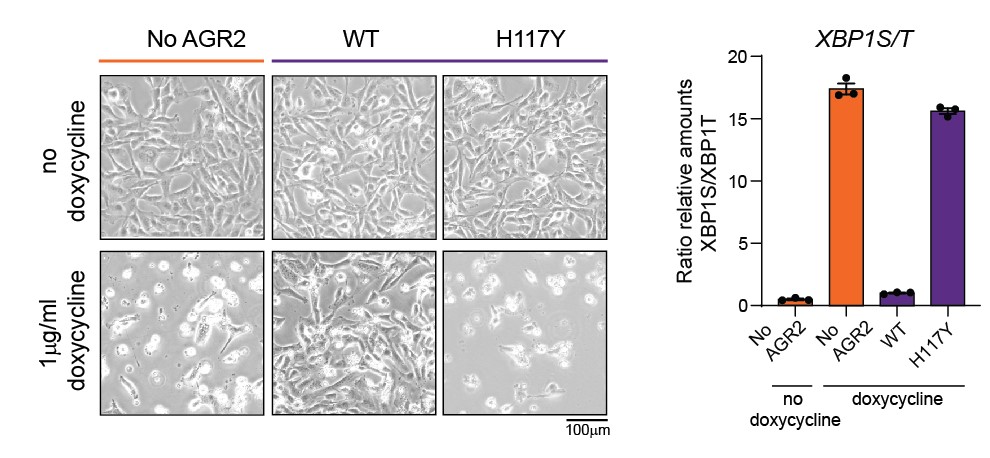
AGR2 is a pretty interesting protein, especially upon mutation of H117 to Y: this causes massive inflammatory phenotypes in patients. Turns out that the H117Y mutant is also completely incapable of blocking IRE1β activity!