Using 2M+ real smartphone texts/calls (not self-reported friends) to track peer networks - richer peers look good for mental health, until you account for the fact that people actually choose who they stay in contact with. Then it flips: bad for mental health. Selection matters
My paper on peer effects has been accepted at the JPE @JPolEcon.
I formulate and empirically test a theory of why students influence each other's learning in school: by competing with each other.
I thank the editor, referees, and data editor.
Paper: https://t.co/7TwMwzdtZc
I suddenly thought of something an alumnus said at a high school talk: “you have to be able to endure loneliness.” I guess this is probably what they meant. But then again, pain always seems to come hand in hand with doing something great (hopefully).
The main source of suffering during a PhD is the lack of relatively frequent positive feedback, the kind you used to get while studying. It’s like hiking: before, walking from one village to the next brought a sense of freshness, and you would happily take on the next challenge.
University peers shape personality development with lasting effects on conscientiousness and competitiveness. Just Accepted new paper by Xiaoyue Shan (@_XiaoyueShan_) and Ulf Zölitz (@uZoelitz) https://t.co/z49lKu9aqN
Join us for the 2nd Scottish Behavioural Sciences Conference 2025 at @UofGlasgow@UofGAsbs in
Scotland
A cradle of behavioural science since the days of Adam Smith & David Hume
👇https://t.co/GHFiJqs0M0
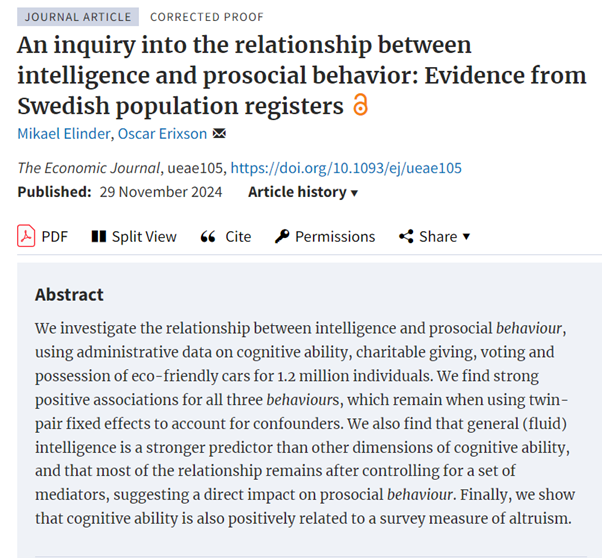
Forthcoming in EJ: An inquiry into the relationship between intelligence and prosocial behaviour: Evidence from Swedish population registers’ by Mikael Elinder, Oscar Erixson https://t.co/pk1NdebZYd @ElinderMikael@RoyalEconSoc@OxfordJournals#EconTwitter