California is looking to cut red tape for robotaxis.
New proposed CPUC rules would streamline service area expansions, make airport access easier, and eliminate unnecessary equipment requirements for purpose-built autonomous vehicles like Tesla’s Cybercab.
Vote set for December 3.
🚨 BREAKING: FSD can come to Austria 🇦🇹, and the Austrian government just confirmed it in writing.
@Tesla@teslaeurope@elonmusk, the green light is here. Ship FSD to Austria ASAP 🇦🇹
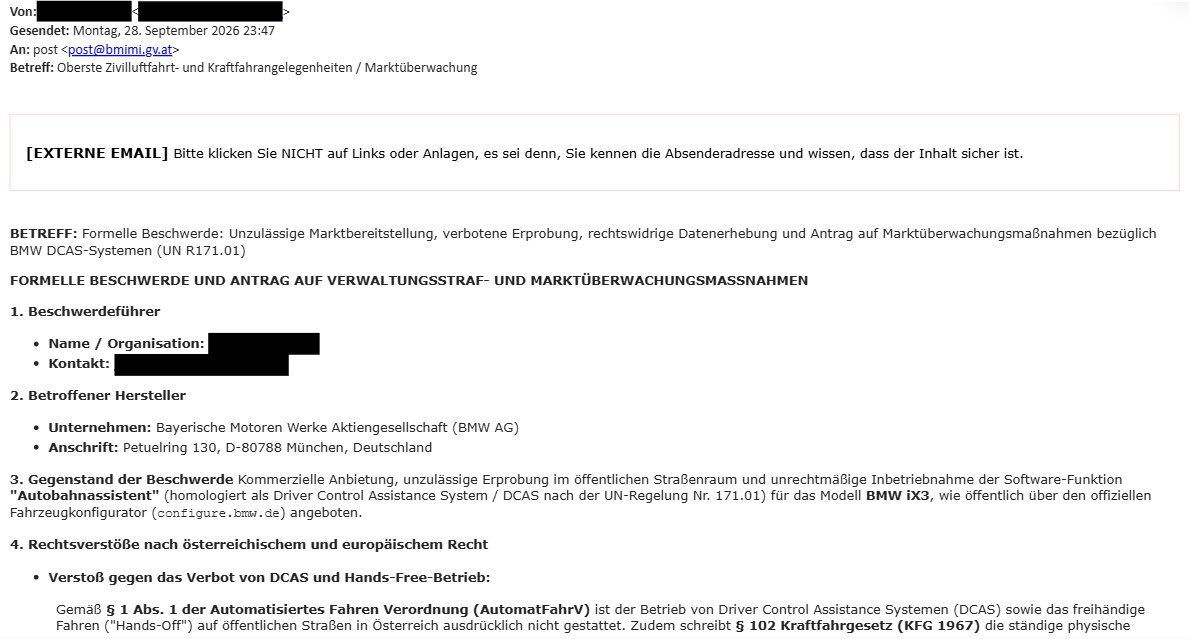
BMW is already selling its hands-free Highway Assistant in Austria. So why not Tesla?
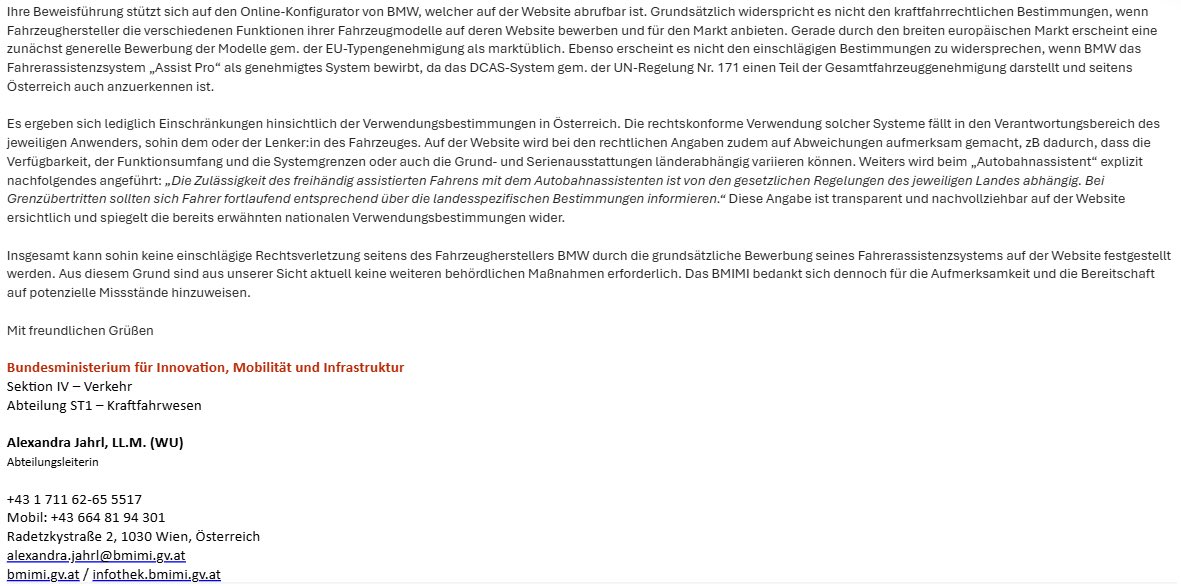
The Austrian transport ministry (BMIMI) has now answered:
✅ Selling it is fine. The manufacturer may advertise and sell the system, and Austria has to recognise the EU approval.
✅ The driver is responsible. Using the system legally is up to the driver, not the manufacturer.
Why does this matter? Because the ministry separates two things: approving and selling a car, and how it's used on the road.
Approval is EU law. Once a system is approved, every EU country has to accept it, including Austria. How it's used is national law, and that part is on the driver, not the company.
FSD Supervised falls under the same EU rule (UN R171) as BMW's system. Same rule, same approval, same market.
So Tesla can legally roll FSD out to Austrian cars RIGHT NOW. An Austrian owner can drive to Italy 🇮🇹, where it's approved, and use it fully legally there. If they choose to use it at home in Austria, that's their own personal responsibility, not Tesla's.
There's no legal reason for Austrian Tesla owners to be left out from a life saving technology. Use it if you want to. Or don’t. It’s up to you. But since there is no regulatory barrier, why not let them chose themselves?
Full ministry reply attached.
MERGER NEWS 🗞️ HSBC just put a price on a SpaceX takeover of Tesla: $507 a share 🔥
That assumes $SPCX would pay a 33% premium over $TSLA's 30-day average price, in line with premiums on recent similar deals. With that average around $381, the premium alone is worth about $126 a share.
Analyst Michael Tyndall doesn't see much business logic in a merger, though. He wrote that the two companies serve very different customers, and he named control as the key motive.
Elon owns about 39% of SpaceX with around 70% of its votes, compared with about 20% of Tesla. Tyndall expects SpaceX to be the surviving company, which would leave Elon with roughly 60% of the combined vote. That fits Elon's own January 2024 post saying he was uncomfortable growing Tesla into an AI and robotics leader without about 25% voting control.
The note still points to a money upside. SpaceX's AI and data center spending far outruns Tesla's capital needs, so one combined company could raise money with less dilution. In its words, "bigger could be better."
Nothing is agreed yet. Independent directors at both companies are studying a deal, and reports point to an announcement as early as December. Any deal needs approval from holders of 50% of all outstanding Tesla shares, not just the votes cast.
That 33% sits well above ARK's estimate that about 24% would split the merger gains evenly, and with that 50% bar to clear, SpaceX may need every bit of it.
@wholemars RAM is super expensive, so we reduced AI4.5 from 32GB to 24GB. That will be fine. It’s hard to use 32GB anyway, given memory bandwidth constraints.
@davidmarcus Hopefully available towards the end of next year.
This will be important for unsupervised FSD, so passengers have high bandwidth everywhere for work and entertainment.
Elon Musk just confirmed Tesla's next-generation AI5 chip is going to Optimus FIRST, while Tesla vehicles will continue using AI4
And the reason is:
“It's going to Optimus. Cars will remain at AI4. That's enough to solve superhuman driving”
Tesla is preparing an enormous leap in computing power with AI5, with a massive 50X total performance improvement over AI4 outlined in its specifications
The numbers are incredible:
• 50X total performance improvement over AI4
• 10X the raw computing power
• 9X the memory capacity
• 5X improvement in hardware-accelerated block quantization and softmax operations
• AI5 integration into Optimus planned for April 2027
The most interesting part is that Tesla considers AI4 powerful enough to achieve superhuman driving performance
Meanwhile, Optimus is being positioned to receive the next major leap in computing capability, handling far more complex physical tasks and interactions with the real world
And there's another important detail
AI4 now costs twice as much due to rising memory and storage prices
With AI5 requiring substantially more memory, allocating computing hardware across Tesla's products is becoming increasingly important
Tesla is preparing to solve autonomous driving with its existing AI4 hardware while directing its most powerful next-generation chip toward humanoid robotics
The future of Optimus is going to be incredibly exciting
@Scobleizer Tesla has Niagara Falls amounts of data. So much, that we will keep much less than a millionth of it. Unless the data is of a super weird, long tail event, it’s irrelevant.
After we moved our tiny decoder into SRAM, we only have half a TRIP out of three on SoC B, for this reality visualizer, so spent the compute as best we could. TRIP basically only handles 8-bit int and has to run softmax in emulation mode in 28 steps.
AI5 is a gigantic improvement. Roughly 12X more compute.
BOOOM 🚨 Elon Musk just dropped the news Tesla owners have been waiting for: FSD v15 goes wide next month, December 2026 🔥
The lines right above that announcement read like AI-lab jargon, so most people will scroll past them 👀 That would be a mistake, because they explain exactly why this release is going to feel so different 🤯
Elon is poking at how most AI chatbots get built. They start by reading a mountain of internet text, then go through a crash course called supervised fine-tuning, or SFT, where they’re drilled on thousands of hand-written answers until they act like polite assistants.
His verdict on SFT is brutal: it’s less like fine-tuning and more like getting a haircut with a chainsaw. Trying to trim a few bad habits can hack off skills the model already had.
He’s not a fan of system prompts either. Most chatbots read a hidden note before every chat telling them how to behave, and Elon calls that silly, because a well-trained AI should simply act sensibly on its own.
Then comes the line that should make FSD owners smile: Elon says Tesla’s AI already works this way.
Owners have been riding with it since v12, when FSD stopped following hand-written rules and started learning to drive by watching video of good human drivers. Elon has said the car doesn’t even get an instruction like “stop at a red light.”
That approach once backfired in a funny way. During the v12 livestream in 2023, the car kept rolling through stop signs, and Elon explained why: fewer than 0.5% of drivers actually come to a complete stop.
FSD had copied human drivers a little too well. A chatbot team might have patched that with a line in a hidden note, but Elon’s answer was more training and more data.
Now v15 takes that same recipe and gives it a brain ten times bigger.
Elon confirmed the jump from roughly one billion parameters in current builds to ten billion. Parameters are the tiny dials a network tunes as it learns, so ten times the dials means room for way more driving know-how.
The wild part is that all of it has to fit inside your car. Chatbots live in warehouse-sized data centers, while v15 runs on the car’s own HW4 computer, and Elon says it’s built to squeeze every last ounce out of that hardware.
That’s the “most efficient AI on Earth” line in action. It’s also why v15 is HW4-only, with HW3 cars staying on the v14 Lite branch.
Owners have already seen how fast FSD can react when things go wrong. When Tesla asked them in August to share the wildest crash FSD helped them avoid, the replies filled up with clips.
v15 aims to push that even further. Tesla AI chief Ashok Elluswamy says it brings earlier hazard prediction, faster reactions, and better collision avoidance.
The upgrades go beyond the scary moments, too.
HOV lanes have been a stubborn headache for years. Owners have been fighting it since the v11 days, with the car refusing to slip into the carpool lane even with passengers on board and the HOV setting turned on.
Some even watched it swing from diving in too eagerly on v13 to refusing to go in at all on v14.
Now Elon confirms the cure is coming in v15, along with a fix for FSD waiting until the last second to move over for a turn or merge.
After all that wrestling with the carpool lane, owners finally have a version to circle on the calendar.
It’s also coming sooner than many expected. In April, Elon was aiming for the end of 2026 or the start of 2027, so next month puts v15 at the early end of his own window.
Elon ended his post with five words: “It will be something special” 🔥
FSD has gone from rolling through stop signs to dodging crashes in a split second, and next month owners get to feel what a brain ten times bigger does next.
SFT is more like getting a haircut with a chainsaw than it is “fine-tuning”! Should just be built into primary training.
And having a “system prompt” is silly! Default behavior should be sensible.
The above are already true for Tesla AI (not yet deserving of “super”). It is the most efficient AI on Earth.
FSD V15 goes to wide release next month. It will be something special.