Last time Bitcoin was at $65,000 (Aug 19th, 2026)
Strive held 20,246 Bitcoin
$ASST closed at: $14.73
Market Cap: ~$1.25B
Today Bitcoin is at $65,000 once again
Strive holds 43,404 Bitcoin (+114%)
$ASST closed at: $18.81 (+27.7%)
Market Cap: $2.4B (+92%)
Cash + $STRC has gone from $202M to $515M (+154%)
Preferred Complex:
SATA: 7.8M shares O/S > SATA+SATS 21.1M shares O/S (+170%)
Business is working
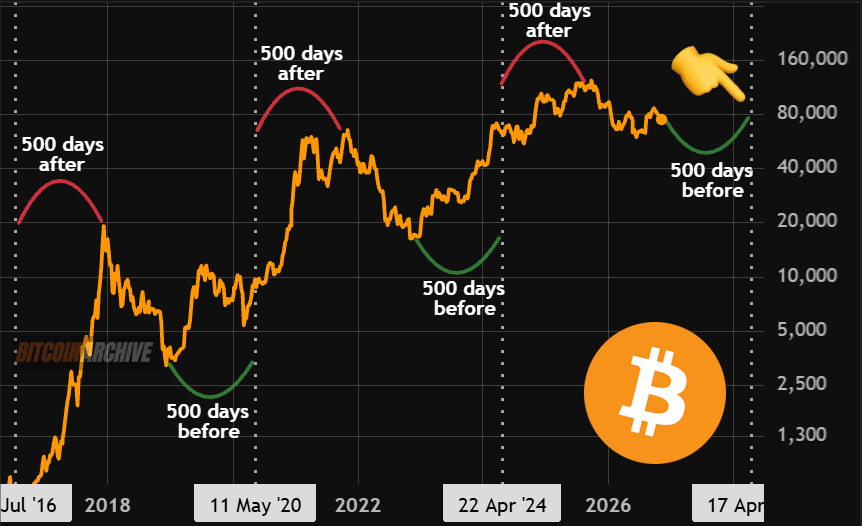
Bitcoin is at its 200-week moving average tonight of ~$68k.
Historically, that’s been one of the best times to increase risk exposure to Bitcoin. It’s also when the way a Bitcoin company is built matters most.
Investors in Strive know our amplification comes only from preferred equity, and that we keep large cash reserves. They also understand we have no encumbered Bitcoin and are uniquely positioned to withstand dips. What I think is less understood is the value of having two deeply liquid preferred equities already trading, and how that lets us turn dips into a higher amplification ratio when Bitcoin recovers. Said another way, these dips can make us even more valuable because of the engines and structure we have in place.
Think about the three ways a Bitcoin company with amplification could go through a drawdown:
1. Bad debt terms. A drawdown can force you to sell Bitcoin at the worst possible time. You don’t just round-trip when Bitcoin recovers. You permanently impair shareholder value.
2. No engine. Bitcoin falls, your stock falls, Bitcoin recovers, and you end up roughly where you started.
3. Liquid preferred equity with real demand already in the market. You can issue more preferred while Bitcoin is cheap, and come out the other side with a higher amplification ratio than you went in with.
That third path is what Strive has done over the last year.
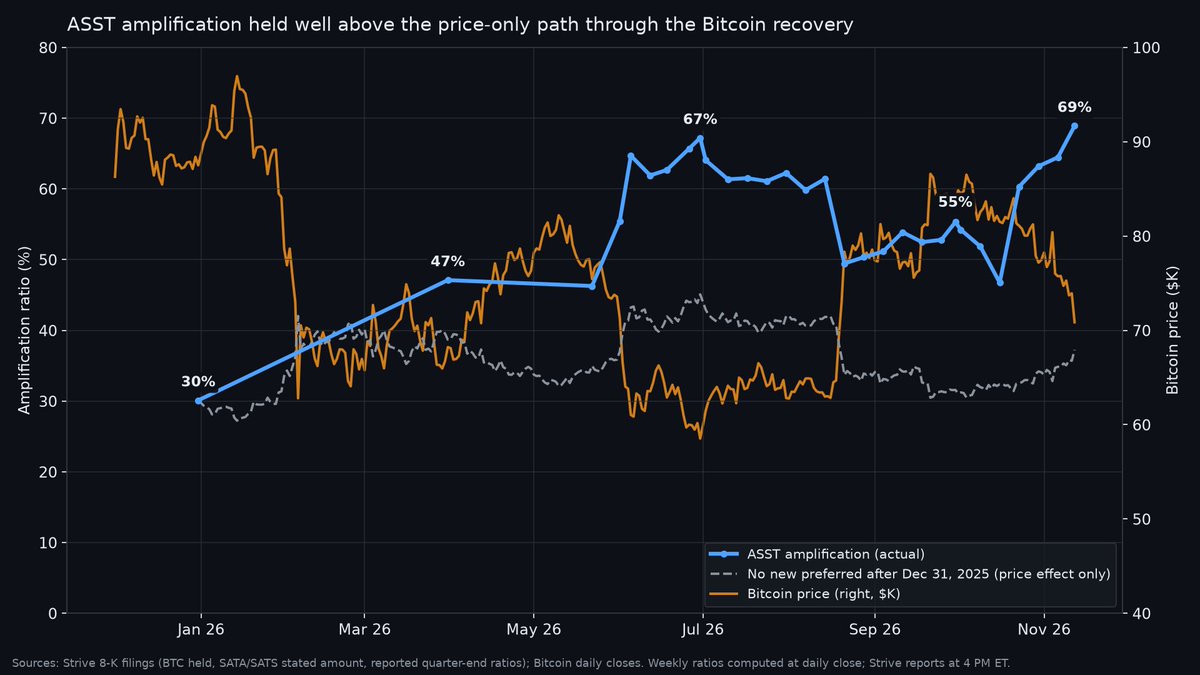
Last Dec 31, Bitcoin was ~$87.5K and our amplification ratio was 30%. By Sep 30, Bitcoin was back near that level at ~$83.6K. Our amplification was 55%.
Similar Bitcoin price, but with almost double the amplification.
Even as Bitcoin rose 43% off the June low, which on its own should have cut our amplification from 67% to ~47%, we held at 55%. After launching SATS and with tonight’s dip, our amplification ratio is now over 70%. Year to date, ASST is up ~51% while Bitcoin is down ~19%.
I believe this performance is primarily due to the structure we’ve very intentionally built with no debt and no pledged Bitcoin. That means no margin calls or debt maturities, and it lets us think long term and act opportunistically when Bitcoin dips.
I don’t think the market properly values this yet, and additionally rarely uses discounted forward-return modeling when assessing what a Bitcoin treasury company is worth. On a forward view of total returns under reasonable Bitcoin bull scenarios, I believe our common equity is undervalued, even though most mNAV calculations would show over 1x.
There is a lot more to discuss on this, but it’s why we removed mNAV calculations from our dashboard over the past week. mNAV captures a single moment in time and treats our operating company as if it were just a passive fund.
The discount we see in our equity is why we haven’t issued common equity over the past couple of weeks. We had some excess cash above our 18-month dividend reserve, and at these levels we’d view common issuance as dilutive, even with an mNAV over 1x, and ideally minimized unless we viewed it as necessary to invest in the long term success of our Digital Credit business.
Bitcoin dips and down years are rough for many investors, especially if you’re not used to Bitcoin’s volatility. As long-time Bitcoiners, we’ve always understood it. We built Strive on purpose not just to withstand that volatility, but to add value for our common shareholders through it.
We remain very constructive on Bitcoin risk going into 2027 and view these dips not only as an opportunity but as a blessing. We’ve used them to create additional value for our shareholders several times over the past year. It’s time to do it again.
$ASST $SATA $SATS
I joined @teresagoody at @Money2020 to discuss Bitcoin as Digital Capital, $STRC, the convergence of TradFi and DeFi, and Strategy’s vision to become the Bitcoin bank of the world.
01:15 - Strategy’s evolution: from enterprise software to 845,000 BTC
02:17 - The next 2–5 years: convergence of Digital Assets, TradFi, and DeFi
04:03 - Bitcoin as Digital Capital: engineering volatility into Digital Credit
07:00 - $MSTR as Amplified Bitcoin and a suite of perpetual preferreds
08:10 - Building financial products on the Bitcoin standard
10:10 - Capital management, $STRC, and expanding access to Bitcoin-linked returns
13:28 - Scale and liquidity: the foundation for institutional adoption
16:07 - Building on $STRC: DeFi yield products, banks, and stablecoins
20:15 - Strategy’s vision: the Bitcoin bank of the world
This may be the most bullish post anyone has made about $ASST or $MSTR yet. Let's talk Trillions.
I was listening to @PunterJeff talk on @TNorth about making an investment grade product using unrated digital credit. He mentioned the rating comes from the structure, not the underlying products.
Enter $DCAP the ETF that nobody talks about or pays attention to in the least. It doesn't need to apply for a standard corporate credit rating, it applies for a Fund Credit Quality Rating (FCQR).
Because the funds inside of it are unrated, a rating agency will not just stamp it with an investment grade. So, @Strive manufactures the credit rating using a fund wrapper.
They anchor the funds with U.S. Treasuries and wrap them with protective put options.
The rating agencies rate the structure. So once $DCAP's options and treasury buffers prove they can keep the funds NAV perfectly flat, the agencies stamp the fund itself as investment grade.
This isn't fast, this is an 18 to 24 month process from launch, but the clock is already ticking.
Once an investment grade gets slapped on it then all of the sudden $SATA, $SATS, $STRC, $STRK, and $STRD all have access to a $150 trillion dollar market.
That's 100 times larger than bitcoins entire market cap for those of us keeping score.
@ColeMacro knows exactly what type of mandates institutional fund managers have and exactly what type of products they wish they had access to. Desks with standard allocation sizes of $50 to $100 million are going to snatch up an 11.5% investment grade product by the armload.
This is the end game. The largest pool of capital on the planet and they already have the tool built.
The world is increasingly complex & dysfunctional, but I believe the optimal investments for the most common needs will become increasingly simple & clear:
Income: Digital Credit
Savings: Bitcoin
Growth: Amplified Bitcoin
$ASST $SATA solana:DSgjVUFC6NA59YuxiEDSxgs6zP4jjwSuoYJ3uS7WboeH $BTC
Let's check the scorecard.
Since Strategy bought its first Bitcoin (Aug 11, 2020):
Bitcoin +579%
MSTR +1,046%
Since the Strive merger was announced (May 6, 2025):
Bitcoin -18.60%
ASST +104.18%
Both have beaten Bitcoin over these periods, even through a bear market.
That's the priority of these companies. Increase the Bitcoin behind each share, so the equity outperforms Bitcoin over time.
Premiums will expand and contract, but the growth in net Bitcoin per share is what compounds.
$MSTR shareholders have approved the Daily Dividends amendment. Preliminary results show 99.3% of votes cast were in favor. The amendment enables $STRF, $STRC, $STRK and $STRD to accrue dividends every calendar day. Thank you to all who voted. https://t.co/w1Cp4GKUy5
SATS vs. SATA - What's the Difference?
If you are interested in the differences between $SATS and $SATA, you're in luck!
Today I want to explain why Strive offers two preferred equities with fundamentally different objectives:
This might be the wildest minimum wage statistic I've ever seen.
In 1971, the federal minimum wage was $1.60 per hour. Gold averaged $40.92 per ounce.
It took 26 hours of minimum-wage labor to earn an ounce of gold.
In 2025, the federal minimum wage was $7.25. Gold averaged $3,432 per ounce.
It took 473 hours of labor to earn that same ounce.
Your hourly wage increased 4.5× in dollars.
The amount of labor required to acquire gold increased 18.5×.
Measured in gold, the federal minimum wage lost approximately 95% of its value.
Fifty-four years of nominal wage increases, and one hour of work buys a fraction of the monetary asset it once did.
Want to have your mind blown?
In 1971, the median household income was $9,030, or 220 ounces of gold.
In 2025, it was $87,460, or just 25 ounces of gold.
Your paycheck went up 10x.
Measured in gold, it fell 88%.
To earn what the median household earned in 1971, you’d need about $890,000 per year today.
That’s what fiat debasement looks like.
A new source of BTC demand is emerging.
BTC-focused perpetual preferred stocks have accumulated more than 135,000 BTC in just over a year, despite representing only a fraction of the global fixed income market.
What could happen if adoption expands?
🔗 Read our latest research: https://t.co/AkMvHQD9Ma
J.P. Morgan Asset Management’s base case projects Bitcoin to outperform U.S. stocks, bonds and gold over the next decade. Wall Street is doing the math.
SATS is now listed on Nasdaq. 15.00% fixed annualized dividend rate based on $100 stated amount. Paid every business day. First dividend: November 9, 2026, inclusive of dividends accrued since the October 20 closing. $SATS $ASST $SATA
My thoughts on Strive's new SATS perpetual preferred, as an $ASST shareholder.
Let's start with the facts:
-15% fixed rate on $100.
-Cumulative dividends paid every business day.
-Junior to SATA.
SATS has no target trading range and no general call. If it trades to $110, buyers get ~13.6% and once it's listed Strive can ATM it whenever they want. The effective cost of capital falls the better it trades.
So why now?
The short answer is to increase amplification while Bitcoin is cheap.
After the warrant exercises, amplification fell to ~47%.
A significant amount of capital is needed to re-amplify the balance sheet. SATS aims to raise $500M, potentially $1B if upsized, which could bring amplification back towards 60%.
An IPO of a new product is the easiest way to do this and doing it while Bitcoin is cheap gives greater returns going forward.
The second reason is to expand the ways Strive can amplify, with a fixed-rate product alongside the variable-rate SATA.
Compare it to Strategy.
Their fixed-rate STRF sits at the top of the capital stack. It's the industry's gold standard, ~$1.3B notional, trading at an effective yield of around 9.7%.
Their junior fixed-rate STRD has $1.4B notional and is non-cumulative.
Strive has done it the other way round. The variable-rate SATA sits at the top. The fixed-rate SATS sits beneath it, and unlike STRD, SATS is cumulative.
I don't believe SATS cannibalises SATA. If anything, it makes SATA stronger.
SATA asset coverage (Bitcoin, cash and STRC) with BTC at $83,500:
-Today: ~2.47x
-After a $500M SATS raise: ~2.83x
-After a $1B SATS raise: ~3.18x
I admit one preferred and one common stock was beautifully simple.
That said, I believe the trade-off is worth it. Strive now has a variable-rate product, a fixed-rate product and another tool to amplify the balance sheet.
In the long run, I think they'll ATM SATS whenever it trades above $100, lowering the cost of capital. Either way it doesn't matter. I expect Bitcoin to outperform 15% over time.
That's what we're all betting on and why we want amplification but remember they don't have to issue another SATS share if they don’t want to.
To put it simply, this is a quick way to raise $500M-$1B and re-amplify the balance sheet while Bitcoin is cheap.
I expect SATA to remain the premier product, just as STRC draws far more interest than STRF or STRD.
Ultimately, this is a land grab
Amplify now while Bitcoin is cheap, not later when it's far more expensive.
I am very bullish on $ASST.
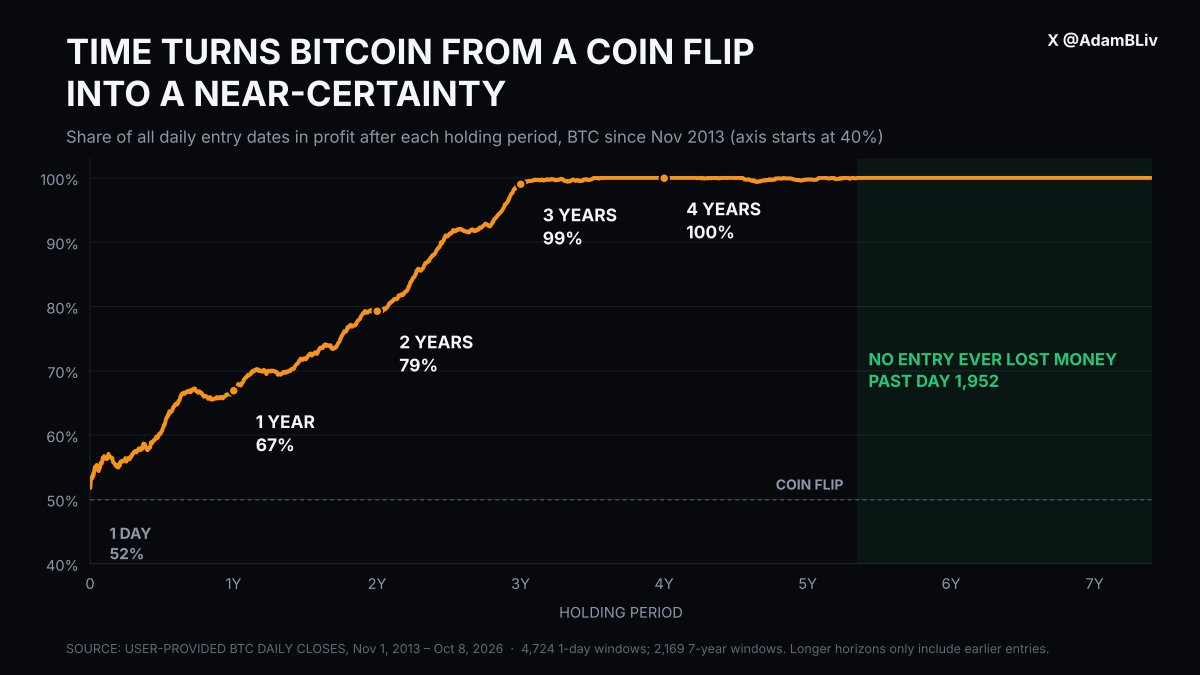
Bitcoin odds of profit by holding period, using every daily entry since 2013:
1 day: 52%
1 year: 67%
2 years: 79%
3 years: 99%
4 years: 100%
No buyer was ever underwater after day 1,952.
Over the short run Bitcoin is a coin flip.
Held long enough, nobody has lost money yet: