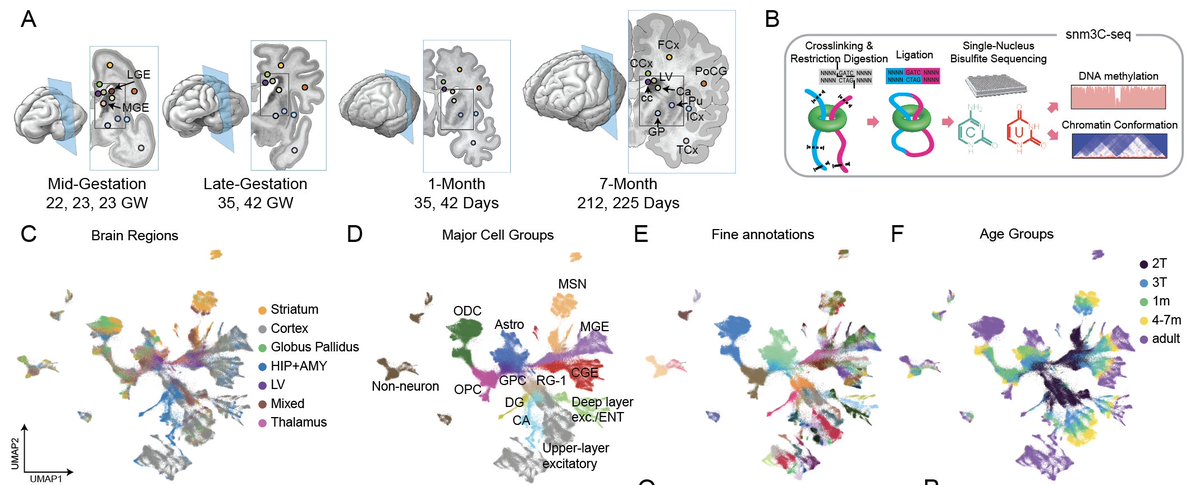
Our study of developing human striatum and inhibitory neurons using 3D-genome conformation+DNA methylome+spatial RNA is online @CellCellPress along with a series of incredible studies of the basal ganglia by @NIH BICAN groups
https://t.co/sifkGNn091
What distinguishes successful from failed reprogramming to iPSC? In this new preprint, part of our @IGVFConsortium efforts, we used single cell methylation, Hi-C, RNA and ATAC, and spatial RNA to answer this question https://t.co/dKtCnB91sl
🔔 We are hiring! 🔔 We are looking for great colleagues doing curiosity driven research at the molecular level across broad areas of science. Please consider applying and spread the word!
https://t.co/XYLUsEdvug
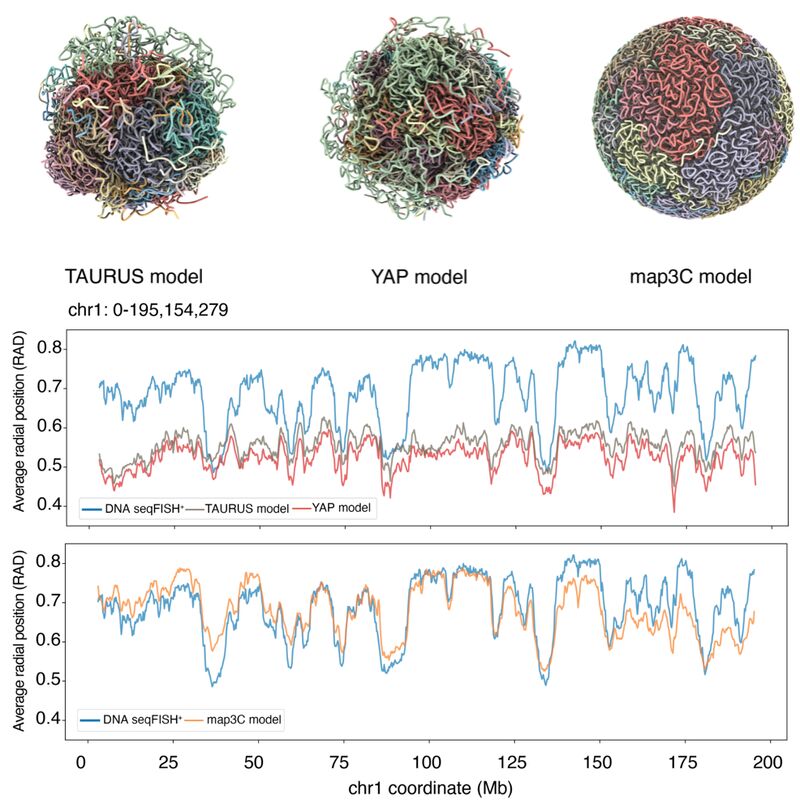
The peer-reviewed version of map3C, a tool developed by Joseph Galasso (co-advised by @jernst98) to more accurately map snm3C-seq data and enable robust 3D conformation modeling, has been published in OUP Bioinformatics. https://t.co/bgJLGYwBbx
I am a guest editor with Martha Bulyk and Katie Pollard of a Genome Biology special collection on "Prioritizing non-coding variants"
Link for more information: https://t.co/1gRWYuqeXy
Submission deadline: November 25, 2026.
We are excited to release a single-cell and spatial 3D epigenomic atlas of developing human basal ganglia and inhibitory neurons, part of our BICAN effort in collaboration with @lab_paredes@jernst98@emukamel@CEpigenomics@bpasaniuc
https://t.co/jabc3mYnpk
Thanks to @ferhatay and Aly Khan, we’re excited to announce a new chapter for RECOMB-RSG 2026. After years with ISCB/DREAM, we are transitioning to an official RECOMB satellite meeting (May 25 in Thessaloniki). https://t.co/QQCRfUARec
We like to introduce map3C, developed by Joseph Galasso, that drastically improves the mapping and contact calling performance of snm3C-seq and now enables accurate 3D genome modeling. map3C was developed in collaboration with @jernst98 and Frank Alber https://t.co/h8jcF768fR
📣New from Li et al!
📄Whole genome sequence-based association analysis of African American individuals with bipolar disorder and schizophrenia
👉https://t.co/7wsrScnj3h
Genome-wide identification and analysis of recurring patterns of epigenetic variation across individuals: Communications Biology, Published online: 07 June 2025; doi:10.1038/s42003-025-08179-5Recurring genome-wide patterns of epigenetic mark variation… https://t.co/GFSqPPuRNA
A new paper: "Genome-wide identification and analysis of recurring patterns of epigenetic variation across individuals" led by Jennifer Zou and @eamaciejewski is now published.
https://t.co/R8cIAWtnru
A new paper: "Identifying associations of de novo noncoding variants with autism through integration of gene expression, sequence, and sex information" led by Luke Li is now published https://t.co/nXk21UpZ4r
Will comparative biology crack the epigenetic code to longevity? New imputed DNA methylation dataset covers 59 tissues from 348 mammals including long living species such as bowhead whale (211 years), bats, and the naked mole rat. Which tissue holds the key to longevity? Which genes, CpGs, and genomic regions? Cutting-edge imputation applied to data from the Mammalian Methylation Consortium.
Emily Maciejewski, Jason Ernst (2025) CMImpute: cross-species and tissue imputation of species-level DNA methylation samples across mammalian species. Genome Biology. https://t.co/IQQP1P71K9
@JasonErnstLab@eamaciejewski
#epigenetics #compbio #longevity
A new paper "CMImpute: cross-species and tissue imputation of species-level DNA methylation samples across mammalian species" led by @eamaciejewski building on our lab's mammalian methylation array collaboration with @prof_horvath is now published https://t.co/HNy78zjSLe
A new paper "ChromActivity: integrative epigenomic and functional characterization assay based annotation of regulatory activity across diverse human cell types" led by @tevzilla is now published. https://t.co/4VItRvDfUA