We are beyond proud to announce that 7-time Formula 1 World Champion, Sir @LewisHamilton, is the patron of the M24 - Motorsport Museum. 🏆
A true icon embodying the excellence of our heritage. Are you ready for this new era?
📆 Save the date: May 28th!
#M24
In 1975, Dan Rowzie sat on the roof of the Red Ball Garage in Manhattan waiting for the Cannonball clock to start. The car was a Porsche 911 fitted with an IROC engine. The target was Brock Yates and Dan Gurney’s cross-country record: New York to Redondo Beach at an average of eighty miles an hour.
They didn’t beat it. But Rowzie still believes their thirty-eight hour and thirty-nine minute run remains the fastest Porsche time of any official Cannonball.
Today he’s eighty-eight years old and still spending time with a Burgundy 1968 911 in his garage. Vintage race motor. Roll cage. Good taste.
“There’s a lot of feedback and spirit,” he says, “that’s missing in the later heavier cars.”
Drive Tastefully®
Watch the full film: https://t.co/w4Y3izvFR3
Director: Tiziano Niero
Featured: Dan Rowzie
#DriveTastefully #Petrolicious #FilmFriday
Surprised how many people thought this was advocating EV. It isn’t. Quite the opposite.
There are over 1.5 billion cars on this planet that need fuel. We can argue semantics over whether their current and by its nature finite fuel supply is running out, but there will come a time when we transition to an alternative fuel. Be that through conscience or necessity. Thus the need for and importance of renewable, sustainable, synthetic, how ever you want to package it, alternative fuels.
Not batteries. Fuel. That you fill your car up with at the gas station.
The post was predicated on the positive reaction to my post about V8s yet adverse reaction to my belief that sustainable fuels need to be part of any future move away from hybrid in racing.
I stand by the notion that if you want a world in which racecars or road cars are to run with internal combustion engines, finding alternative fuels is your best way to future proof the tech we already love. And that by advancing the development of alternative fuels in the racing world, you speed up its potential rollout to the masses.
Guess what folks. Fossil fuels are running out. Don’t want to convert to electric? You’re gonna need an alternate fuel for your engines. That’s where sustainable fuels come in. Ramp development through motorsport and it’ll hit a price and efficiency that’ll make it market ready.
That’s why it’s relevant and that’s why it matters both in racing and on the road.
OEMs want to push electric because it will force you to buy a new car. But the charging infrastructure is not ready and won’t be for decades. The international infrastructure already exists for mass rollout of sustainable, renewable fuels via regular fuel pumps. And it works in your engine like regular gas.
Indycar already uses Shell 100% renewable fuel. F1 has adopted the move more recently. If you want to keep proper engines, you’ve gotta quit getting your diapers twisted over the one thing that’s going to continue to allow them to run.
@OtisOstertag If there is a blog to read I sooooo recommend reading the late Kirk F White’s (he died March 20 of this year) who was aligned with Algar Ferrari but so much more! https://t.co/yvygWRTJdN
“Going to the Moon may have been my Super Bowl, but I sure loved watching yours. (I watch Eagles games on Earth, too.)
My husband introduced me to this team and city-gritty, hard working and embodying the underdog mentality. Now I'm all in. As a surprise for him, I flew confetti from Super Bowl LIX around the Moon. Go birds!”
Astronaut Christina Koch flew 250,000 miles from earth and brought her Eagles Super Bowl confetti with her on the Artemis II as she flew around the moon! 
📸 @Astro_Christina
Recently I have been starting to worry about the state of prediction markets, in their current form. They have achieved a certain level of success: market volume is high enough to make meaningful bets and have a full-time job as a trader, and they often prove useful as a supplement to other forms of news media. But also, they seem to be over-converging to an unhealthy product market fit: embracing short-term cryptocurrency price bets, sports betting, and other similar things that have dopamine value but not any kind of long-term fulfillment or societal information value. My guess is that teams feel motivated to capitulate to these things because they bring in large revenue during a bear market where people are desperate - an understandable motive, but one that leads to corposlop.
I have been thinking about how we can help get prediction markets out of this rut. My current view is that we should try harder to push them into a totally different use case: hedging, in a very generalized sense (TLDR: we're gonna replace fiat currency)
Prediction markets have two types of actors: (i) "smart traders" who provide information to the market, and earn money, and necessarily (ii) some kind of actor who loses money.
But who would be willing to lose money and keep coming back? There are basically three answers to this question:
1. "Naive traders": people with dumb opinions who bet on totally wrong things
2. "Info buyers": people who set up money-losing automated market makers, to motivate people to trade on markets to help the info buyer learn information they do not know.
3. "Hedgers": people who are -EV in a linear sense, but who use the market as insurance, reducing their risk.
(1) is where we are today. IMO there is nothing fundamentally morally wrong with taking money from people with dumb opinions. But there still is something fundamentally "cursed" about relying on this too much. It gives the platform the incentive to seek out traders with dumb opinions, and create a public brand and community that encourages dumb opinions to get more people to come in. This is the slide to corposlop.
(2) has always been the idealistic hope of people like Robin Hanson. However, info buying has a public goods problem: you pay for the info, but everyone in the world gets it, including those who don't pay. There are limited cases where it makes sense for one org to pay (esp. decision markets), but even there, it seems likely that the market volumes achieved with that strategy will not be too high.
This gets us to (3). Suppose that you have shares in a biotech company. It's public knowledge that the Purple Party is better for biotech than the Yellow Party. So if you buy a prediction market share betting that the Yellow Party will win the next election, on average, you are reducing your risk.
Mathematical example: suppose that if Purple wins, the share price will be a dice roll between [80...120], and if Yellow wins, it's between [60...100]. If you make a size $10 bet that Yellow will win, your earnings become equivalent to a dice roll between [70...110] in both cases. Taking a logarithmic model of utility, this risk reduction is worth $0.58.
Now, let's get to a more fascinating example. What do people who want stablecoins ultimately want? They want price stability. They have some future expenses in mind, and they want a guarantee that will be able to pay those expenses. But if crypto grows on top of USD-backed stablecoins, crypto is ultimately not truly decentralized. Furthermore, different people have different types of expenses. There has been lots of thinking about making an "ideal stablecoin" that is based on some decentralized global price index, but what if the real solution is to go a step further, and get rid of the concept of currency altogether?
Here's the idea. You have price indices on all major categories of goods and services that people buy (treating physical goods/services in different regions as different categories), and prediction markets on each category. Each user (individual or business) has a local LLM that understands that user's expenses, and offers the user a personalized basket of prediction market shares, representing "N days of that user's expected future expenses".
Now, we do not need fiat currency at all! People can hold stocks, ETH, or whatever else to grow wealth, and personalized prediction market shares when they want stability.
Both of these examples require prediction markets denominated in an asset people want to hold, whether interest-bearing fiat, wrapped stocks, or ETH. Non-interest-bearing fiat has too-high opportunity cost, that overwhelms the hedging value. But if we can make it work, it's much more sustainable than the status quo, because both sides of the equation are likely to be long-term happy with the product that they are buying, and very large volumes of sophisticated capital will be willing to participate.
Build the next generation of finance, not corposlop.
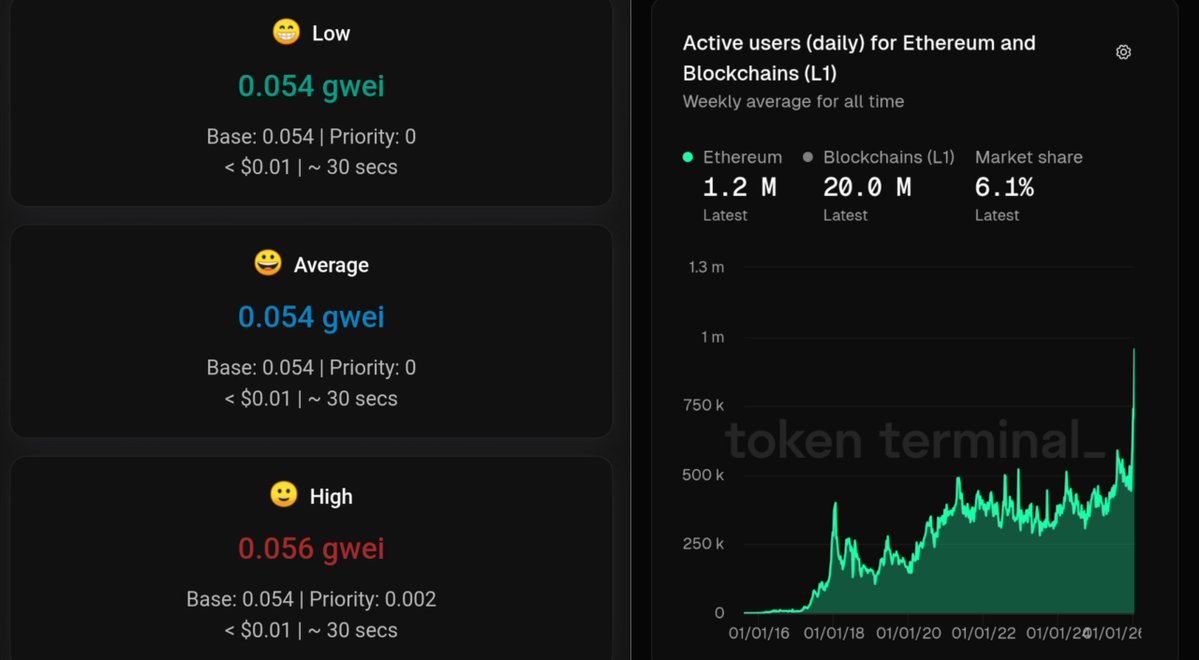
BREAKING: Ethereum gas fees have dropped below $0.01 while network activity is at an all time high.
For comparison, in 2023 during PEPE memecoin season, gas fees spiked to $50.
Same network. More users. Almost zero cost. Massive win for Ethereum.
This was my plan to relaunch MTV.
All you do is replay the first decade of MTV in real time.
It woule be like an instant music-history channel.
Zero production costs. Add new sponsors.
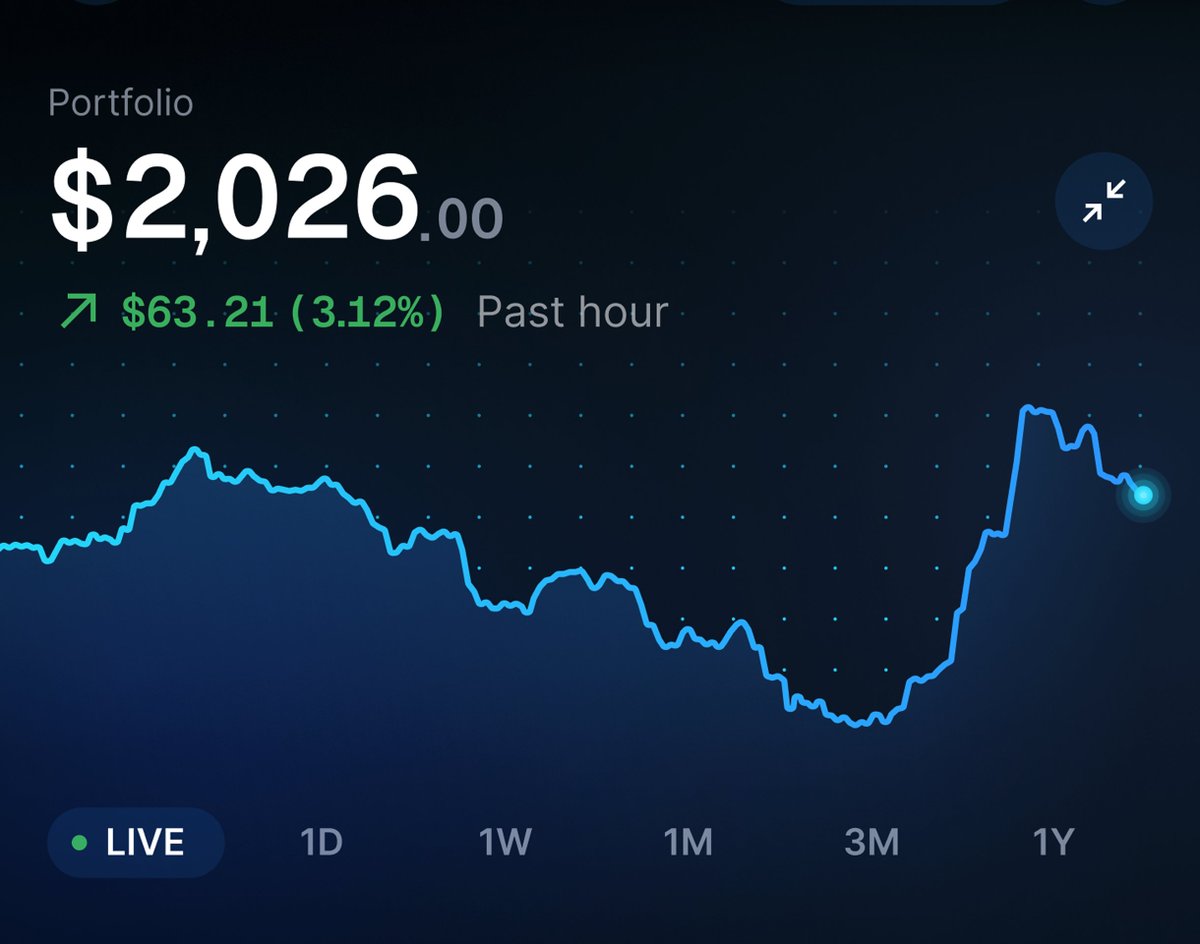
Feeling generous to start the new year, so we loaded up a fresh wallet and decided to give it away.
🎁 $2,026 in BTC to one winner
🧡 Like this post and follow @Gemini
✅ Winner selected January 2
#Bitcoin – What’s Next?
The Big Sunday Report: All You Need to Know:
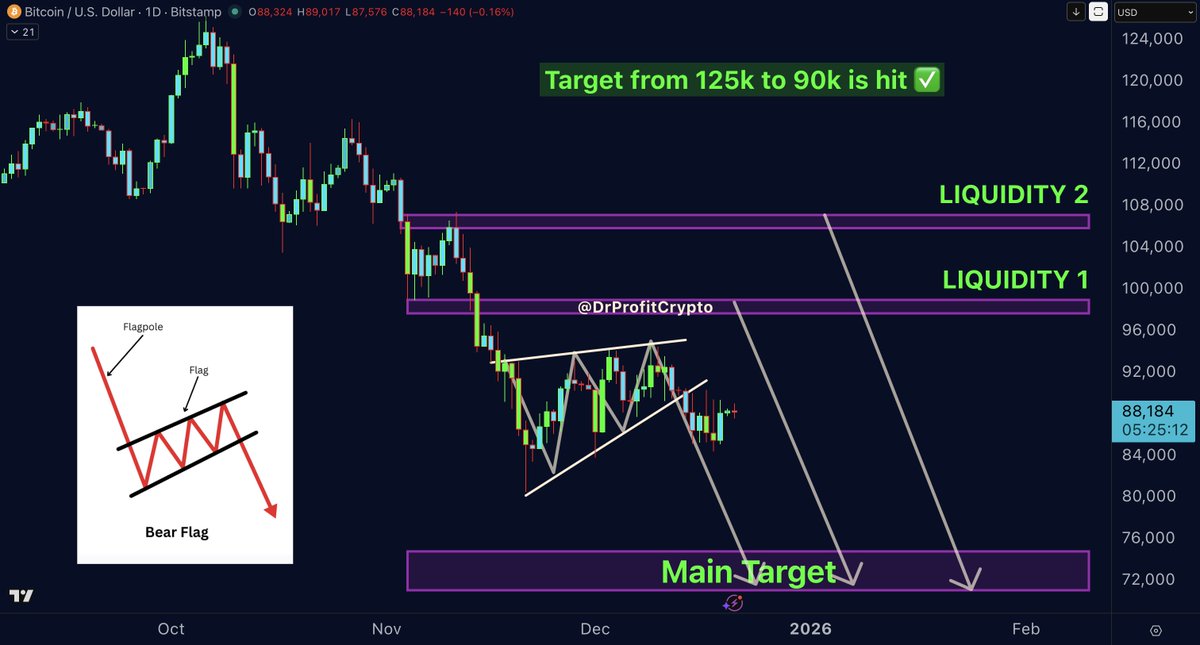
🚩 TA / LCA / Psychological Breakdown: Bitcoin has been in a bear market since September, and nothing has changed since then. I said in September that we would not bottom in 2–3 months, not in 4–5 months, no. It will take at least 12–14 months to fully bottom out, with a price target in the 60k region for BTC, which is going to happen. As always, people tend to believe that markets will react or move fast, not understanding the importance of liquidity formation and that’s why time matters in such a price movement. Regarding this, I believe that BTC will see an upside move toward the 97–107k region in the coming weeks. I don’t even believe that any big downside move will happen before February, March 2026. This is why I am saying we will stay in a long sideways range for the next couple of weeks until the final leg down starts. I have been saying this since November, stating that BTC entered a phase of sideways movement, whose entire goal is to create more liquidity on the downside. That’s why it takes time, and this means a couple of months. It’s hard for many people to understand, as many expect fast moves or moves straight to the target, but that’s not how markets work.
For this reason, I am bullish in the short term and have bought BTC, but my short stays open and is not closed at all. This means the market allows me to operate more flexibly by keeping the short open, which can now act as a perfect hedge, while using capital in reserve to buy more BTC and sell later with a 20% price increase once we reach the target of the 97–107k region. This is the exact plan as of now, and I am expecting a slow rise as well, continued with a lot of manipulation to exhaust as many people as possible. Imagine the following scenario: the same repeat of what we saw in the last 6 months, again for another 12 months. How many will be able to buy the bottom? How many will be psychologically able to buy the bottom in a year? How many will be psychologically defeated? And how many will start FOMO after prices reach a new ATH and beyond, missing the entire move after the bottom was seen? These are very important questions that should be answered.
In my opinion, the markets remain in an extremely tight liquidity crisis, as I mentioned and observed already in August, and now the markets seem to have understood that liquidity is indeed extremely low. We see, on almost all recession or liquidity indicators, the same levels as in 2008 and worse. We have worse liquidity than during the Credit Suisse crisis, and somehow the banks manage to survive. The reason for this survival is the new rule regarding the Standing Repo facility, which no longer limits banks to borrowing a maximum of $500bn per day in total for all banks together. Now it means each bank can borrow up to $240bn per day from the Fed and needs to pay it back 1–2 days later with interest. This change means the Federal Reserve is acting like an always-open emergency cash window for banks so the financial system never runs out of short-term money. Banks are not being given free money, and they are not being paid to borrow. They temporarily hand over very safe assets like US government bonds and receive cash only for one night, and the next day they must give that cash back with interest. Before, the Fed limited how much total cash all banks together could borrow, which risked panic if too many banks needed money at the same time. Now that limit is gone, so any bank with proper collateral will always get the cash it needs. The number showing that a bank could theoretically borrow up to $240bn per day sounds huge, but it is misleading because the money must be returned the next day and cannot be kept or accumulated. This is very important for those who watch the standing repo and understand that the repo market is something like a money-printing machine, this is something only someone uneducated would say. Saying this equals tens of trillions per year is like saying someone earns money by using a credit card every day, which is not true. This does not mean the Fed is printing unlimited money or canceling tariffs or politics; it simply means the Fed wants to prevent sudden freezes in the financial system. The real message is that the system is fragile enough that the Fed wants to remove any chance of a liquidity accident by guaranteeing short-term cash at all times as long as banks provide safe assets.
Now ask yourself again: why all of this? Are we fighting inflation? Are we winning the fight or losing it? The real answer is that we are losing the fight against inflation and debt, and I am expecting a big crisis to happen in 2026, followed by COVID-style money printing in late 2026 and a repeated 2020 scenario. Assets, real estate, gold, silver, Bitcoin everything will increase, and money will keep losing value. That’s the reality, and yet I am saying the printers will turn on once we see the crisis, and it is very close in my opinion.
Enjoy your tea, wait, dont over-trade
Regarding #Bitcoin, my position is changed from fully USDT, with shorts averaging an entry around 119K to Fully BTC from 85k and short entry from around 119k average
THIS IS NOT FINANCIAL ADVICE BUT EDUCATIONAL CONTENT ONLY. ALL WRITTEN HERE IS MY OPINION AND MY OWN TRADING AND INVESTING STRATEGY
Join Premium: https://t.co/4ilNrRs1q2
Join Free TG: https://t.co/zkdgaR7eSK
this is not an ad, this is my personal recommendation
you know why i use @brave on everything?
- does everything chrome does
- doesnt report everything to google
- adblock built in, no youtube ads, no sponsored garbage
- no annoying cookie notifications
- resource efficient
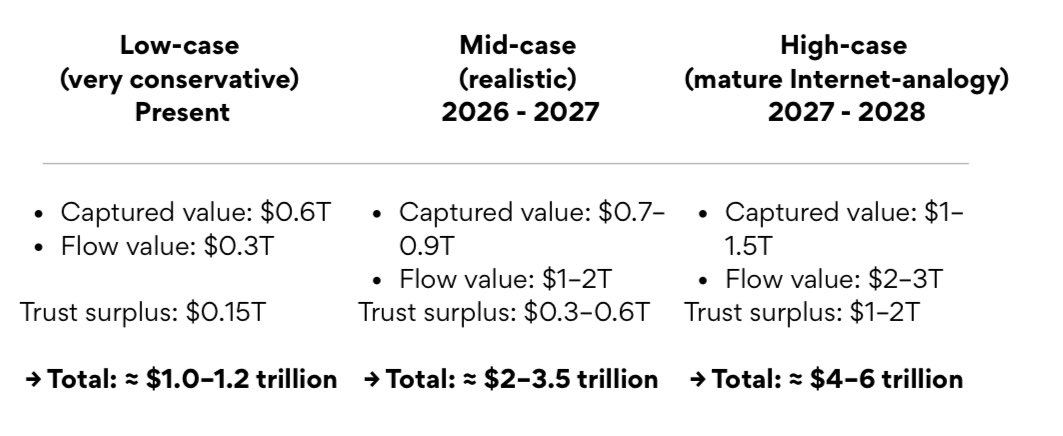
Longtime Ethereum / ETH investor @wmougayar has a new report out arguing that ETH is fundamentally mispriced because markets value Ethereum as a for-profit company rather than as a public good.
“Like the Internet’s base protocols (TCP/IP), Ethereum’s true economic power lies not in the fees it extracts (revenue), but in the vast ecosystem of value it enables (externalities) . Traditional financial metrics fail to capture this “invisible” infrastructure value.”
“By aggregating these layers, the report places Ethereum’s current intrinsic valuation at the $2–6 trillion range. As the platform matures into the “Global Trust Underlayer” for institutional finance—mirroring the Internet’s historical trajectory, the model projects a long-run valuation of $10–20 trillion by 2035.”