I'd always thought AI was terrible at design, but after reading today's 🤯 post by @anshuc, I realized I was just doing it wrong.
"AI models are capable of amazing creativity, but that creativity gets stifled. LLMs are trained to be next-token predictors: they look at a sequence of text and predict what typically comes next. Great design is exactly the opposite of this. Great design bends the rules and delights users with memorable, unexpected choices."
@anshuc led design and engineering teams at Apple for 12 years. In his words: "Most people only see 1% of AI's creative potential. I want to show you how to tap into the other 99%."
His 8 techniques for breaking out of the 1%:
1. Use seed strings to inject variety
2. Be much more ambitious with your prompts
3. Create positive feedback loops with subagents
4. Use image generation to enrich designs
5. Use video generation
6. Cut out elements that don’t add value
7. Remove AI tells
8. Rewrite copy by hand
Read the post here: https://t.co/OEnvr1Z1LK
P.S. This design was made by AI 👇
Been thinking about “pivots” today.
Many of the best companies I have been lucky enough to get involved with are pivots.
Fates Forever (game) -> Discord
Cicada (education) -> https://t.co/vLSmnRRpkw
Fanbase (sports fans) -> Nextdoor
Odeo (podcasts) -> Twitter
0→1 is hard.
People will open source you. Thought bois will elegantly pick apart your product choices. Poasters will say nobody will ever use it, but also that it’s a commodity. That you’re the symbol of the top. That you’re cooked cooked cooked.
Until you’re inevitable. Then the idea was obviously good to anyone with eyes.
Fuck em and keep shipping. Coming up with one great idea means you can come up with the next thousand, while the replicators / NPCs are still struggling to copy your first.
And if you’re a mad observer, the best revenge is building something better—not extinguishing the flame of genuine new thinking, product craft, and the beginning of a new cycle for consumer software.
Build mad. Build happy. Just build.
We're at an interesting time in AI apps where viral consumer growth leads to enterprise adoption.
The most popular consumer products (largely creative tools / productivity, think ElevenLabs, Midjourney, HeyGen) get adopted by individuals in companies and pulled upmarket.
As a result, you can build a sizable enterprise business with no sales team or outbound marketing - and either entirely self-serve or via "light touch" business plans.
IMO, this is one of the reasons we're seeing AI companies with faster revenue growth than ever before - there's massive consumer adoption and large enterprise contracts layer on + provide a sticky revenue base.
AI will make expertise near free. Who will build the first billion $ revenue company with <100 employees with near free programmers/doctors/advisors/etc etc? Worth attempting!! The power of ideas powered by entrepreneurial energy will be hugely multiplied as the scarce resource
Anthony Edwards is expected to debut the low-top edition of his signature @adidasHoops AE 1s during the NBA Playoffs.
Edwards’ 1st signature shoe has become one of the industry’s best-selling basketball shoes since launching in December.
great to see everyone at AI rabbithole event today!
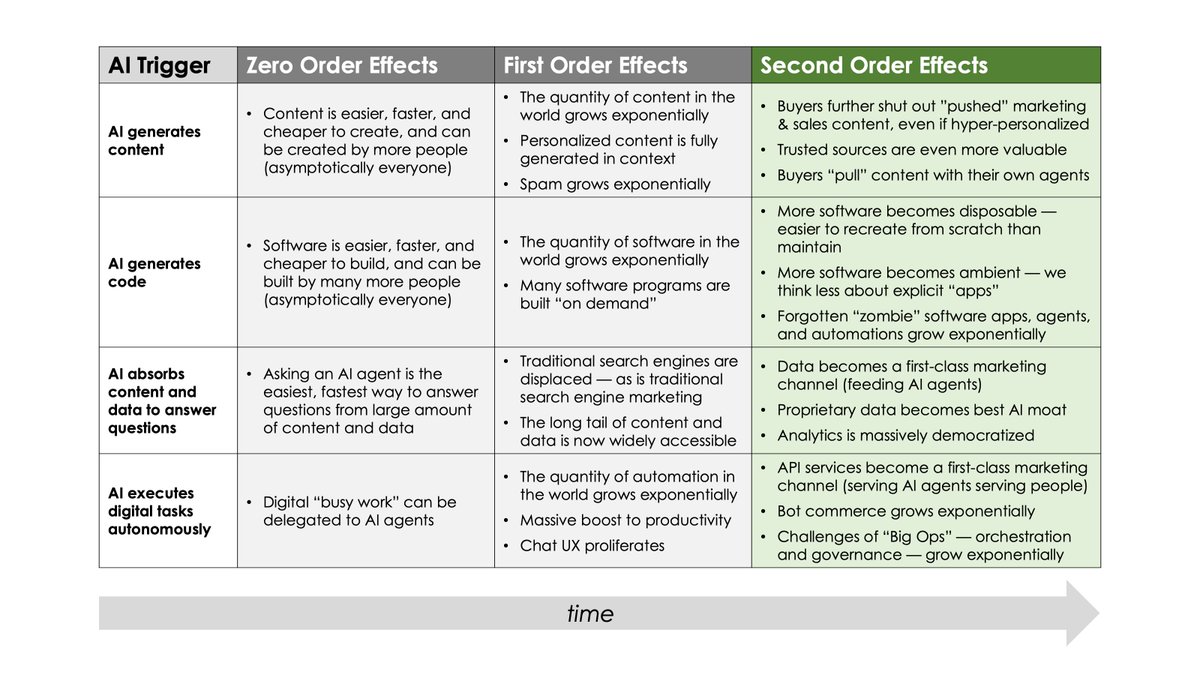
as promised, here's my deck with abbreviated narrative.
(video was recorded, will share when available)
What do marketplaces look like in the age of AI?
Some will grow, some will shrink, and some will disappear. It's a new era for the marketplace model!
My take on who will be impacted - and how 👇
Whenever a new enabling technology appears, it allows new marketplaces to arise that couldn't exist before.
SEO + Search: Trulia, Zillow, Indeed
Mobile: Uber + Lyft
AI will have the same effect
The potential of AI-first marketplaces here + below: https://t.co/4OTjklIqBT
It’s impossible to look at the big apps today and learn anything about how to launch your new app.
The smartest founders dig in to understand bootstrapping stories as they craft their own.
I was recently asked about https://t.co/EU8WrAFakQ / Tiktok and shared:
AI apps
Context: The AI stack has 4 layers. From bottom to top, infrastructure (eg Nvidia), foundational models (eg GPT), AI tooling (eg Hugging Face) and Apps (eg Harvey for legal). There are many sub-buckets within each layer, but for the purposes of the post below, I’m talking about the highest layer (apps).
There will be mega winners in both horizontal and vertical AI apps. I include functional (sales / marketing / etc) AI apps within the horizontal bucket. Vertical here refers to an industry focus (eg healthcare, legal, etc)
Early stage horizontal AI apps face competition from other startups due to relatively low barriers of entry (eg half a dozen strong products in the sales tooling space) as well the looming threat of incumbents making it into a feature of their products. Results in horizontal AI apps likely facing an extended period of intense competiton and consolidation before we can pronounce a winner.
On the other hand, vertical AI apps don’t face exceptional incumbents, need more domain expertise leading to fewer startup competitors, have a unique data advantage and focused GTM, leading to higher chance of winner take most. Even seemingly narrow niches of a vertical are absolutely massive opportunities. Easier to justify an early stage investment.