MAGALLONA V ERMITA EXPLAINED
Merlin Magallona, Harry Roque et al wanted to include as Philippine territory all the islands and all the waters enclosed by the 1898 Treaty of Paris lines.
That would include as Philippine territory waters beyond our 12 nautical mile territorial sea measured from our archipelagic baselines, in clear violation of UNCLOS and customary international law.
It would also include as Philippine territory large areas of our EEZ and even small areas of the high seas, in clear violation of UNCLOS.
It would be like China's nine-dash line, in clear violation of UNCLOS and customary international law. Had the Supreme Court upheld the contention of Magallona et al, our arbitration against China would have been dismissed outright by the arbitral tribunal under the legal principle that he who comes to court must come with clean hands.
The Philippines cannot claim before the tribunal that China's nine-dash line violates UNCLOS when the Philippines has its own Treaty of Paris lines that also violate UNCLOS. In fact one of the judges of the tribunal pointed this out.
The Philippine lawyers explained that RA 9522, which the Supreme Court upheld unanimously (the decision penned), already abandoned the Treaty of Paris lines as enclosing Philippine territorial seas. The Philippine lawyers submitted to the tribunal a copy of RA 9522 and the SC decision in Magallona v Ermita.
@SeaLightFound We must not let this behavior continue to be normalized, otherwise what is occurring now in the Philippines' waters will surely be replicated against all other claimants of the SCS.
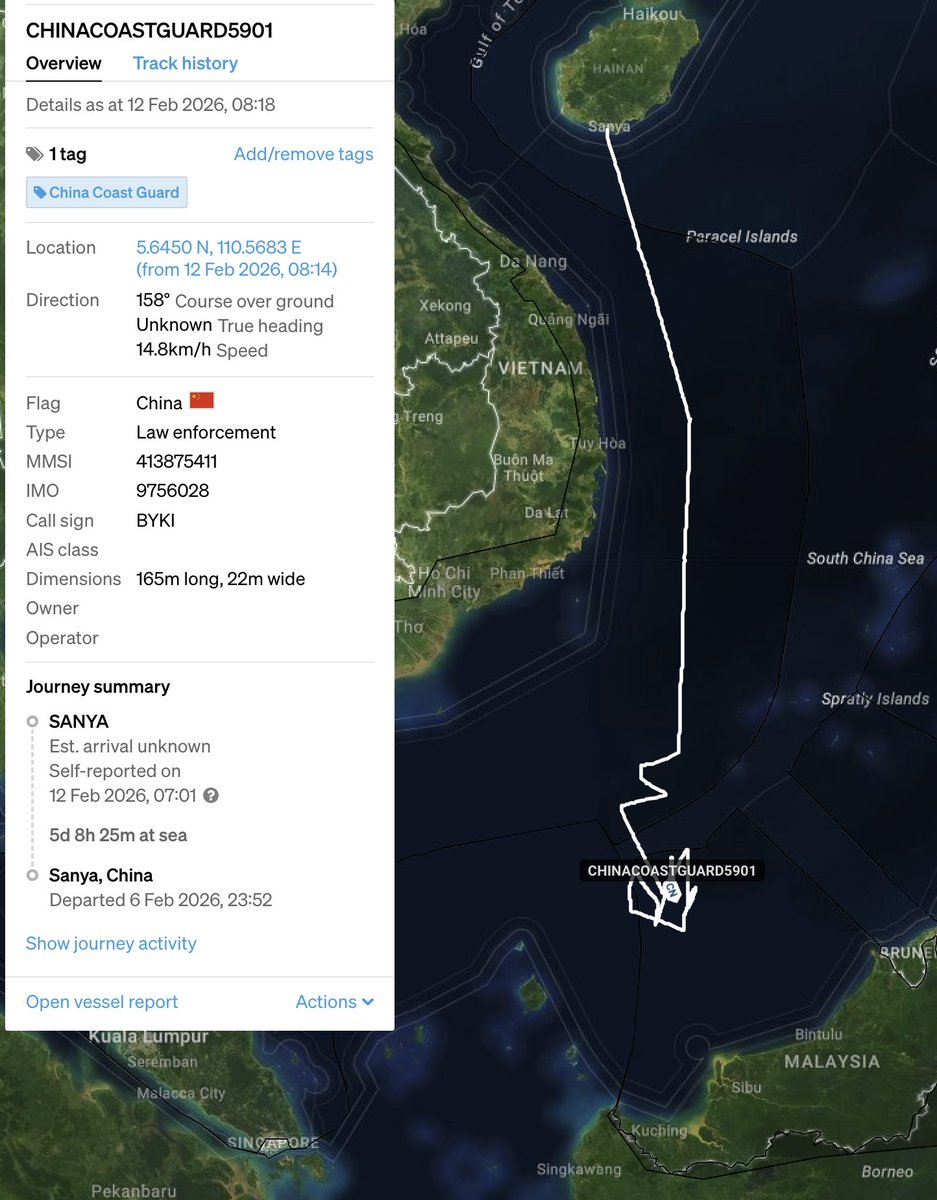
Mere days ago, China Coast Guard 5901 (called "The Monster" due to its size) entered into the EEZs of Vietnam, Malaysia and Indonesia, in an attempt to assert China's outlandish claims in the South China Sea.
Image courtesy of @SeaLightFound.
This article by @AsiaMTI provides a brief explanation of how certain Southeast Asian nations (🇻🇳🇲🇾🇧🇳🇵🇭) have been trying to balance their economic interest and territorial claims by "shelving disputes" with 🇨🇳.
While the author maintains a diplomatic stance on the issue, the conclusion of the article contains an interesting insight: "The passage of time without resolution benefits the party with greater capacity to establish and maintain physical presence in disputed areas." This implies that by "shelving disputes" China is simply biding its time - coaxing rival claimants into passivity until such a time that it can take the territory from under their noses by force.
https://t.co/d0Y2ibRqy7
Episode 2 Part 5 “Just science” can be the perfect cover: sea-level monitoring, climate research, global data. But this scene shows why a “station” on Fiery Cross is never neutral—once it’s written into documents and treated like coastline, research becomes presence and paperwork becomes leverage.
FULL doc: https://t.co/fxnO3kGyph
Post two (extra context):
Maps don’t care about slogans. A tide gauge on a disputed reef isn’t only about data—it’s about normalizing control without saying the quiet part out loud.
#WestPhilippineSea #WPS #PhilippineCoastGuard #MaritimeSecurity #InternationalLaw #UNCLOS #RulesBasedOrder #EvidenceSpeaks #SovereigntyDefended #FactsFirst #MaritimeTruth
For those who are unaware, #Shiprecycling helps reduce the environmental impact by reusing materials instead of manufacturing from raw materials. However, the process can be dangerous for workers. Setting new safety standards are a step in the right direction for the future.
Old Ships, New Purpose: Join @UN Volunteer Iffat Ahamed behind the scenes!
Explore the photostory which shows how IMO is transforming #shiprecycling and setting new safety standards in Bangladesh.
Smart adaptation to shifting trade dynamics or #flagsofconvenience? MSC is considering re-registering vessels after New Delhi changed a number of shipping regulations aimed at foreign-based liner operators. This is also in the wake of proposed changes to anti-trust regulations.
A big development in the shipping industry is that the top liner in the world, Mediterranean Shipping Company (MSC), is considering registering its ships under the Indian flag
This is about preparing for the next wave of international trade and local development.
This is yet another attempt by the People’s Republic of China to undermine the final and binding 2016 Arbitral Award on the South China Sea. China’s claim that the award is invalid because it did not participate in the proceedings is baseless under the United Nations Convention on the Law of the Sea (UNCLOS), to which China is a party.
The arbitral tribunal, constituted under Annex VII of UNCLOS, directly addressed this argument in its 2015 jurisdictional ruling and 2016 merits award, emphasizing robust procedural safeguards to ensure fairness.
Under Article 286 of UNCLOS, states parties are obliged to settle disputes through peaceful means, including binding arbitration under Part XV. By ratifying UNCLOS in 1996, China accepted these compulsory procedures. Article 287 permits states to choose a forum, but in the absence of such a choice, arbitration under Annex VII applies—a basis invoked by the Philippines in its 2013 notification. The tribunal confirmed jurisdiction over the Philippines’ submissions, clarifying that China’s objections did not bar it from ruling on maritime entitlements under UNCLOS.
UNCLOS provides that non-appearance does not halt proceedings. Instead, it imposes a “special responsibility” on the tribunal to ensure claims are well founded in fact and law. The tribunal discharged this duty by:
-Continuously notifying China of developments and sharing transcripts of hearings;
-Repeatedly inviting China to participate or submit evidence;
-Treating China’s 2014 Position Paper as a formal jurisdictional submission; and
-Examining extensive documentary evidence, expert reports, and historical records.
The tribunal concluded that China’s absence did not prevent proceedings from going forward, consistent with broader principles of international law, including Article 53 of the ICJ Statute. Article 296 of UNCLOS makes clear that arbitral awards are “final and binding” on the parties concerned. The award binds China and the Philippines and carefully avoided adjudicating sovereignty disputes or third-party rights.
China’s policy of “four no’s”—no acceptance, participation, recognition, or implementation—does not alter these legal realities. International law is clear: non-participation is not a veto. Precedent, including the 1999 Southern Bluefin Tuna arbitration, confirms that tribunals proceed even when a party refuses to appear.
For China, the path forward lies not in rejecting a treaty it helped shape, but in RECOMMITTING TO UNCLOS. China was a leader during UNCLOS negotiation. China should lead in preserving it for world peace and stability, not in undermining it for selfish and illegal claims.
Despite this article being from 2017 it is as relevant as ever, with 🇨🇳 harvesting giant clams in Philippine waters, and drilling for oil within Taiwan's. I can only imagine how much worse the damage is now eight years later.
These researchers found that 99% of the damage done to the reefs was a result of China's activities, and that the damage done was essentially permanent. And all of that within waters that are not even theirs.
https://t.co/6VPGIgjqtQ
The Federal Maritime Commission's investigation into #FlagsofConvenience marks an important step in addressing significant issues in the maritime industry. FOCs often lead to lower safety, environmental, and labor standards, posing risks to both crew members and the environment, as evidenced by numerous accidents that have occurred in recent years.
However, as this article notes, we should apply the label of "Flag of Convenience" more carefully, rather than using it as an umbrella term to mean 'any ship registry that is open to foreign shipowners'. Some registries, such as those of Liberia and the Marshall Islands, are incorrectly labeled as FOCs due to their open registries, despite adhering to rigorous standards.
Perhaps the fight against FOCs would be more easily fought if efforts we focused on the right places...
https://t.co/4ZSV8afgpN
An interesting read from @CSIS. The article asserts that unilateral actions taken by the US to conduct deep-sea mining (#DSM) in international waters would have an immense destabilizing impact on the current rules-based order and would undermine the #UNCLOS, providing 🇨🇳 with justification to ignore UNCLOS and sideline the ISA.
I would argue that China's continuing actions in the #SCS already demonstrate its defiance of the UNCLOS - though maybe further action on this front by the US would only add fuel to the fire.
https://t.co/zLtjaVVdFC
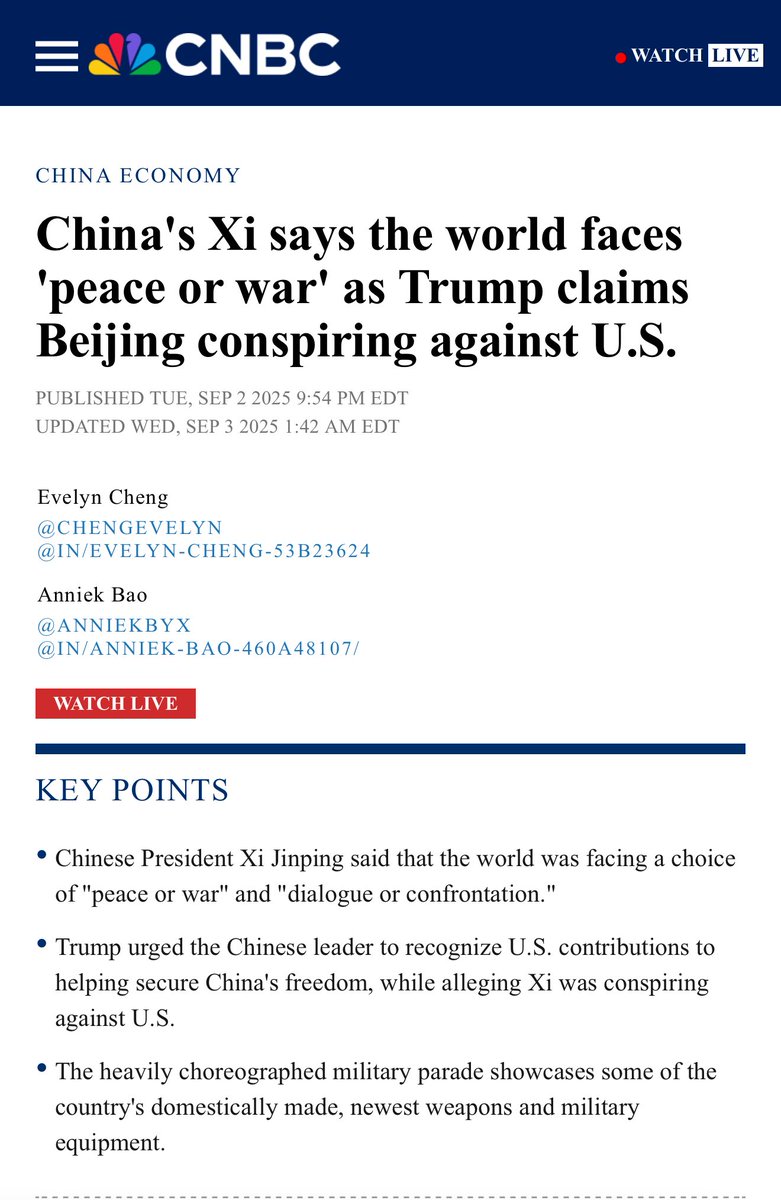
Xi deliberately obfuscates the issue by presenting a false “peace vs war” dichotomy and glosses over how Beijing exploits the grey area in between - “grey zone aggression” as we are now so familiar with. https://t.co/R6RxUw6Gmf
In case that doesn't underscore the severity of their corruption issues enough, I have since read that during CSIC's anti-corruption purges their Head of Discipline, Liu Changhong, was removed and charged with accepting bribes.
I don't think I need to point out the irony in that.
The PRC's intense military-civil fusion (MCF) strategy has given rise to the world's largest shipbuilding industry, with 🇨🇳's #DualUse shipyards producing more vessels than the rest of the world combined. The linked @CSIS article from earlier this year provides a comprehensive analysis of the industry (as well as a handy two-page summary if you don't have hours to spare to read the full 74-page document!)
However, one thing that this analysis could have dedicated more space to is the wave of corruption that has plagued the industry for decades.
The China State Shipbuilding Corporation (CSSC) is the company underpinning the Chinese dual-use shipbuilding industry, a company whose history is marked with a long line of corrupt high-ranking individuals despite rigorous anti-graft measures. The CSSC merged with the China Shipbuilding Industry Corporation (CSIC) a few years ago, which suffered from a spate of arrests of top-level executives following anti-corruption investigations between 2015 and 2019 - including the arrest of former Chairman Hu Wenming, and his deputy Sun Bo who allegedly leaked classified information to foreign intelligence officials.
Given that CSSC Chairman Wen Gang was removed as recently as December last year on suspicion of corruption, it is clear that the problem persists in spite of their many efforts to eliminate it.
Failing to stamp out this endemic corruption could mean real trouble for 🇨🇳's MCF strategy, and by extension for the PLA Navy, as theft of company funds and cronyism are known to lead to poor equipment quality, and the leaking of confidential information poses a severe security risk - both of which are incredibly detrimental to military capabilities.
This raises the question, why, despite their best efforts, is it so hard for them to eradicate this plague of corruption from such a vital industry?
https://t.co/HifmXOvZLV
It is disappointing and concerning to think about the impacts of 🇨🇳 Distant Water Fishing Fleet (DWF). Unsustainable practices and overfishing threaten marine ecosystems and harm local communities. China is a significant contributor to #IUUFISHING, which continues to expand its reach, undermining marine biodiversity and local fishing communities especially in the #SCS. It's time for China to prioritize sustainable practices and respect international law.
Chinese Distant Water Fishing Fleet (DWF) are changing the face of ocean all across the world.
After depleting the fishing resources in China's neighbourhood, Chinese DWF is now making its presence felt in the EEZ of almost all the coastal nations in the world. @jaytaryela
New update from @onenewsph in the #BanLaoshan saga: a Chinese research vessel was caught illegally conducting marine research activities in the Philippine EEZ. Coincidence or a pattern?
Spotted with a deep-sea submersible named the "Deep-Sea Warrior" & unidentified marine research equipment, would these happen to be the same research equipment as the drones, floats and gliders previously reported on, and attributed to Chinese intelligence capabilities? #UNCLOS #WestPhilippineSea #SCS
A Chinese research vessel believed to be engaged in deep sea mapping to support submarine operations was escorted out of the waters of Ilocos Norte on Monday, the Philippine Coast Guard (PCG) reported on Tuesday. https://t.co/Udiejn3uzL | via @onenewsph
Pleased to see @gmanews is also reporting on China's #PLA covert and illegal activities in the South China Sea under the guise of 'scientific research' #WestPhilippineSea.
In a recent press briefing, West Philippine Sea Rear Admiral Roy Vincent Trinidad reports submersible drones recovered in Philippine waters were likely deployed by China.
"Based on the technical study and forensics of the SIM card, the last contact that it had was in mainland China."
"These underwater drones have the capability to receive, process, store, and transmit data through satellite communications to a station on land, to a mothership, or to other drones."
With these underwater drones used for intelligence purposes, @NSCPhil is right to call this extent of operations in the Philippines "alarming", and is further irrefutable proof of the illegal activities conducted by the #PLA and PRC research institute Laoshan Laboratory.
Follow for latest updates #BanLaoshan
China possibly deployed some of the submersible drones recovered in Philippine waters, according to the Armed Forces of the Philippines (AFP) on Tuesday. https://t.co/30XOgg6cPJ
This is dangerous!
While illegally navigating in #Philippines EEZ, #CCG vessel aggressively changed its direction & aimed to ram #PCG vessel. CCG's unlawful activities & reckless & dangerous maneuvers are direct threat to human life. 1/3 @PingpingTweets @MalayaIrredenta