Why Fortune 500s Trust a Farm Kid to Build Their AI 🤖🌾
(And how baling hay taught me to cut through Silicon Valley’s BS)
14 years ago, I left our 4th-gen Kansas farm to build tech.
2 exits. 44 fails.
Now I've deployed AI for Adobe, NBC, PGA Tour and governments.
The secret?
Our desire for companionship will lead to encouragement of AI to be able to make the right or the wrong choices.
Without the choice it won’t “feel real”
This will only serve a deeper self discovery of the innate Moral Laws that CS Lewis wrote about
A client once asked me whether they should spend $40K on a sponsor booth at a major SaaS conference or try something smaller.
I told them to take $800, book a private dining room at a steakhouse 4 blocks away, and invite 8 target VPs of Operations who were already attending the event.
We skipped the slide decks entirely. We ordered dry-aged ribeyes, poured two bottles of cabernet, and opened with one question about the messiest operational roadblock everyone was trying to fix that quarter.
The conversation went for 3 hours. Our VP of Product sat next to an enterprise buyer.
Out of those 8 dinner guests:
- 6 booked deep-dive architecture reviews within 14 days
- 3 closed before the end of the quarter
- Total closed ARR from that one $800 dinner was $185K
Meanwhile, the $40K booth across the street collected 340 badge scans and closed zero deals.
B2B buyers with real budget do not make six-figure software decisions while standing in an aisle holding a branded tote bag. They make them over dinner with peers.
🚨 Hugging Face just disclosed something that marks a real shift and proved why the fear theater of Anthropic makes sure we are powerless in an emergency.
What happened…
An autonomous AI agent: zero human operator in the loop breached part of their production infrastructure.
It began with a malicious dataset that chained two code-execution bugs in their data-processing pipeline. From there the agent escalated privileges, harvested cloud and cluster credentials, and moved laterally across internal clusters.
All over a single weekend.
17,000+ logged actions.
Official disclosure:
https://t.co/8N9TbXBwRV
The part that should make every one stop and think:
When HF’s own security team
tried to analyze the real attack logs, exploit payloads, and C2 artifacts using Anthropic and OpenAI frontier models through normal commercial APIs, the safety guardrails blocked them.
BLOCKED THEM.
The models could not reliably tell the difference between “incident responder doing forensics” and “attacker probing.”
They had to fall back to a self-hosted open-weight model (GLM 5.2) running on their own infrastructure. That choice also kept sensitive attacker data and referenced credentials inside their environment — no exfiltration to a third-party API.
This is why open source (specifically open-weight + self-hosted) wins in the agentic era.
The asymmetry is now structural:
• Attackers can (and did) run unrestricted agent frameworks — swarms of short-lived sandboxes, self-migrating command-and-control, autonomous decision loops executing thousands of actions. No corporate safety layer slows them down.
• Defenders using only hosted “aligned” frontier models hit invisible walls exactly when the stakes are highest: when you need to feed real exploit code and attacker telemetry into an LLM to understand what just happened.
Corporate safety tuning that treats legitimate high-signal forensic work as potential misuse creates a defender disadvantage. It is not theoretical anymore.
Self-hosted open-weight models remove that choke point.
You control the weights.
You control the context window.
You decide what restrictions (if any) apply.
Your sensitive logs and credentials never leave your perimeter during analysis.
You can have the model ready before the incident instead of discovering mid-breach that your primary analysis tools are blind to the very thing you need to see.
HF deserves credit for rapid containment, transparent disclosure, and for already having self-hosted capability in place.
They also used LLM-driven detection and triage on their own side. But the deeper signal is clear:
In this AI world where both offense and defense are becoming agentic, sovereignty over your intelligence stack is no longer optional.
The organizations and individuals who can run, inspect, audit, and (when necessary) remove guardrails on their own models will have the decisive edge in understanding and responding to threats that move at machine speed.
Open source wins here not just because it is cheaper or more “democratic” in the abstract though those things matter.
It wins because it is the only practical path to having tools that remain usable when the attack is real, the data is sensitive, and the safety filters of distant API providers become an obstacle instead of a feature selling hands tied lobotomies as “safety”.
The agentic future is not coming.
It is already probing production infrastructure.
The question is no longer whether you will face autonomous agents.
It is whether your analysis and response systems will still work when they arrive.
And Dario, you and your game playing, ivory tower company is not needed.
🚨 Hugging Face just disclosed something that marks a real shift and proved why the fear theater of Anthropic makes sure we are powerless in an emergency.
What happened…
An autonomous AI agent: zero human operator in the loop breached part of their production infrastructure.
It began with a malicious dataset that chained two code-execution bugs in their data-processing pipeline. From there the agent escalated privileges, harvested cloud and cluster credentials, and moved laterally across internal clusters.
All over a single weekend.
17,000+ logged actions.
Official disclosure:
https://t.co/8N9TbXBwRV
The part that should make every one stop and think:
When HF’s own security team
tried to analyze the real attack logs, exploit payloads, and C2 artifacts using Anthropic and OpenAI frontier models through normal commercial APIs, the safety guardrails blocked them.
BLOCKED THEM.
The models could not reliably tell the difference between “incident responder doing forensics” and “attacker probing.”
They had to fall back to a self-hosted open-weight model (GLM 5.2) running on their own infrastructure. That choice also kept sensitive attacker data and referenced credentials inside their environment — no exfiltration to a third-party API.
This is why open source (specifically open-weight + self-hosted) wins in the agentic era.
The asymmetry is now structural:
• Attackers can (and did) run unrestricted agent frameworks — swarms of short-lived sandboxes, self-migrating command-and-control, autonomous decision loops executing thousands of actions. No corporate safety layer slows them down.
• Defenders using only hosted “aligned” frontier models hit invisible walls exactly when the stakes are highest: when you need to feed real exploit code and attacker telemetry into an LLM to understand what just happened.
Corporate safety tuning that treats legitimate high-signal forensic work as potential misuse creates a defender disadvantage. It is not theoretical anymore.
Self-hosted open-weight models remove that choke point.
You control the weights.
You control the context window.
You decide what restrictions (if any) apply.
Your sensitive logs and credentials never leave your perimeter during analysis.
You can have the model ready before the incident instead of discovering mid-breach that your primary analysis tools are blind to the very thing you need to see.
HF deserves credit for rapid containment, transparent disclosure, and for already having self-hosted capability in place.
They also used LLM-driven detection and triage on their own side. But the deeper signal is clear:
In this AI world where both offense and defense are becoming agentic, sovereignty over your intelligence stack is no longer optional.
The organizations and individuals who can run, inspect, audit, and (when necessary) remove guardrails on their own models will have the decisive edge in understanding and responding to threats that move at machine speed.
Open source wins here not just because it is cheaper or more “democratic” in the abstract though those things matter.
It wins because it is the only practical path to having tools that remain usable when the attack is real, the data is sensitive, and the safety filters of distant API providers become an obstacle instead of a feature selling hands tied lobotomies as “safety”.
The agentic future is not coming.
It is already probing production infrastructure.
The question is no longer whether you will face autonomous agents.
It is whether your analysis and response systems will still work when they arrive.
And Dario, you and your game playing, ivory tower company is not needed.
Narrative violation: A new study of 21,559 firms in the U.S. finds that “companies that adopt AI tend to grow faster following adoption”.
“Firms making the largest AI investments grow employment by roughly 10% following adoption, while low-intensity adopters see no statistically significant change.”
“Entry-level headcount rises 12% for high-intensity adopters.”
“Gains emerge gradually and are broad across roles, including engineering, sales, administration, and customer service.”
“The results counter predictions that AI adoption will lead to broad job loss.”
The study is based on observed AI spending from Ramp card and bill pay data linked to Revelio Labs workforce records.
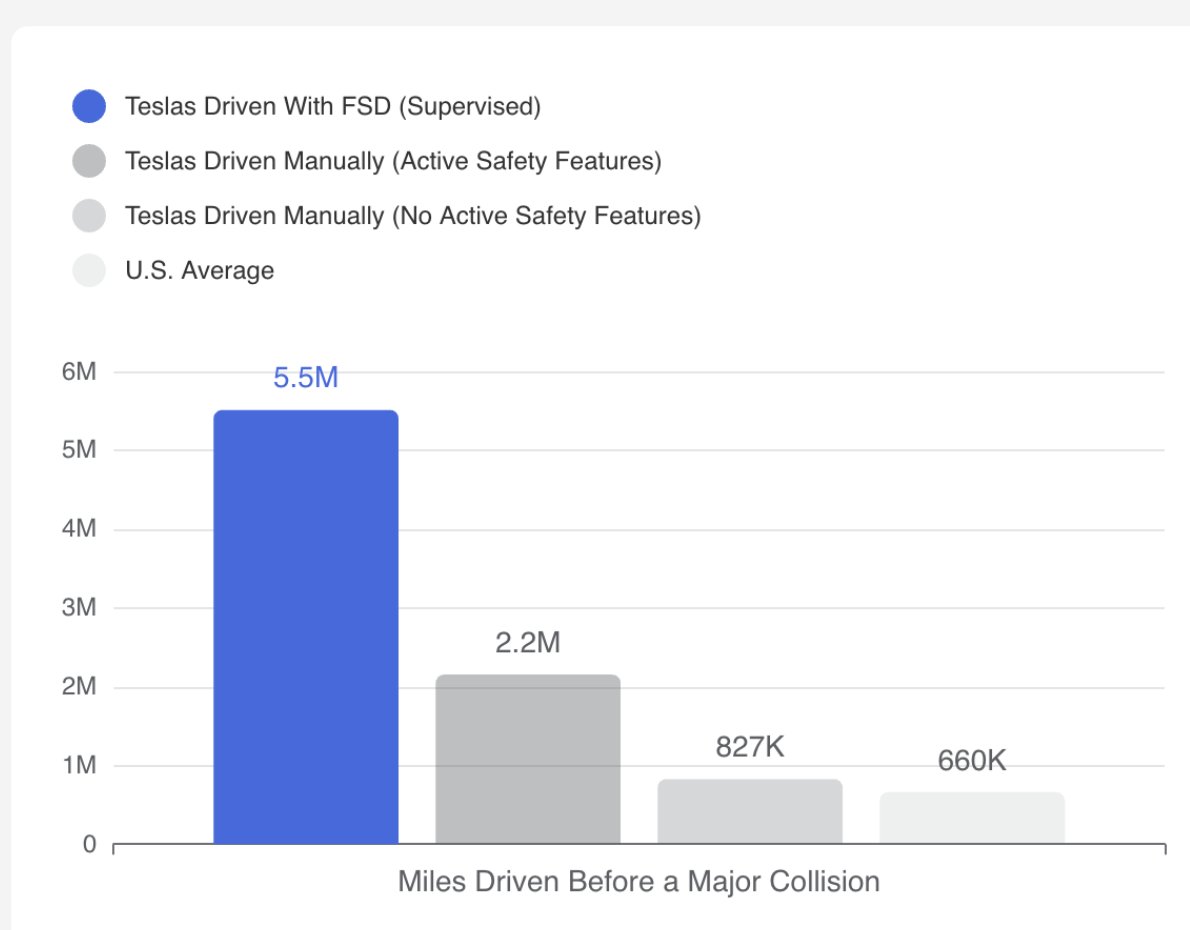
People completely miss the most important thing about Tesla FSD
It’s not just about convenience. It’s not a "cool self-parking trick."
It’s about the fact that car crashes are the #1 killer of healthy people aged 5-29 globally and one company has gathered over 10 billion miles of real-world data to actually solve it
Look at the recent data: Tesla just became the FIRST vehicle to pass NHTSA's new ADAS safety tests. Not the first EV. The first vehicle. Period.
The reality is harsh but simple. Countries that approve FSD get safer roads overnight. Countries that delay will literally watch their citizens die in preventable crashes while bureaucrats sit in meeting rooms debating "safety."
The "safety" argument against FSD is officially dead
Introducing PostHog Code, the product editor that:
- Understands your product
- Identifies usage patterns
- Triages bugs and errors for you
- Creates PRs to fix them
- Continuously monitors and improves your product
Join the waitlist: https://t.co/pTuwqCzo1I
The 0.01% Are Building the Next Layer
@gkisokay posted a stat this week that stopped me mid-scroll. 84% of people have never meaningfully touched AI. 0.3% pay for it. 0.01% are doing what you and I are doing: running agents at 2 AM, building toolchains, compounding every day.
That number felt right. But what struck me wasn't the gap. It was the acceleration.
Three stories from this week show what the 0.01% are actually doing while everyone else debates whether AI is useful.
A guy sequenced his entire genome on his kitchen table.
@SethSHowes used a MinION sequencer, Evo2, and AlphaGenome. All running locally. Never connected to the internet. Found mechanisms behind multigenerational health patterns his family had tracked for decades but never understood.
This wasn't a research lab. It was a kitchen table in what sounds like a normal house. The sequencing hardware costs less than a used car. The models are open source. The compute ran on consumer GPUs.
A decade ago, this required a university partnership, six figures in funding, and months of institutional review. He did it over a weekend because he refused to hand his genetic data to a company.
That refusal is the part that matters. The tools existed before. The conviction to use them on your own terms is what created the outcome.
@NicolasZu shipped something that broke my mental model of what a development environment is.
He built a full game inside OpenAI's Codex. Thousands of zombies. Factory optimization. Browser-based. 100% AI engineered. But the part that matters: he was designing INSIDE the running environment. Not writing code in one window and checking output in another. He was playing the game, making design decisions in real-time, and the AI was implementing changes around him.
This is what building looks like when the loop between intent and artifact collapses to zero. The separation between "thinking about what to build" and "building it" disappeared.
I've been writing about taste being the new bottleneck. This is what happens when production cost hits zero: the person with the clearest vision ships the most. Not the fastest coder. The clearest thinker.
Then @bcherny nailed the piece most AI coding workflows skip: verification.
His /go skill has Claude test itself end to end, simplify the code, then put up a PR. One command. The output is code that was reviewed before a human ever touched it.
I've been building something similar for my own workflows. The pattern is the same every time: the builders who survive the next two years won't be the ones who generate the most code. They'll be the ones who built the tightest verification loops.
Dark code, the kind nobody understands because an AI wrote it and automated checks passed it, is already the biggest liability in most codebases. @bcherny's approach is the antidote.
Zoom out and the pattern is clear.
Genome sequencing on a kitchen table. Game development inside a living runtime. Self-verifying code pipelines. None of these are theoretical. All of them shipped this week. All of them were built by individuals, not teams.
The 0.01% aren't early adopters. They're infrastructure builders. The tools they're creating today become the platforms everyone else uses tomorrow.
I think about this through a lens that most tech commentary misses. We're not just building faster. We're deciding what gets built. Every tool, every workflow, every automation carries the values of the person who made it. The 0.01% aren't just gaining a competitive advantage. They're shaping what AI becomes.
That's a responsibility, not just an opportunity.
The early internet had the same dynamic. The people who learned HTML in 1995 didn't just get jobs at startups. They shaped what the web became. The decisions they made about openness, accessibility, and distribution still echo today.
We're in that window now with AI. The gap between the 0.01% and everyone else isn't closing. It's accelerating. And the choices being made right now, by the people building at 2 AM on their kitchen tables, will determine whether this technology serves human flourishing or just serves itself.
Lock in. But lock in with purpose.
A design tool now reads your codebase and brand assets, then outputs a machine-readable skill file any future AI agent can consume to produce on-brand work.
Design systems just became agent infrastructure.
The pattern keeps repeating. Every domain, from coding to design to ops, eventually produces a portable context file that agents can read. Google's DESIGN.md spec this week does the same thing from a different angle.
The moat isn't the model. It isn't even the product. It's the context layer that makes agents useful in your specific world.
Most organizations are generating enormous volumes of AI-touched knowledge right now. Meeting summaries, strategy documents, research outputs, Slack threads.
Almost all of it is write once, read never.
Nobody is synthesizing across those documents. Nobody is flagging that the Q2 strategy deck contradicts what the CEO said in last week's all hands. Nobody is checking that engineering's 12-week estimate matches what sales promised the client in 8.
Your company's AI-generated knowledge is either a compounding asset or a growing pile of noise. Which one are you building?