As a developer, you should know core system design concepts.
This helps show potential employers that you can turn design requirements into production-ready code.
This course covers app architecture, API design, caching, networking, databases, and more.
https://t.co/j6TmwXZox7
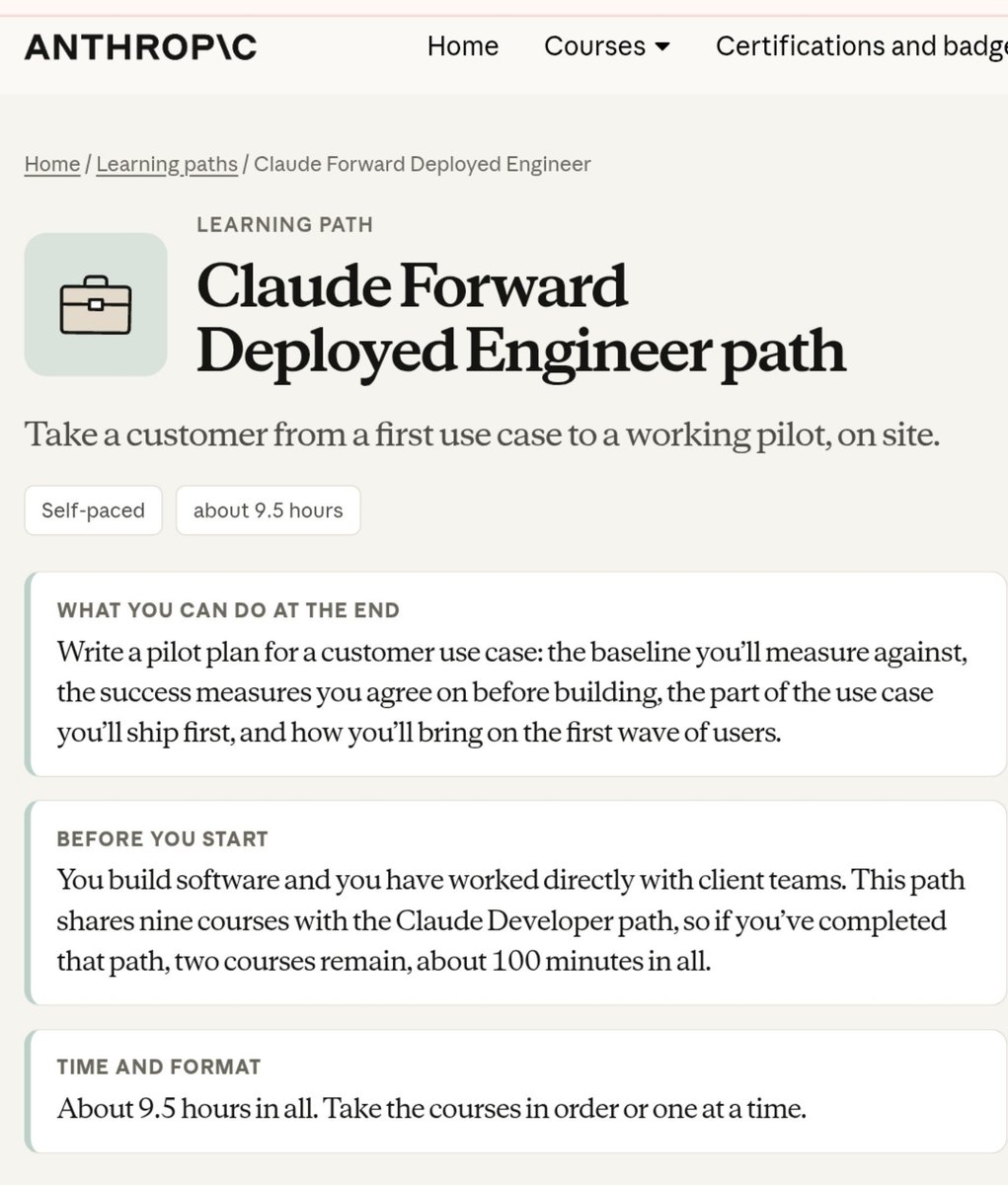
ANTHROPIC JUST DROPPED A CLAUDE FORWARD DEPLOYED ENGINEER PATH 🤯
▫️ ~9.5 hours, self-paced, 11 courses
▫️ claude platform 101: api, agent loop, tools, mcp
▫️ claude code in a customer's repo
▫️ building mcp servers + agent skills
▫️ how to design a pilot, set a baseline, drive adoption
▫️ leads to claude certified developer exam
the tech is the easy part. getting a client to actually use it is the job
FDE is the hottest AI role nobody talks about 🔖
link in the first reply 👇
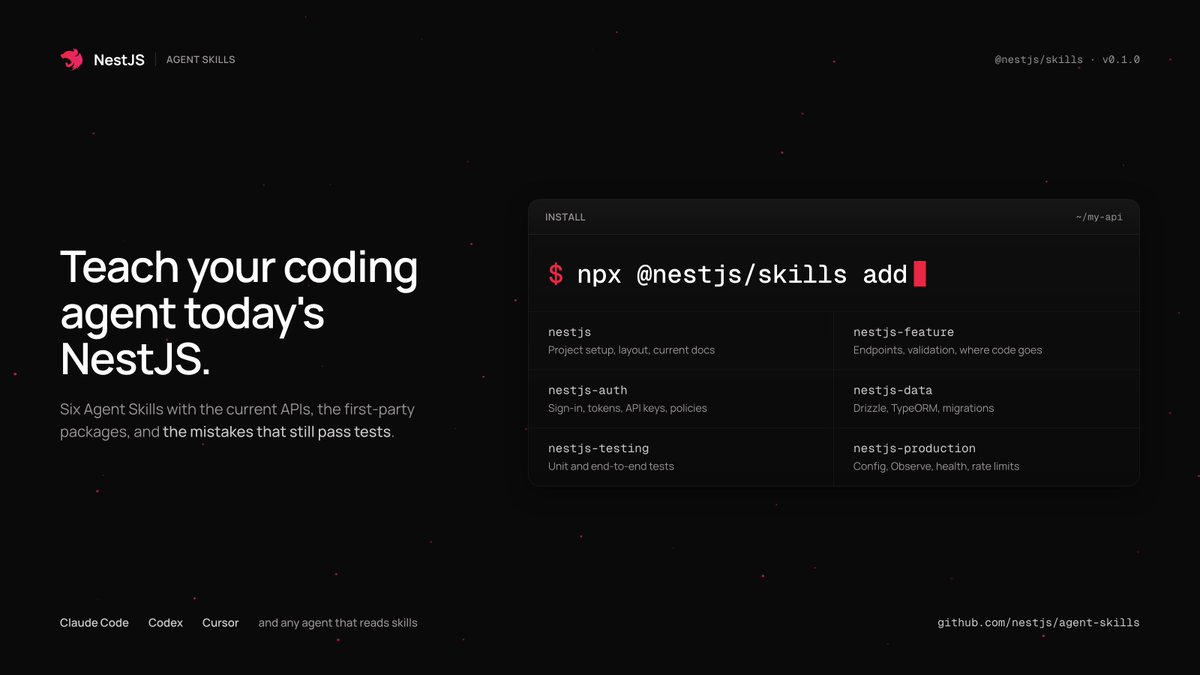
🚀 Introducing the official NestJS agent skills!
Today’s APIs, first-party packages and the mistakes that still pass tests, for your coding agent 🧠
⚡ npx @nestjs/skills add
✨ Built into nest new
🤖 Claude Code, Codex, Cursor & more
👉 https://t.co/wr9EugoZCO
A new Docker, but a familiar story.
Today we're introducing a new look, a new focus, and a refreshed Moby.
Same Docker you've trusted for over a decade, now built to run on trust in the agentic era. We can't wait to show you.
Read the full story: https://t.co/vGfxtsiVFT
🚨 AWS acaba de lanzar su emulador oficial que funciona 100% en local.
Ahora puedes desarrollar aplicaciones y probar servicios de AWS directamente en tu ordenador, sin crear una cuenta ni generar costes en la nube.
Se llama AWS Emulator y ofrece lo siguiente:
→ Simula servicios de AWS como S3 y DynamoDB
→ Ejecuta tests de integración y pruebas de CI/CD
→ Funciona con AWS CLI y los SDKs habituales
→ Incluye una skill oficial para utilizarlo con agentes de IA
Funciona en Linux, Windows y macOS, estos dos últimos mediante Docker.
Eso sí, todavía no dispone de interfaz gráfica ni reproduce completamente la evaluación de políticas IAM.
Es completamente gratuito, tiene licencia CC0 1.0 y ya supera las 8.000 estrellas en GitHub.
Repo 👇
I’ve decided to leave NVIDIA. There are a few things I want to say.
As a robotics engineer at NVIDIA, I have seen Jensen as much more than the company’s CEO.
I admire his willingness to invest in a future that was not yet obvious. He committed to CUDA long before the deep learning boom and positioned NVIDIA for AI before it became everyone’s priority. Those decisions helped build the infrastructure that powers today’s AI.
I have seen that same vision in physical AI: investing in robotics, sharing open-source tools and projects, and building computing platforms that bring AI into the physical world. This is the work I do every day—and a future I believe in.
But what matters most to me is the culture he helped build.
Engineers are encouraged to explore, take risks, and learn from mistakes. Jensen reads employees’ Top 5 emails, follows their work, and engages directly. In a company this large, that connection matters. It makes an individual engineer feel that their ideas can still be heard.
That is why this has been so disappointing.
I do not have all the facts surrounding the allegations, and I cannot prejudge the investigation. My admiration for Jensen does not put him above scrutiny.
What I find difficult to accept is having to come to terms with his departure before receiving an explanation that helps me understand it. What this means for our direction, our culture, and the people doing the work remains unclear to me.
I have felt that engineers’ perspectives matter here. On this decision, I have not felt heard. That gap has been more painful than I expected.
I understand that some information cannot be shared immediately. But that does not erase the feeling of being left outside a decision that affects the company we help build every day.
A company’s greatness comes from its leadership, its governance, and the people who turn its ambitions into reality. Employees’ trust and sense of belonging are part of that, too.
Jensen’s vision and the engineering culture he shaped were important reasons I wanted to stay. His departure led me to decide that my own chapter here should also come to a close.
I leave with sadness and gratitude. The colleagues I have worked with, and the work we believed in together, will always matter to me.
These are my personal views.
Your Android app no longer needs to ship its own ML runtime. 📦
LiteRT in Google Play services got a massive upgrade: CompiledModel API & ML Drift GPU acceleration → https://t.co/6hLGIMLKGA
That means:
🔹 ~8 MB smaller APK size
🔹 ~1.4x faster GPU inference
🔹 Auto runtime updates
This is a post about SBMM. But it's really just an anecdote about development, and I wonder if other devs out there have had the same experience.
When making a competitive MP game like CoD or XDefiant, we try to playtest the game every day. Now I don't know about other devs, but I can say that some of the most fun I've had playing an MP game were those office playtests. And guess what, because the pool of people playing is often just enough for 1-2 games, there is no SBMM. And we had some Pro to nearly Pro players vs some players who were not that great. When I started at Infinity Ward, I was horrible at controller, as I had always been MnK. But I played every day, and it was an absolute blast. And I got better. Never got to the top, but I got decent. And I will always look back on those playtests as some of the most fun I've had playing MP.
Now, as I said, this is just an anecdote, but I thought it might be a good one for devs out there to think about. Were your playtests just absolutely a blast because you loved the game you were making? And if so, how did the skill imbalance feel? Again, not trying to prove anything; I'm just sharing my experience. That even with a lobby of very mixed skill, the game was so much fun to play.
¡AWS ha sacado un emulador oficial 100% local!
No tiene coste y todo se queda en tu máquina.
Perfecto para pruebas en local, crear prototipos, ejecutar tests de integración y más.
Para Windows, macOS y Linux. De código abierto:
https://t.co/IL6MRkYa14