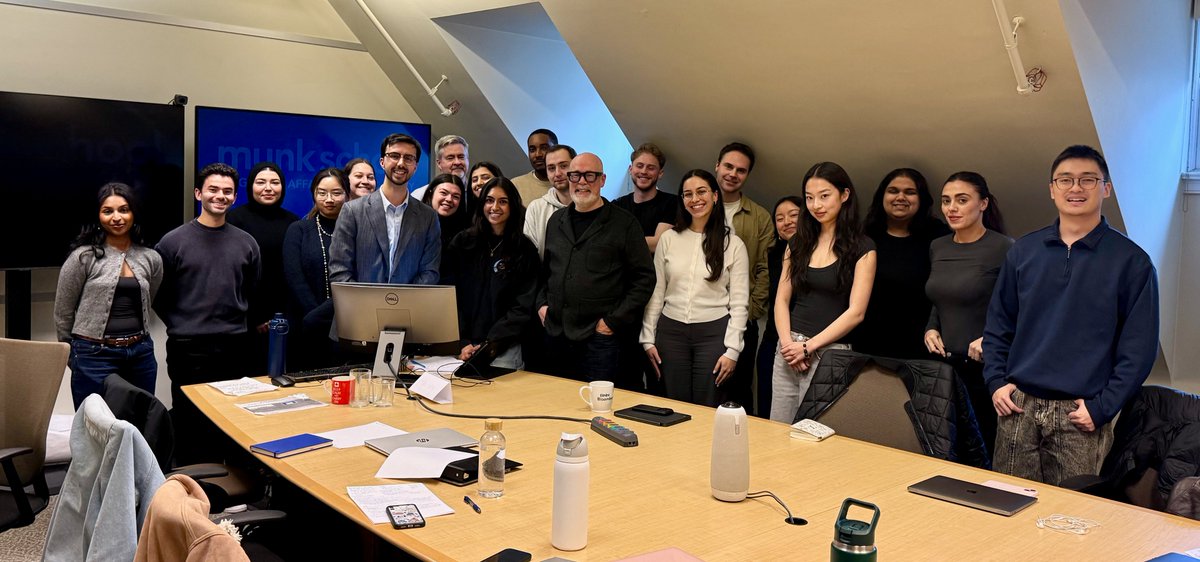
I've been teaching a master's course on AI at @UofT 's @munkschool - and I'm excited to share it with you!
One of the best parts has been the calibre of guest lecturers: folks from @AnthropicAI@GoogleDeepMind and @law_ai_. This week, Mark Surman — @mozilla President and one of the most important voices on open source AI — came by and gave us a fantastic walkthrough of how he's thinking about the evolution of the internet to frontier AI, and Canada's role as a middle power.
When I told him about the course, his first reaction: "You should open source it."
So we did. Full syllabus and a couple AI agents and resources we've built together — all on GitHub: https://t.co/wSOeeNP6DM
Covers everything from the AI supply chain to frontier model governance to hands-on prototyping. More materials and agents coming at the end of term.
Feel free to use it, remix it, share it.
And remember a future with plenty of open source AI is a good one!
Last-minute - join me and over 500 registered attendees for our webinar tomorrow, The Algorithmic State! I'll be moderating a session with @deanwball, Senior Fellow at the @JoinFAI and @shuyanglin, Head of Design at CrownShy.
Thanks to the @IntTlcSoc, @munkschool, and @TELUS for hosting us!
https://t.co/ZedCnIVeXU
We brought a vintage Polaroid to the RBC-Eurasia Group #uscanadasummit and asked premiers, ministers, CEOs, and a post-lunar astronaut one question: what does Canada need to do right now?
https://t.co/UArgauJwjQ
The US government, citing national security authorities, has issued an export control directive to suspend all access to Fable 5 and Mythos 5 by any foreign national, whether inside or outside the United States, including foreign national Anthropic employees.
The net effect of this order is that we must abruptly disable Fable 5 and Mythos 5 for all our customers to ensure compliance.
Access to all other Claude models is not affected.
We apologize for this disruption to our customers. We believe this is a misunderstanding and are working to restore access as soon as possible.
Read our full statement: https://t.co/bwn0sximKZ
Canada’s March to the Match continues to work its way through the Toronto streets toward the stadiums.
Beautiful scenes as fans chant and cheer and high five fans who are lining the streets.
It’s going to be electric inside the stadium today.
Looking forward to reading this new report on opportunities for better measuring the job impacts of AI. Thanks to @aidangomez for the share and @Cohere_Labs for putting this together.
A single exposure score is driving the future of work debate.
Our latest report examines what a fuller evidence base looks like, and what it would take to build it.
See what is being missed. https://t.co/fzcJntnav2
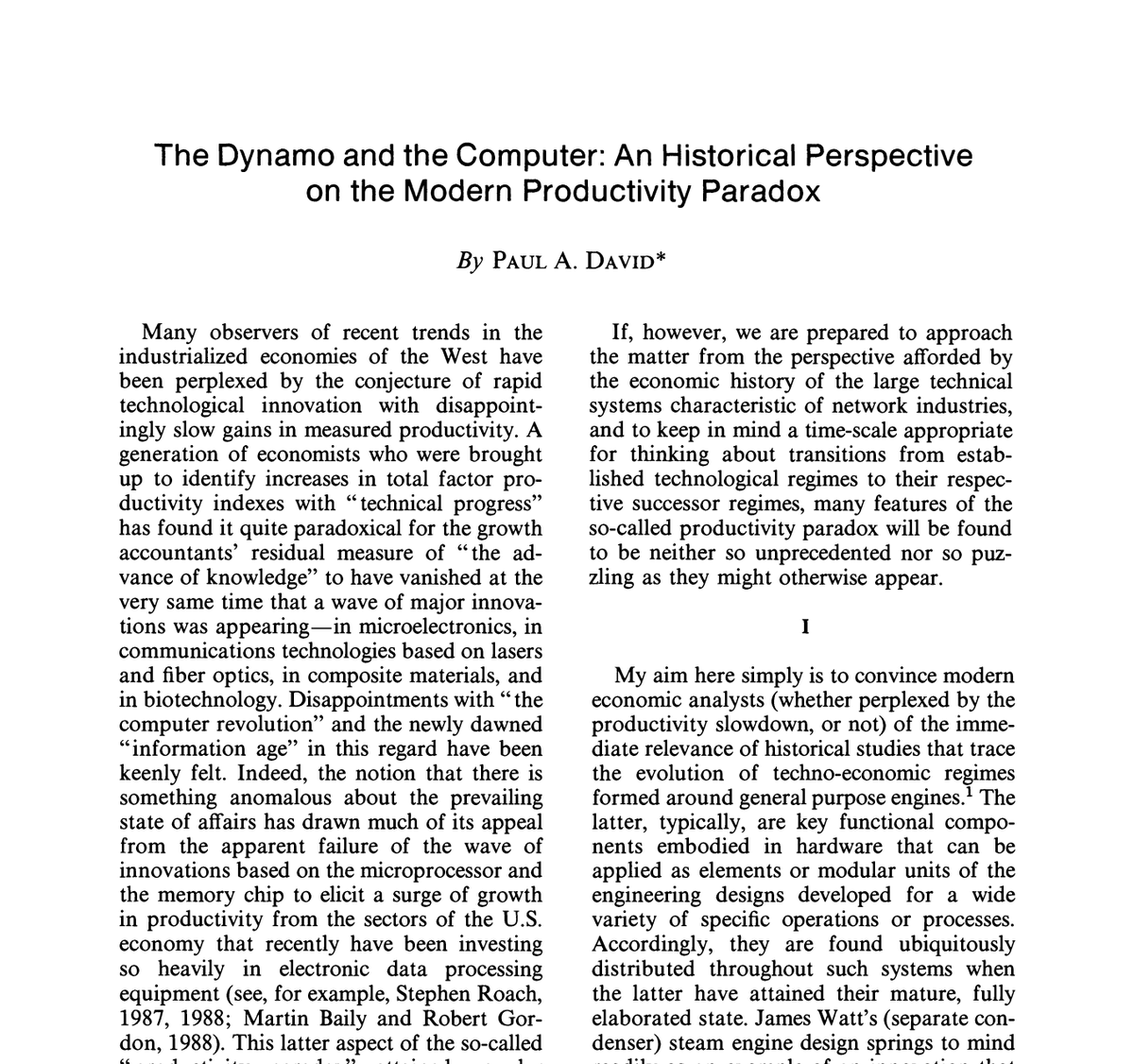
If you've adopted AI at your company but haven't seen any tangible results, read this 1990 article: "The Dynamo and the Computer" by Paul David.
When electricity first arrived, factories that "adopted" it barely got faster. They just swapped the steam engine for an electric one and ran everything else exactly as before: same machine layout, same workflow, same management. Electricity in, no real gains out.
The most common mistake with any new technology is to drop it into the old organization and then declare the transformation done.
The real leap came decades later, when each machine got its own small motor. Suddenly machines no longer had to be lined up around one central drive shaft. They could be rearranged around the actual flow of work.
The productivity gains didn't come from electricity. They came from REDESIGNING THE ENTIRE FACTORY around it.
AI is the same. Bolting it onto your existing process gets you a faster steam engine. The payoff comes when you redesign the work itself.
(link to paper in comments)
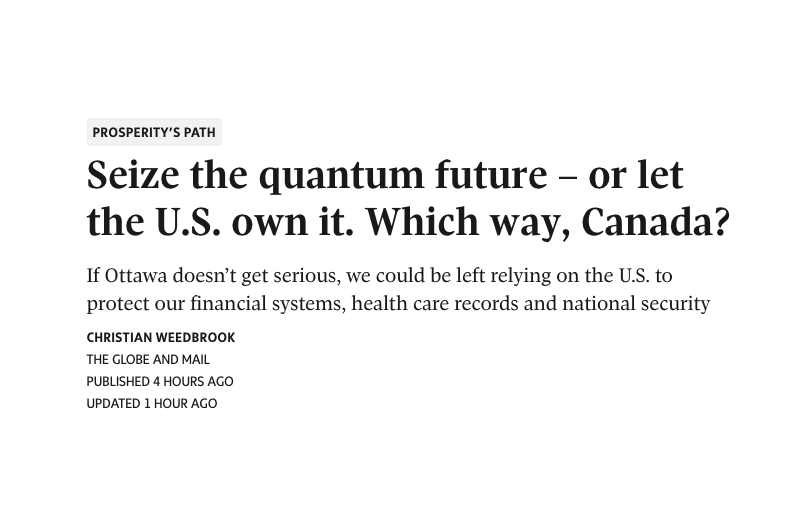
Thoughtful read from @_cweedbrook, CEO of @XanaduAI, about our quantum future. Hot off the heels of the AI strategy, it's important to consider that Canada has multiple globally competitive quantum companies. How does Canada shape our future part in the quantum supply chain?
Quantum computing could be just as transformative as AI – so why isn't quantum literacy part of Canada’s AI strategy?
In his latest op-ed for The Globe and Mail (@globeandmail), Christian Weedbrook (@_cweedbrook), Founder and CEO of Xanadu, explains why we must prepare our economy for the next phase of technological progress today, rather than playing catch-up tomorrow.
🔗👇
I believe they would fund the expansion of existing programming at non-profits, for example from the Alberta Machine Intelligence Institute (https://t.co/UJJb8hUDVh) which has been taken by over 250K learners in Canada.
As an anecdote, I taught my first semester at University of Toronto this past winter and I think more direct action to ensure most - if not all - students graduate with AI skills is definitely needed.
Canada's national AI strategy has real promise. It invests across literacy, compute, missions, talent, safety, and alliances, and that breadth matters. The next step is focus: picking the areas where we want to win and backing them with big bets. My new piece with @mullinsean in the Globe and Mail. https://t.co/8lzjqf0Jhh
Unequivocally good news on the Canadian employment front this morning. Employment rose by a huge 88,000 positions in May, the unemployment rate fell 0.3 percentage points to 6.6% and private sector jobs rose by 56,300 positions, also a very substantial gain.
When I first became a dad I was genuinely worried my career would suffer.
The opposite happened. 3 things changed that I wasn't expecting.
First, a child cuts the filler from your life instantly.
I used to sit at my desk for 14 hours and feel like I was crushing it when in reality maybe 4 of those hours were actual work and the rest was meetings that didn't need to happen, scroll sessions I told myself were research, and "quick calls" that turned into 90 minutes of nothing. A child deletes all of that overnight.
Because you literally don't have the time anymore. Every hour matters in a way it didn't before. You could be with your kid, working on your startup, exercising, having dinner with your wife, sleeping. When your time is actually full of things you care about, the filler can't survive. I'm shipping more now than before my kid was born. Half the meetings. Faster decisions.
I stopped saying yes to things out of politeness because my time has a very real cost now that I can feel in my bones.
Second, your risk tolerance goes up, not down.
Everyone assumes having a kid makes you play it safe. For me it created this urgency to build something real while my kid is young enough to not remember the hard parts. That urgency is more useful than any productivity system I've ever tried.
Third, your thinking just gets clearer.
I don't know how else to explain it. You stop deliberating for days and just make the call. You stop chasing every opportunity and only chase the ones that actually excite you.
Something about being responsible for another human being gives you this filter that cuts through the noise instantly. Before my kid, I'd go back and forth on a decision for a week. Now I make it by lunch and move on.
I used to think having a kid was the thing I'd do after I built the company. Turns out the kid made me better at building the company. Wish someone had told me that sooner. So I'm telling you.
I know this sounds like something a new dad says to justify it. I thought the same thing when other dads told me. Then it happened to me and I understood.
I think you will too.
For decades, Canada invested to build the research foundations that made modern AI possible. Now we have to build, train, and scale what comes next here at home.
Canada's new national AI strategy is an important step toward that goal, and Cohere is proud to be part of the national effort.
Let’s build a better, stronger Canada. 🇨🇦