Fuel cell retrofit aircraft will be the 1st use of H2 in commercial aviation. New @theICCT research suggests that while they will suffer from payload and range reductions, they will be less polluting and could service up to 20% of the turboprop market https://t.co/A0kxuZhLIp 1/11
Check out @mariagallucci's article for this at Canary Media where she covers the role fuel cell retrofit aircraft could play in reducing aviation emissions. (11/11) https://t.co/cpotXNvb6n
Fuel cell retrofit aircraft will be the 1st use of H2 in commercial aviation. New @theICCT research suggests that while they will suffer from payload and range reductions, they will be less polluting and could service up to 20% of the turboprop market https://t.co/A0kxuZhLIp 1/11
These retrofit aircraft will be the proving ground for hydrogen storage, refueling, and safety procedures at airports. If all goes well, they could pave the way for bigger hydrogen powered aircraft like those modeled in a previous @theICCT study: https://t.co/zs8OrmTKoC (10/11)
@fluxart1 We are yet to analyze hybrid aircraft, but I was wondering what you mean by hybrid? Is it a fuel cell and battery hybrid? There are a few different ways you can hybridize, fuel cell+battery, fuel cell+H2 combustion, Jet A+battery, fuel cell + Jet A. Which is the most promising?
In this month’s issue of the EM Magazine from @AirandWaste , @Mittonius and I write about the lifecycle emissions of the various decarbonization options for aviation. @TheICCT@rutherdan https://t.co/G0UAoXvNFB
@_SafeLanding This is based on our Vision 2050 paper (pg. 11) which is, in turn, based on the projected biofuel availability under the net zero emissions report by the IEA https://t.co/slXJg5Cin5
https://t.co/vBdoiKu9WN
@Mittonius
@_SafeLanding Yes, we do not assume that it would end up in an Anaerobic digester. The reason is similar to why we assume point-source carbon capture. The best alternate is not being practiced right now and if fuel can be produced from it, then it makes sense to do that.
@_SafeLanding Agreed and maybe it is time to move away from using that term. Including the option of limiting growth is very important. At the same time we cannot expect developing economies to stop the growth of their aviation sector now that the developed world has availed of its benefits
@KarstenCapion I agree with Prof. Millers. The advantage of hydrogen is increased as you go a longer distance. (Fig 7 in linked paper). It makes sense to eventually build long-haul hydrogen aircraft. Unfortunately those aircraft are unlikely to enter service before 2040 https://t.co/BSUPCL89S3
There is no silver bullet. All decarbonization options are needed to meet ICAO's 2050 net-zero goal. SAF will be required on routes that cannot run on electricity or H2. And electricity and H2 will be required to ensure the limited supply of SAF can be focused on long-haul
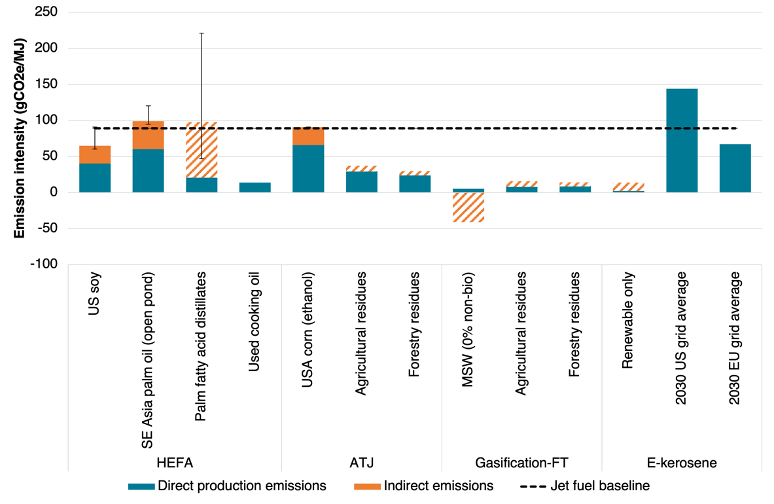
Biofuels can incur indirect emissions due to induced land use change and/or displacement of the feedstock from existing uses. The lifecycle emissions for e-kerosene, like with electricity and H2, depends on the source of the electricity.