@gnievchenko I still think your point is valid—and surely if we’re “stuck” w a certain share of liquid fuels why not improve their process emissions and divert them to aviation? Though I’m more cautious about the high land use change risk oilseeds.
@gnievchenko “Decarbonize” is the tricky part of this. Sugars and starches have fairly high direct LCA emissions (though lots of opportunities to reduce that via low-CI process energy inputs or CCS). Instead, the industry seems to be going for shaky soil carbon offsets within the LCA.
@argonbeam88 @ChetEdinger@biofuelslaw And next frontier is figuring out the impact of additionality req's and hourly matching on H2 and e-fuel costs. This influential 2023 paper is helpful on that: https://t.co/ZppHGBGDqw
@argonbeam88 @ChetEdinger@biofuelslaw I think this is the most helpful paper to understand the key issues on electricity: https://t.co/3wURxPBgFe.
If renewable electricity is diverted from existing productive uses or provided through a loose book-and-claim system, there is a risk that e-fuels are worse than fossil
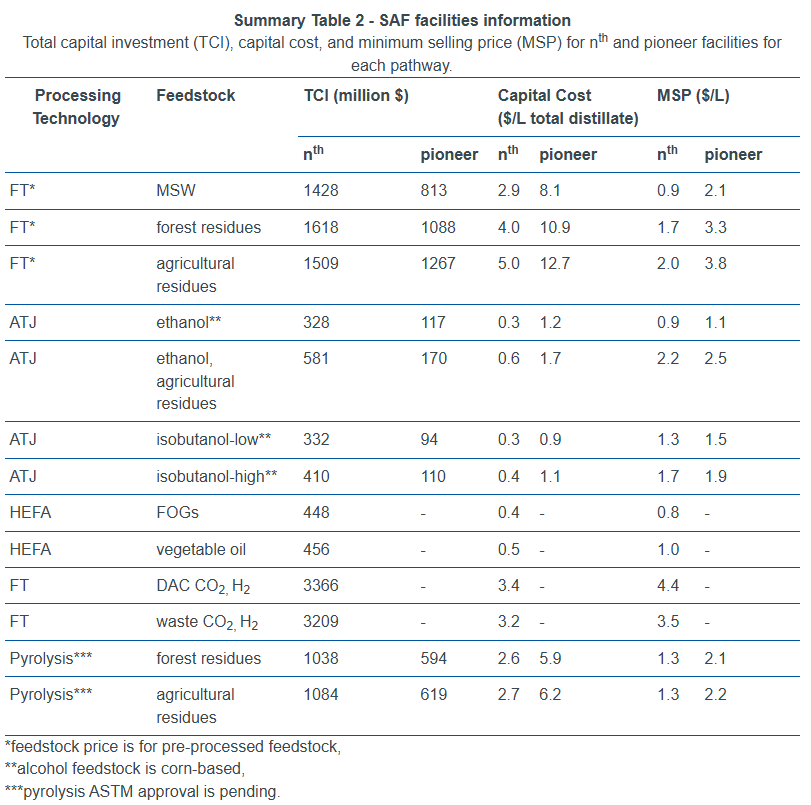
@dunnde Table 2 here from ICAO is not perfect but can give a sense of the literature.
Meanwhile, Gevo applied for $950M (and bumped to $1.46B) from DOE for a 60 Mgal facility (though w/ additional bells & whistles); so quite likely that TEA's may have underestimated by quite a bit.
@Mattherman09 Important to note that this still hasn’t happened yet—there are still some hoops to jump through for safrinha corn to qualify. It is not clear if second cropping in that climate is truly an “unused” land approach, plus the CORSIA ILUC assessment already included multi-cropping
@CarbonAcumen Granted, the network is nationwide, but could this include revenue from things like like LCFS credits? This is a higher revenue than the posted prices @ Chargers.
@Mattherman09 I think I figured it out. For SAF's you're assuming a starting point of $1.25 for a 50% GHG reduction under 45Z. However, the value of 45Z should begin at $0/gal for aviation fuels and increase to $1.75--See Table 1: https://t.co/up6abrbnLF
@rb_coleman @argonbeam88 @biofuelslaw Couldn’t agree with you more on that last part. More focus should go towards improvements in measurable reductions along the supply chain.
@rb_coleman @argonbeam88 @biofuelslaw By all means, it takes a few seconds to convert between a 30 year and 25 year time horizon.
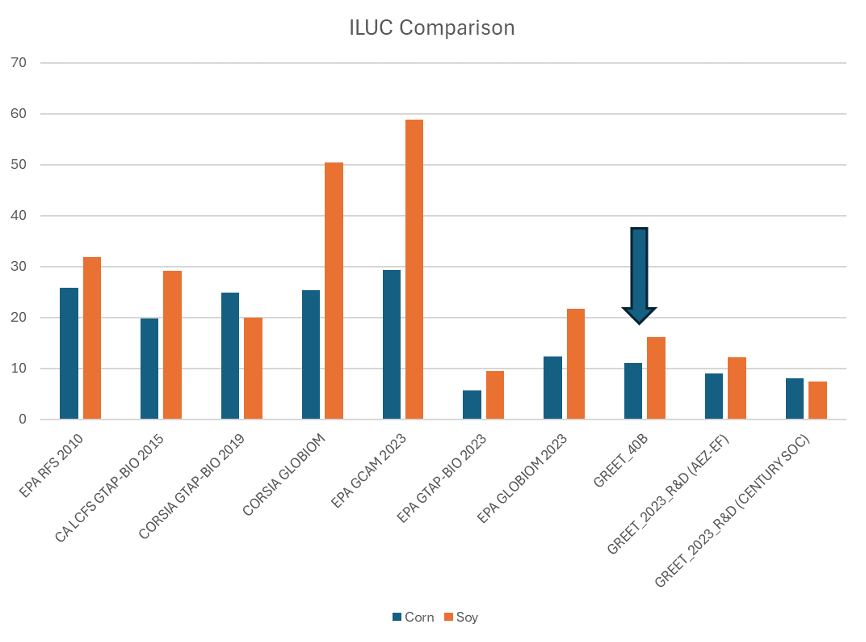
Doing that (for consistency w US policy), the CORSIA default remains somewhere between the CA LCFS and RFS values.
@argonbeam88 @biofuelslaw@rb_coleman See here—it’s easy to rerun the model w different inputs and get wildly different results. Lots of different GTAP-BIO runs in the quote here to compare.
On indirect land-use change, the default EF's are a departure from previous regulatory assessments for EPA RFS, CA LCFS, or ICAO-CORSIA--compare the 40B EF's to the lefthand side EF's.
@argonbeam88 @biofuelslaw@rb_coleman Searchinger (2008) is very outdated. I recommend supplementing Lark w the 2023 EPA ILUC model comparison exercise (5 models), ICAO’s 2019 LCA to harmonize between two ILUC models, and Plevin’s work w the PNNL GCAM model.
Soy oil and other HEFA pathways fare better--they qualify using default assumptions--and have opportunities to reduce their CI further. Soy oil in particular benefits from mass allocation in the direct LCA--a departure from energy allocation under CORSIA
A few quick thoughts on yesterday's #SAF tax credit announcement from US Treasury. It's a mixed bag--there's a few promising elements, but a few components of the methodology that are political compromises.
https://t.co/8QW4zO6LwL
All together, a pathway like corn ethanol-to-jet starts from a high EF using default assumptions (even with the lower ILUC factor)--about an 18% reduction from the fossil baseline or 30% with CSA's. But there are many opportunities to use CCS, RE or RNG to reduce direct emissions