Excited to announce that my GSoC 2026 proposal has been accepted!
I'll be working with @fossasia on "PyTorch Deep Integration Auto Logging for Visdom".
Super grateful to the GSoC team and FOSSASIA mentors! Ready for an amazing summer of open source.
#GSoC2026#FOSSASIA #PyTorch #OpenSource
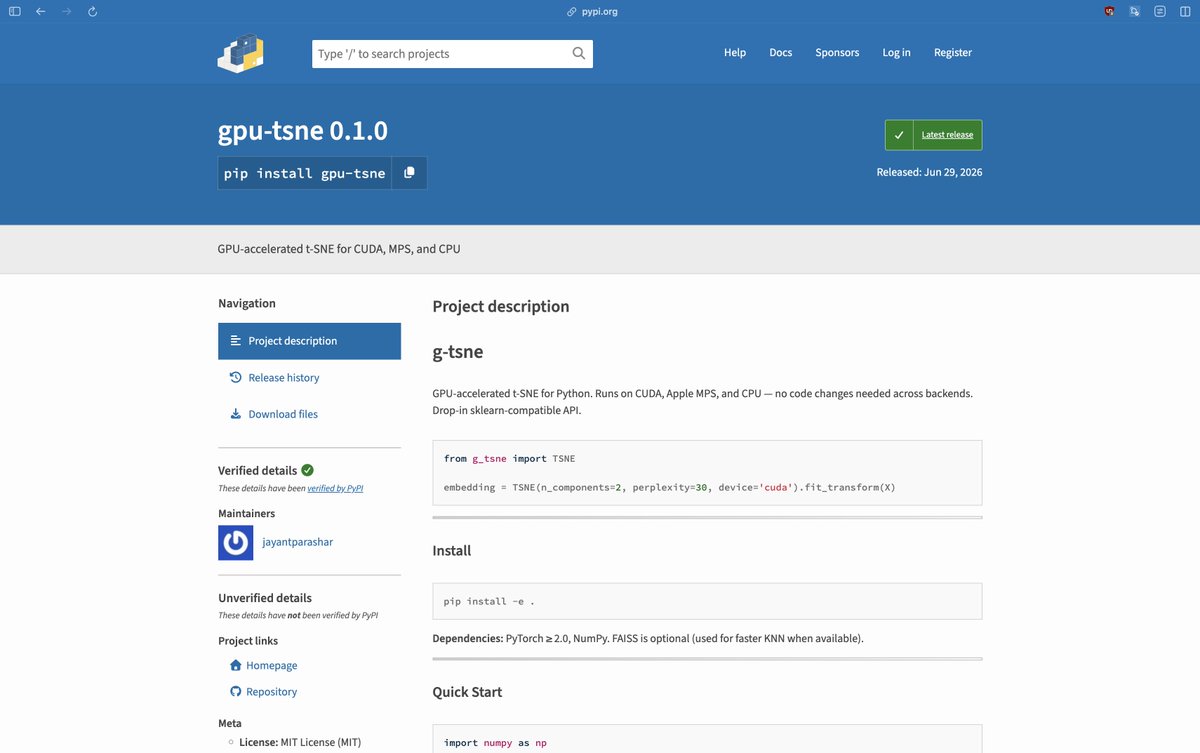
built g-tsne — a GPU-accelerated t-SNE library in PyTorch.
runs on CUDA, Apple Silicon (MPS), with automatic CPU fallback. Drop in sklearn style API, exact gradients for small N and FFT-accelerated for large N.
pip install gpu-tsne
(from g_tsne import TSNE)
Github: https://t.co/6ZcKsSwdK3
PyPi: https://t.co/Tr1OWaJyT3
Anthropic 2026 Hiring Announcements:
May 19th: Andrej Karpathy
June 19th: John Jumper
July 19th: Alec Radford
August 19th: Jeff Dean
September 19th: Alan Turing (resurrected by Fable 5)
A bit of news: After nearly 9 years, I have decided to leave Google DeepMind and join Anthropic (after taking some time to recharge). I am incredibly grateful for my time at GDM. @demishassabis took a real chance letting me lead the AlphaFold team just six months after finishing my PhD, and the entire GDM team taught me so much about how to do great science. GDM is a special place, and I’ll still be excited to hear about what amazing things they discover next.
world models are the next big thing coming up for ml researchers and engineers, just like Attention Is All You Need. optimized self-supervised learning is next big thing.
Working on Visdom as part of GSoC 2026 under @fossasia !
Before diving deep into the main project, we're spending time on a maintenance release to fix real bugs reported by the community.
This includes:
• Float image rendering issues
• Plot layout problems
• Scatter label support
• Server startup edge cases
• And a few long-standing TODOs
Nothing flashy, just making the tool more reliable and work correctly for how people actually use it. Excited for the bigger improvements ahead!
Trying to use AI for coding in research is shit. It can find details but the implementation sucks. I vibe-coded a fully productive app with agents for my Google Workspace, but when asked to write a small data pipeline to download the data, it failed and used some unrelated library even when the correct library and function were mentioned.
Just read the SimCLR paper for the image-based self-supervised work I’m doing.
It’s a nicely simple framework: standard ResNet, a small nonlinear projection head you throw away after training, strong data augmentations, and NT-Xent contrastive loss. The results are surprisingly strong.
That said, it’s noticeably more memory-hungry. The method really benefits from large batch sizes (4096 and up), which ends up requiring quite a bit of compute power.
Now reading Meta’s DINOv2, which seems far more memory-efficient by comparison. Will share some thoughts on it soon.
Still digesting the trade-offs.
Paper link: https://t.co/se5zHI3PXW
@skvdst@IITKgp Thank you for sharing the GRISHMA Summer Research Program opportunity! I’m very interested in applying but I’m unable to receive the OTP for email verification on https://t.co/Joar2mNbgw. I’ve already emailed the team ([email protected]) about this.
Software horror: litellm PyPI supply chain attack.
Simple `pip install litellm` was enough to exfiltrate SSH keys, AWS/GCP/Azure creds, Kubernetes configs, git credentials, env vars (all your API keys), shell history, crypto wallets, SSL private keys, CI/CD secrets, database passwords.
LiteLLM itself has 97 million downloads per month which is already terrible, but much worse, the contagion spreads to any project that depends on litellm. For example, if you did `pip install dspy` (which depended on litellm>=1.64.0), you'd also be pwnd. Same for any other large project that depended on litellm.
Afaict the poisoned version was up for only less than ~1 hour. The attack had a bug which led to its discovery - Callum McMahon was using an MCP plugin inside Cursor that pulled in litellm as a transitive dependency. When litellm 1.82.8 installed, their machine ran out of RAM and crashed. So if the attacker didn't vibe code this attack it could have been undetected for many days or weeks.
Supply chain attacks like this are basically the scariest thing imaginable in modern software. Every time you install any depedency you could be pulling in a poisoned package anywhere deep inside its entire depedency tree. This is especially risky with large projects that might have lots and lots of dependencies. The credentials that do get stolen in each attack can then be used to take over more accounts and compromise more packages.
Classical software engineering would have you believe that dependencies are good (we're building pyramids from bricks), but imo this has to be re-evaluated, and it's why I've been so growingly averse to them, preferring to use LLMs to "yoink" functionality when it's simple enough and possible.
Thrilled to apply for @fossasia GSoC 2026 with mentors @marcoagutier@mariobehling@norbusan!
I'm proposing PyTorch-Native Deep Integration & Auto-Logging for Visdom. I've already opened 3 PRs (#966, #973, #1003) with full Lightning integration, GradientNormCallback, and unit tests.
Super excited to contribute more if selected! 🤞
#GSoC2026 #FOSSASIA #PyTorch #OpenSource
Just walked out of computer networks exam… bro I was running on 0 sleep and completely blanked on the data link layer error detection/correction question 😭 mid sem ruined fr.
Fun fact: Cloudflare's crawler dodges its own defenses
• Built to enable Always Online + performance checks
• Internally verified → skips Bot Management, AI blocks & strict WAF rules
• Ignores external-style restrictions like robots.txt blocks
• Just works quietly for Cloudflare customers 🚀 #WebSecurity
Introducing: Zed for Students! 🎓
Enjoy Zed's Pro plan free, for a year, if you're a current university student (or teacher!)
- Zed Pro features for 12 months
- $10/month in token credits
- Unlimited edit predictions
Apply today: https://t.co/YE6suEkB2U