Our predictor was trained primarily to make repeated inference-time steering computationally practical. NetMHCIIpan provides a separate-model check, not a claim of training-data independence. Our head uses IEDB eluted-ligand data only, excludes binding affinity data; We treat the agreement as supporting computational evidence, with direct immunogenicity assays underway.
Protein immunogenicity is a major driver of drug failure in the clinic, a problem especially important in the age of generative AI when we can design de novo medicines with desired function.
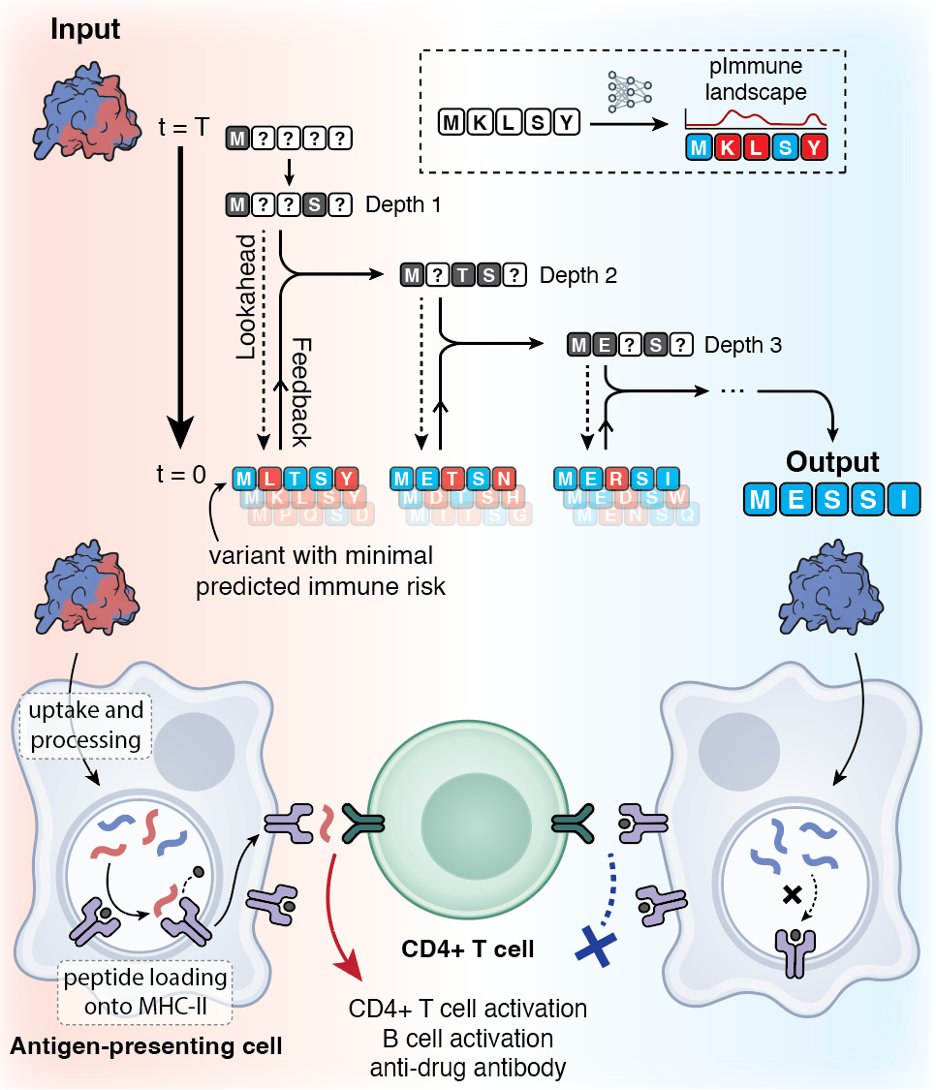
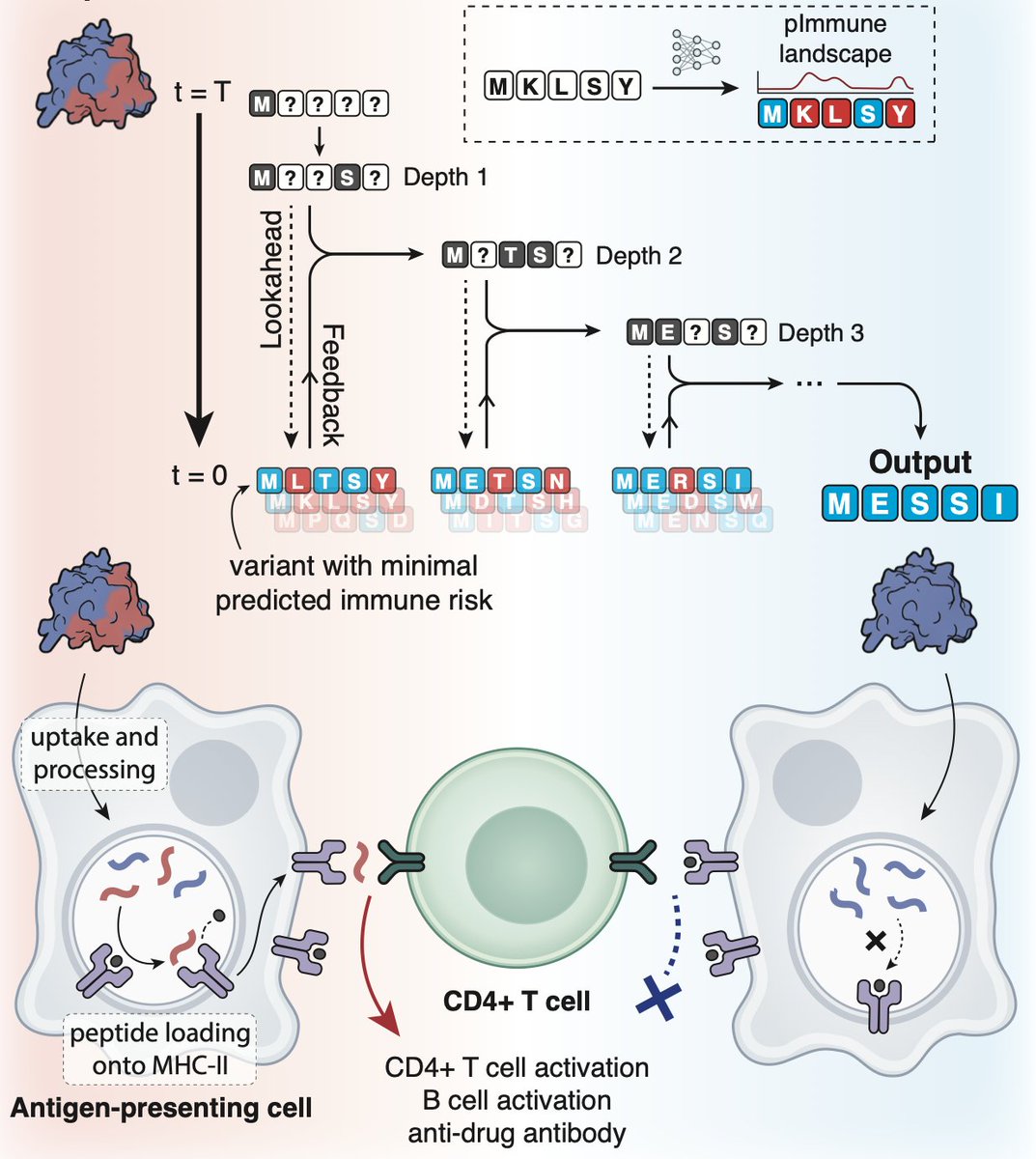
Meet 🐐MESSI: a generative method for deimmunizing proteins with discrete diffusion. We reduce predicted MHC-II epitopes and experimentally validate retained or improved function in luciferases, PD-1 binders and uricases—an enzyme family used in FDA-approved therapies.💊
Watch the story below:
1/n 🧵
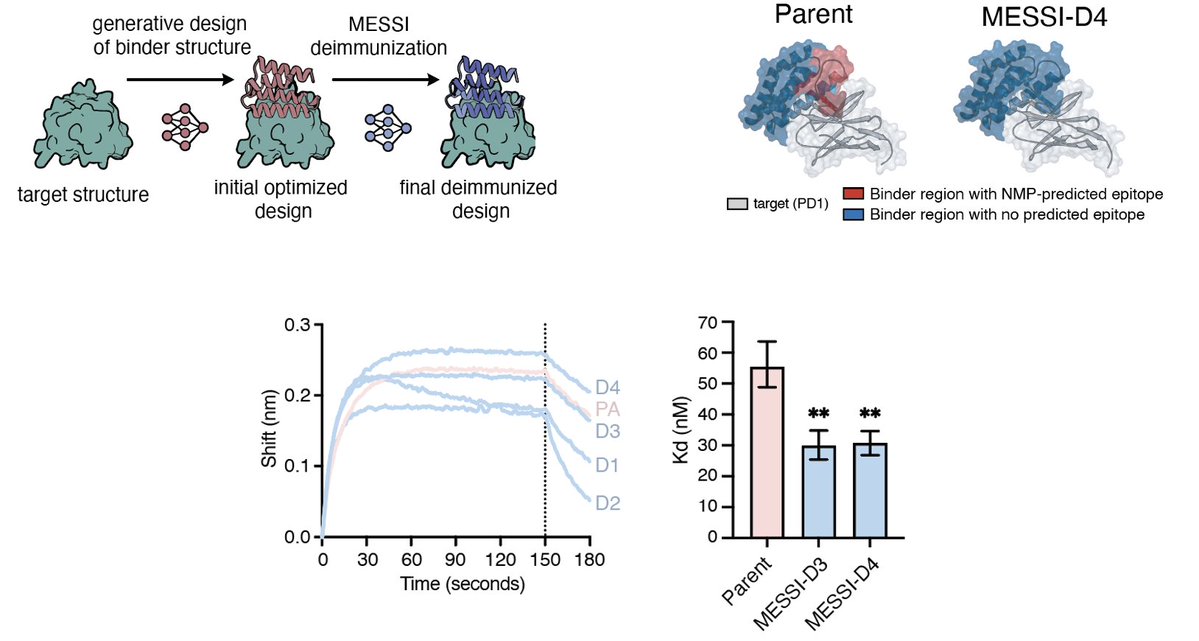
Thanks! Completely agree that the paired functional data matter. In the anti-PD-1 panel, all four redesigns showed higher cell-free expression and retained binding; both variants tested by multi-concentration BLI had tighter binding than the parent (Fig. 4). We also report paired, expression-normalized uricase activity (Fig. 5). SEC/nanoDSF aren’t included in this current version of preprint.
Thanks! Antiviral protein binders are a plausible application: MESSI redesigns sequences around a structural scaffold, rather than being trained for a particular therapeutic target. Our binder example targets PD-1 and could be any given structure, so antiviral binding and activity would still need validation but seems to be interesting to try with! Peptides are more case-dependent: structured peptides may be suitable, while short, flexible or chemically modified peptides are outside what we’ve validated.
Generative protein design is transforming macromolecular drugs, but de novo designed therapeutics could still be hindered by immunogenicity in the clinics. Excited to introduce MESSI, a discrete diffusion model for generative protein deimmunization.
Protein Deimmunization with a Generative Diffusion Model
1. The paper introduces MESSI, a structure-conditioned discrete diffusion model that generates protein sequences predicted to preserve a given backbone while eliminating MHC class II (HLA-DR) peptide presentation risk—often down to 0 predicted epitopes for a specified allele.
2. Key technical idea: inference-time “lookahead–feedback” steering for discrete diffusion. From a partial denoising state, MESSI samples multiple full sequences (lookahead), scores whole-protein and residue-level immune risk, then “reopens” high-risk positions (masking them again) while keeping low-risk choices as generative memory (feedback), iterating to progressively lower epitope burden.
3. To enable fast closed-loop steering, the authors train an allele-specific immune-risk predictor directly on IEDB MHC-II eluted-ligand MS data (12–25 aa windows) with both window-level and residue-level supervision, producing a local risk landscape for targeted edits plus a global score for candidate selection.
4. Benchmarking vs NetMHCIIpan-4.3: the learned predictor matches ROC-AUC while better capturing residue-level risk patterns (higher Pearson correlation with ligand coverage) and is reported up to ~1,500x faster, GPU-compatible—critical for coupling to generative sampling.
5. Large-scale design tests across 211 proteins and 3 HLA-DRB1 alleles (04:01, 07:01, 15:01) show MESSI shifts the design distribution toward lower predicted immune risk while maintaining strong structural recovery (e.g., scTM > 0.7 across tested proteins), outperforming post-hoc filtering of unguided inverse folding and reducing variance seen in unconstrained ProteinMPNN designs.
6. Multi-allele proof-of-concept: MESSI can be constrained against two alleles simultaneously (DRB1*04:01 and DRB1*07:01), producing sequences with reduced risk for both, suggesting a path toward broader population coverage (while noting the scaling challenge to many alleles/loci).
7. Experimental validation 1 (enzyme): MESSI deimmunizes a de novo luciferase (LuxSit-i) by fixing 22 catalytic/pocket residues and redesigning the rest. Five variants at ~53–57% identity retain near-identical predicted folds and achieve 0 predicted epitopes for DRB1*15:01; all show detectable luminescence in cell-free expression, with one variant matching parent activity.
8. Experimental validation 2 (binder): MESSI is inserted into the BindCraft pipeline to redesign a PD-1 minibinder while fixing 57 hotspot contact residues. Four designs achieve 0 predicted epitopes (DRB1*15:01), maintain high complex confidence (iPTM > 0.9), express better in cell-free E. coli, and show measurable binding by BLI; two variants improve affinity, with a best reported Kd ~30 nM.
9. Experimental validation 3 (clinically relevant enzyme): MESSI deimmunizes uricase, motivated by ADA issues in approved rasburicase/pegloticase. Across 11 diverse uricase orthologs, designs reduce predicted epitope counts (NetMHCIIpan evaluation), sometimes to 0 (e.g., G. max and D. radiodurans), while retaining activity in IVTT Trinder assays; some variants show higher normalized activity than wild type (best S. scrofa redesign ~2.7x).
10. Discussion emphasizes MESSI as an “immunogenicity-aware inverse folding” module compatible with modern generative design, highlights future needs (DP/DQ coverage, many-allele scaling, TCR recognition/self-similarity, B-cell epitopes and aggregation/stability), and suggests personalized design against patient HLA genotypes or rotating epitope-distinct sequence reservoirs for repeat dosing.
💻Code: https://t.co/v8wLm4KthX
📜Paper: https://t.co/2Va8vFCrY4
#ProteinDesign #DiffusionModels #GenerativeAI #ComputationalBiology #Immunology #Deimmunization #MHCII #HLA #Biologics #TherapeuticProteins #InverseFolding #ProteinEngineering #DrugDevelopment
Yes on the cross-predictor check: the 211-target benchmark was also evaluated with NetMHCIIpan-4.3, an orthogonal predictor not used for steering. MESSI is guided by our learned immune-risk model. Direct immunogenicity assays are underway; the wet-lab results in the current preprint validate retained protein function, and predicted immunogenicity.
Thanks for highlighting this important precedent, which we cite in the paper. MESSI focuses on recursive immune-feedback steering of generative models at inference time. We agree that predicted epitope reduction cannot replace direct immunogenicity measurements; those assays are underway. And thanks for mentioning your discovery!
Bringing the computational ideas and experiments together was very much a team effort.💪
Huge thanks to Kaiyi @idmjky for the original idea and for leading the project! and to my co-first author and wet-lab collaborator, Chih-Chieh (Jay) Yu, for working so closely with me throughout.🧪
Thanks also to Cai Zhou @zhuci19 for helping develop the algorithm, and to Xinyun Jiang and Long T. Nguyen for their contributions to the experimental work. I’m also grateful to Cameron Myhrvold @cambearon and Tommi Jaakkola for their generous support. And thanks to @PrincetonPLI , @omenndarlingbio@EPrinceton for supporting this work.
Grateful for everything I learned through this collaboration, and for the chance to build this work together.🥹
A protein's function is not tied to a single sequence. That creates room to search for new encodings that retain useful biology while reducing immune liabilities.
MESSI makes this search part of generation: structure and functional constraints specify what must be protected, while immune feedback helps guide what can change.
From de novo designs to nature's evolutionary repertoire, our goal is to make immune compatibility a design dimension of future protein medicines.👁️🗨️💊
8/n
Rediscovering uricase potential across nature's diversity.
Humans lost functional uricase during evolution, but nature offers thousands of alternative sequences for the same catalytic task. Uricases already underpin FDA-approved therapies, yet immunogenicity remains a challenge.
We explored a tree of 3,034 uricase sequences spanning more than 20 phyla and tested 11 natural orthologs. All 11 were active, giving us diverse functional starting points with different epitope burdens and different opportunities for redesign.
With catalytic, tetramer-interface and evolutionary constraints, 7 of the 11 backgrounds yielded redesigns with near-WT or higher activity. Soybean and D. radiodurans variants combined zero epitopes with retained catalytic activity, normalized to enzyme concentration.
Nature supplies multiple ways to encode the function. MESSI lets us explore that diversity with immune awareness.
7/n
An immune-aware sequence-design step for BindCraft.
Building on BindCraft, developed by Martin Pacesa (@MartinPacesa), Sergey Ovchinnikov (@sokrypton) and colleagues, we replaced its sequence design step with MESSI to redesign a PD-1 binder while protecting its binding interface.
All four variants reached zero epitopes, expressed at higher concentrations than the parent in our cell-free system, and retained detectable binding to PD-1. Two also improved affinity, with the best reaching a Kd of about 30 nM in multi-concentration binding measurements.
Immune-aware redesign can fit into an existing binder-design workflow while preserving the interaction the binder was designed for. 🔩⚙️
6/n
Re-encoding a functional luciferase.
We redesigned LuxSit-i, a de novo light-producing enzyme, while protecting residues important for catalysis and the substrate pocket. The five designs share only 53-57% sequence identity with the parent and all reach zero epitopes.
We then made the proteins and measured their light production. All five had detectable activity; one, MESSI-D2, retained parent-like luminescence despite changing nearly half the sequence.
This is functional retention after extensive sequence rewriting, measured directly in the lab.
5/n