A new research article from the TI Lab.
https://t.co/WrF7WICzh6
In this article, we reveal the molecular mechanism by which a specific tubulin isotype renders cancer cells resistant to paclitaxel, a WHO-listed essential medicine for cancer treatment.
Very pleased that after a rigorous (and lengthy) review process, our paper visualizing how myosin generated forces modulate actin filament structure for mechanosensitive recogntion by α-catenin has appeared in @Nature
https://t.co/gzEziWL8aB
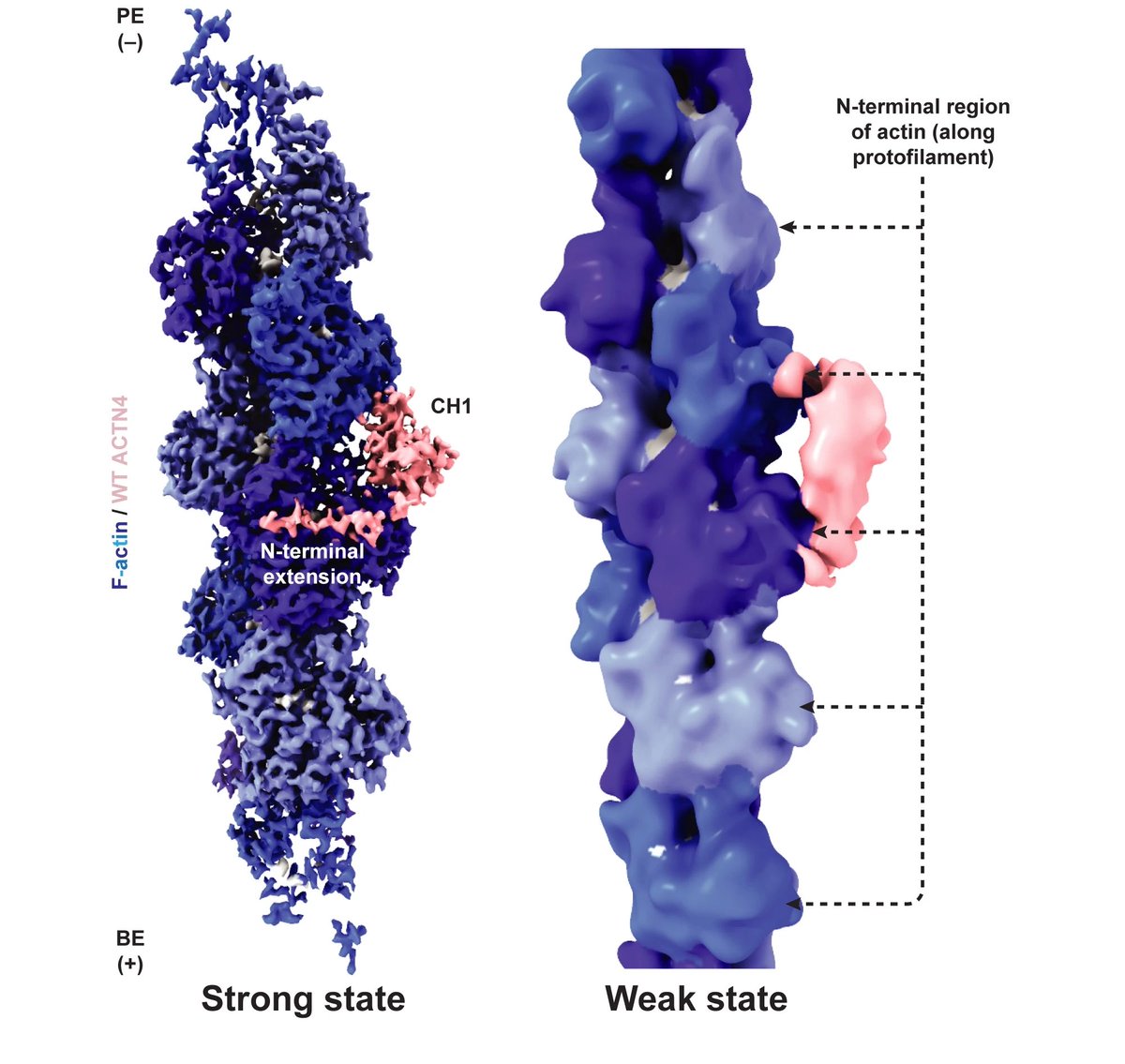
Very excited to share our latest preprint, where we visualize the impact of force on the catch bonding actin crosslinker α-actinin-4. Led by @alfredcchin, a great collaboration with Glen Hocky's lab.
https://t.co/7GoQA85Nhz
Two weeks left to apply for a PhD with us at MRC-LMB in Cambridge. Join our team for an exciting project on transcription-coupled splicing to understand human gene regulation 🧬 Feel free to get in touch directly #PhD#cryoEM#biochemistry
https://t.co/Ud5RRaw5Px
which then determine the accessibility of the lumen to an luminal enzyme. This study opens new avenues to understanding the roles of microtubule building blocks in diverse biologically relevant mechano-environments.
regulate the accessibility of the confined microtubule lumen remain elusive.
In this paper, by employing optical tweezers, cryo-EM, computer modeling, and single-molecule fluorescence microscopy, we found that tubulin isotypes can regulate how microtubules respond to forces,
Cytosolic CRISPR RNAs for efficient application of RNA-targeting CRISPR-Cas systems | EMBO reports https://t.co/5s2KPR2S88 Our paper is out in @emboreports! 1/n
We are delighted to announce that the 3rd DivIDE Conference will take place from 22–25 September 2025 with a fantastic lineup of speakers.
Registration opens soon - stay tuned and help us spread the word!
We are looking forward to meet many of you in Barcelona! ☀️
Excited that the peer-reviewed version of our fascin structure paper is now out in @NatureSMB. Thanks very much to the referees for their constructive feedback. https://t.co/awfbPda6TN
With help from @RuiZhangWUSTL we have successfully adopted Rui's protocol to achieve high-resolution cryo-EM 3D reconstruction of undecorated microtubules polymerized from recombinant tubulin. Please see the following user-friendly version of the workflow.
https://t.co/xlcB52FdkX
I want to take the opportunity to mention that I've written a slightly more user-friendly tutorial for the original microtubule seam-search protocol, together with other useful MT processing tricks.
https://t.co/Uzh7SuD4zR
https://t.co/ntPpfOdxie
The latest research article from Ti Lab. We employed cryo-EM structural analysis, single-particle fluorescence microscopy, and recombinant tubulin to reveal how tubulin acetyltransferases modify the K40 residue inside the microtubule lumen. (1/N)