Ego or money. Which one do you actually want.
Had to ask myself that a long time ago. Got more personal than usual on this one with Mat Yarger, talking trust, my mother's one-liners, and handing my son a hammer before he could even walk.
🎧 The Future of Trust: https://t.co/3j7SnbmeEe
T+1 will do more than shorten settlement times.
It will expose where outdated infrastructure creates friction, risk and cost across capital markets.
@SteveDurbin explains why the shift matters:
https://t.co/IBcDeP4YPM
What you get when you remove corrupted intermediaries: the user pays actual cost, the worker keeps actual earnings and the middle stops collecting rent.
More and more, end users don't even know stablecoins are settling their transactions. Could be VISA cards issued through Rain or savings circles in our Komiti app.
This is how infrastructure is supposed to work. Invisible to the user, transformative underneath. The user just uses it, our architecturally gas-free settlement layer does the work.
This is the regulatory perimeter taking shape.
The FDIC’s latest proposal adds BSA, AML, sanctions, reporting, supervision, and enforcement expectations for stablecoin issuers it regulates.
That matters because stablecoin issuance is moving from a product question to an operating model question.
Who has real monitoring?
Who can screen at scale?
Who can satisfy examiners?
Who can prove the controls work?
The answer will separate serious issuers from everyone else.
The FDIC proposed BSA and sanctions standards for stablecoin issuers it regulates.
This is the third rule in the sequence.
Application process.
Capital, liquidity, and risk.
Now AML, sanctions, reporting, supervision, and enforcement.
Stablecoin issuers are being pulled closer to the banking compliance perimeter. Not light-touch oversight.
Firms with real transaction monitoring and sanctions screening will have an advantage. Firms without it are looking at a serious build.
https://t.co/xQFTsdg22S
Tokenization is getting more practical.
The push to tokenize real-world assets in Saudi Arabia is a useful signal for where blockchain infrastructure may be headed: ownership records, settlement, collateral, and asset transfer.
Still a lot to prove, especially in regulated markets. But the strongest use cases are tied to real assets, clear records, and systems that need transparency without unnecessary complexity.
At @RYTchain, this is the broader shift we’re watching.
https://t.co/a3cDK1lHp6
Talent is equally distributed. Opportunity isn't.
That's the problem we're trying to solve. AI built into Layer 1 blockchain infrastructure can deliver financial products to people who have never had access to them — that's not a distant vision, it's where the technology is heading.
Had a good conversation with Mark Smith on the AI Unfiltered podcast covering that, where we actually are on the AI S-curve, and why regulatory fragmentation remains the biggest brake on real progress.
https://t.co/E7V120UKLh
Institutional adoption of digital assets is increasingly becoming an infrastructure discussion.
The focus across global markets has shifted toward tokenized assets, stablecoin settlement, and compliant blockchain-based financial systems capable of operating at scale.
The next decade will likely be shaped by the institutions and jurisdictions building the foundations for that transition today.
Wall Street has moved past crypto exploration.
Now it is focused on implementation.
Tokenized assets, stablecoin products, bitcoin-backed lending, and 24/7 markets are becoming part of the institutional roadmap.
The real question is who builds the rails.
The flagships are being chosen now.
#crypto #RYT @RYTchain
https://t.co/WsMgDH3z0F
Drex is Brazil's CBDC project. In August 2025, after two pilot phases, Banco Central confirmed Drex would launch on centralized architecture, not the blockchain platform it had piloted, citing privacy and costs.
Buried in that decision was a critical insight: Privacy as a bolt-on doesn't work at production scale.
The most useful filter I have for evaluating early stage tech:
Most failed innovation tries to solve a future problem, not today's. It tries to change user behavior rather than work with it. And it tries to fix everything instead of one thing well.
Real adoption fits into what people already do.
https://t.co/52bDciqjX3
1.4 billion people are unbanked.
What gets missed is what those communities built without a bank: Savings circles. Hundreds of millions use it.
Here's how stablecoins can make them better - https://t.co/dwCmRLPSPe
TRON announced they're deploying post-quantum cryptography on mainnet. If they execute, first major blockchain to ship quantum-resistant signatures in production.
Real engineering challenge: quantum-safe signatures are 50x larger. Means slower transactions, higher costs. TRON's billions in daily stablecoin volume = perfect stress test.
Smart timing. Their technical decisions on algorithms, signature handling, migration will inform how everyone else approaches this inevitable upgrade.
https://t.co/DzLYx7hPBo
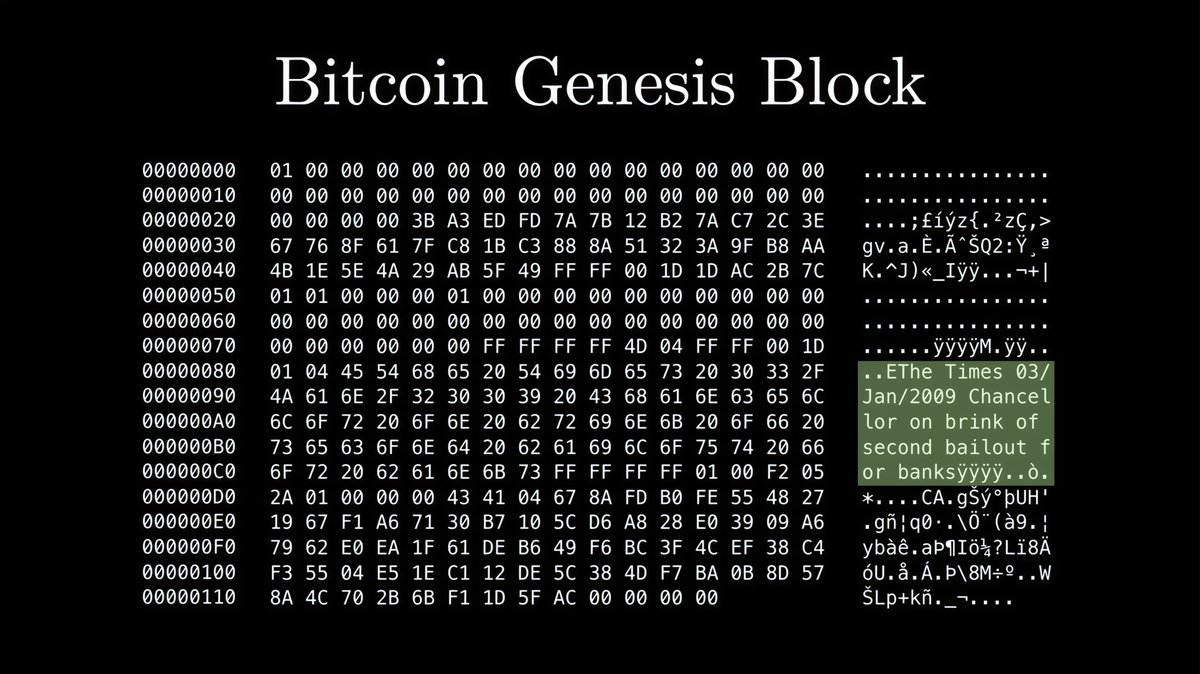
Seventeen years later, the bailed-out are the largest beneficiaries of the technology built to route around them $BTC.
The whole arc:
https://t.co/x9s3Pjd6Hv
Four years ago Anchor held $17 billion in deposits and pitched 20% APY as a savings product to people who'd never bought a token before.
When UST collapsed in May 2022, the industry didn't just lose money. It lost permission to ask normal people to trust it with their savings.
That's the wound that never healed:
https://t.co/97rb7PYt8L
RYT's identity infrastructure uses W3C Verifiable Credentials and zero-knowledge proofs.
Those are terms that get thrown around a lot in blockchain identity so this thread explains what they actually mean for the person holding the credential and the government issuing it.
@Visa stepping in as a validator on @CantonNetwork is a signal about where financial infrastructure is actually heading.
The real issue for institutions has not been speed or cost. It has been control over data.
They want shared systems so they can coordinate and settle efficiently. At the same time, they need to control who sees positions, flows, and counterparties.
Canton moves in that direction. It allows participants to operate on shared rails while keeping data private.
If this model scales, it changes how financial networks connect. You get interoperability without exposing sensitive information.
That is a much more practical path for institutional adoption than forcing everything onto fully transparent systems.
https://t.co/f7kGvoU3tm
Good to see @RYTchain included in this conversation.
The shift toward government infrastructure is real, and the industry is starting to recognize which systems can actually support it at scale.
National identity, payments, and capital markets require a very different level of performance, predictability, and accountability.
Appreciate the coverage from @hackernoon as this narrative continues to develop.
https://t.co/sL3BcXmyrT
The Office of the Comptroller of the Currency is opening a path for crypto firms to obtain national trust bank charters.
@Ripple and @cryptocom are already pursuing approvals.
National trust charters allow crypto firms to operate regulated custody and payment services inside the U.S. financial system.
Traditional banks are pushing back. They see new entrants gaining access to financial infrastructure without following the same legacy models.
Crypto companies now face a different set of expectations.
➡️ Regulatory oversight increases.
➡️ Operational standards increase.
➡️ Accountability increases.
The next phase of the industry will depend on execution inside regulated environments.
Platforms that support compliance, reliability, and scale will define the outcome
https://t.co/z1uby64LV3
It’s an interesting hypothesis. If autonomous systems begin executing transactions and interacting with protocols on behalf of users, blockchain could increasingly function as infrastructure for machine-to-machine activity.
But the more autonomy we give AI systems, the more important oversight and accountability become. As I’ve said before, AI can easily operate at a pace that outstrips human supervision, creating an accountability gap when too much decision-making rests on a single model.
That raises a bigger question: if AI agents begin interacting with blockchain networks at scale, what does meaningful oversight actually look like?
Will AI agents become the primary users of blockchain?
A recent @CoinDesk article explores this idea, with NEAR co-founder Illia Polosukhin suggesting that autonomous AI agents could eventually interact with blockchain networks more than humans do.
If AI agents begin executing transactions, managing assets, and interacting with protocols on behalf of users, it could fundamentally change how people access blockchain infrastructure.
But is that where the technology is actually heading?
Curious how others are thinking about the intersection of AI and blockchain — will agents become the dominant users of decentralized networks, or will humans remain at the center?
https://t.co/eDZQ4l5Z5O
#AI #Blockchain #Web3