We discovered that the skull bone marrow has direct connections to brain surface & mirrors brain inflammation, making it a new site for diagnosing & monitoring brain pathologies.
Kolabas…Ertürk, Cell:
https://t.co/uymKr3tRMg
https://t.co/xZmKU9nLBs
https://t.co/75ib4gCe5K
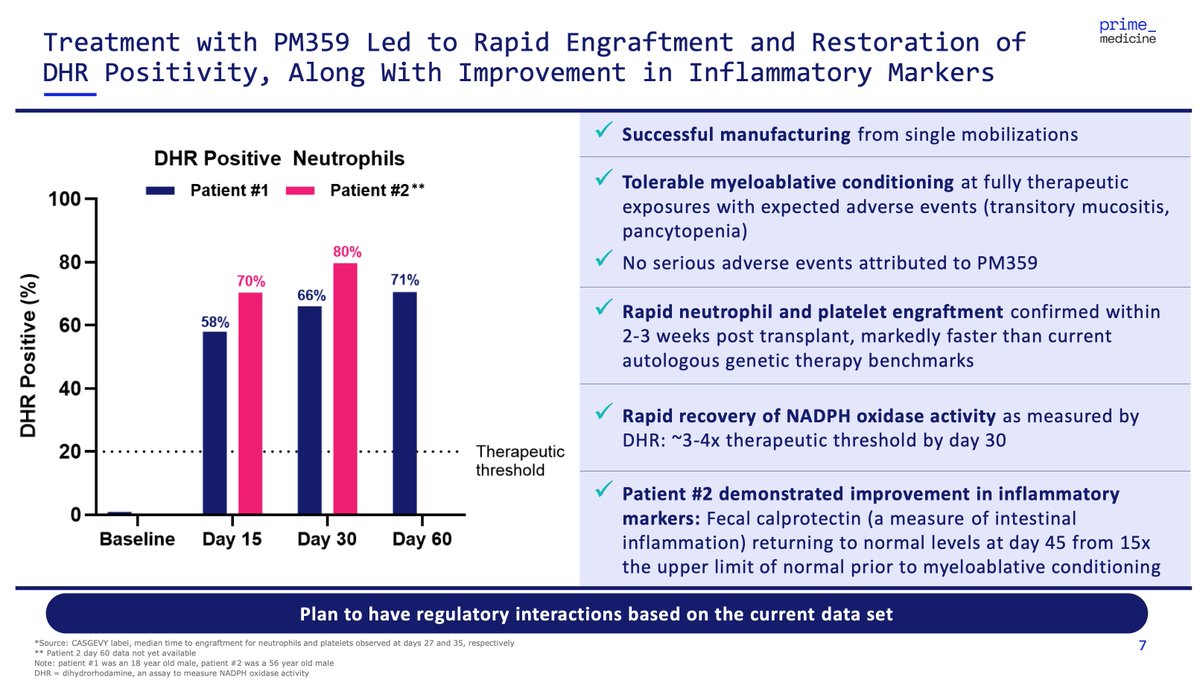
Data from the second human treated with a prime edited medicine: a 56-year-old male with chronic granulotamous disease (CGD) had his bone marrow prime edited to insert the missing GT in NCF1, restoring NADPH oxidase function in neutrophils (DHR positivity) several fold beyond the therapeutic threshold. His intestinal inflammation is now normal, and his prime-edited HSCs rapidly engrafted with 15 days post-transplant, consistent with well-tolerated editing.
Each new therapeutic technology is dependent on brave patients willing to be among the first humans to receive a new type of treatment. For prime editing, that's this patient, and an 18-year old who also responded in a similarly encouraging manner.
Patient #2 sent our lab a kind message, noting that helping other patients with rare diseases was deeply meaningful to him.
Data from @PrimeMedicine.
Very promising news on the next seven-year EU budget, with a proposed substantial increase for Horizon Europe including the ERC.
We are analysing the other parts of this proposal in more detail.
@Vonderleyen@EZaharievaEU
https://t.co/Ak8XiokMRI
We mourn the loss of our beloved department member, Prof. Zelig Eshhar — a visionary immunologist and pioneer of CAR-T cell therapy. His groundbreaking work revolutionized cancer treatment and gave hope to countless patients.
To me, this is the most remarkable thing about global health: With a relatively small amount of money, you can do a great deal of good for a great many people. This is money well spent, and we should go back to spending it—now.
There's still time to register for the CRISPR-Cas9 workshop - registration has been extended. Participate to the second CRISPR-Cas9 workshop in the beautiful city of Sorrento, featuring renowned scientists from around the globe! https://t.co/IeD4lV3J6V
We're thrilled to be organizing a CRISPR-Cas9 workshop in the beautiful city of Sorrento, featuring renowned scientists from around the globe!
https://t.co/IeD4lV3J6V
Never could I have imagined that ABE would someday enable such a transformative outcome for a child. Thank you @kiranmusunuru, Rebecca Ahrens-Nicklas, and KJ’s family for having the courage to demonstrate to the world what is possible. Incredible. 💕
https://t.co/U2WhZYBQRP via @nytimes
#CRISPR cures on-demand can and will be scaled nationwide.
In this talk at the Oxford-Harrington symposium I argue - with data - that the first nation to do so will be the United Kingdom and describe an actionable path to that goal.
https://t.co/jHVdOIbhcX
@BKleinstiver Congrats. This is an important study assessing the feasibility and safety of „PAMless“ (base) editing for clinical use. It might serve as a compass for many others
*Efficient PAMless base editing in patient-derived HSPCs* 🧬🖌️
https://t.co/fi6qp018J5
For a few years now, we've been collaborating with clinical experts to develop genome editing-based treatments for genetic diseases. It has been a great fortune to work with, and learn from, Dr. Suk See De Ravin and her team at the @NIAIDNews @NIH. Today in @ScienceTM we publish a longstanding collaborative effort with Suk See's team to develop base editing approaches to correct genetic mutations that cause X-linked Chronic Granulomatous Disease (X-CGD). @CGM_MGH @MGH_RI @MassGeneralNews@harvardmed
This collaborative effort was led by Vera Bzhilyanskaya @NIH and Dr. Linyuan Ma @Linyuan79834832 from my group @CGM_MGH, and featured many key contributions from other collaborators (mostly X-less but including @mn_whittaker).
BREAKING NEWS
The 2024 #NobelPrize in Physiology or Medicine has been awarded to Victor Ambros and Gary Ruvkun for the discovery of microRNA and its role in post-transcriptional gene regulation.
Another scientist whose work initially didn't get the recognition that it deserved - Victor Ambros was denied tenure at Harvard, even after publishing the seminal work that resulted in him receiving the Nobel Prize today!
@UrnovFyodor Could not agree more. The editing tools work beautifully. The real challenge is now to bring them to patients and find ways to do so for large but also very small indications. And find sustainble models