@bert_hubert Hmm wat vaag verwoord… Denk je dat ze bedoelen om een nieuwe Nederlandse CA in het leven te blazen of misschien een soort Nederlandse NIST?
@rossjanderson Encrypted data are not like castles: they can be stored until a ‘heffalump’ (quantum computer) emerges and be broken retroactively. Castles, on the other hand, can be fortified: they cannot be retroactively breached.
Still, no one knows for sure if ‘heffalumps’ will exist!
@ZekiErkin@GSmaragdakis@tudelft@CyberSecTUDelft Thanks Zeki! Let’s also give some credit to @CelioM6, and I want to thank @realFWDekker for all the fruitful conversations we had about this topic. It’s been an amazing experience!
@CionnRatz @tudelft If we do we should have LaTeX rendering! 😁 I would join in a heartbeat. Otherwise I am considering joining https://t.co/LI2HeoYeWo.
@m_ou_se@sdowney Until this (https://t.co/jB51O7L7wM) is stable we may have to limit the compiler to a million instructions 😛 Although I suppose fewer instructions means even more safety!
If you are a fan of homomorphic encryption, then try your hand at the secure biometrics competition @daniel_a_vos and I are organizing! Registrations opened today and the data becomes available on Friday next week. (And yes, it involves dogs 🐕)
More at: https://t.co/JT40aCRpUb
@cronokirby We brainstormed about this shortly with some people at #tpmpc, I’m very curious if there are any schemes that do not make it prohibitively expensive when doing rotations, bootstrapping, etc. 😄
This week, @AarhusCrypto is hosting the 2022 Theory and Practice of Multi-Party Computation Workshops at the department - gathering experts from all over the world. Unable to attend? Follow the live stream ➡️ https://t.co/yLcd8c7wab
https://t.co/MvD5nsju8P
In this work we show how to construct multi-party private set operations that function strictly in a star topology 🌟. All protocols rely on the same primitive: A multi-party private OR protocol. Our weapon of choice is ElGamal over elliptic curves.
@cronokirby@CryptoHack__ I recently learned a trick that made safe prime generation a lot faster from studying the openssl code! It turns out you can do some local sieving for (almost) free. I implemented it here (go easy on the crate, it’s a rough first version): https://t.co/kSThiUmqvN
A happy Christmas present 🎁 is that our paper about multi-party private set intersections was published in the IEEE TIFS journal! (with Aslı Bay, @ZekiErkin, @xotoxot, and Simona Samardjiska)
Check it out here [open access 🔓]:
https://t.co/3XkEDyE14u
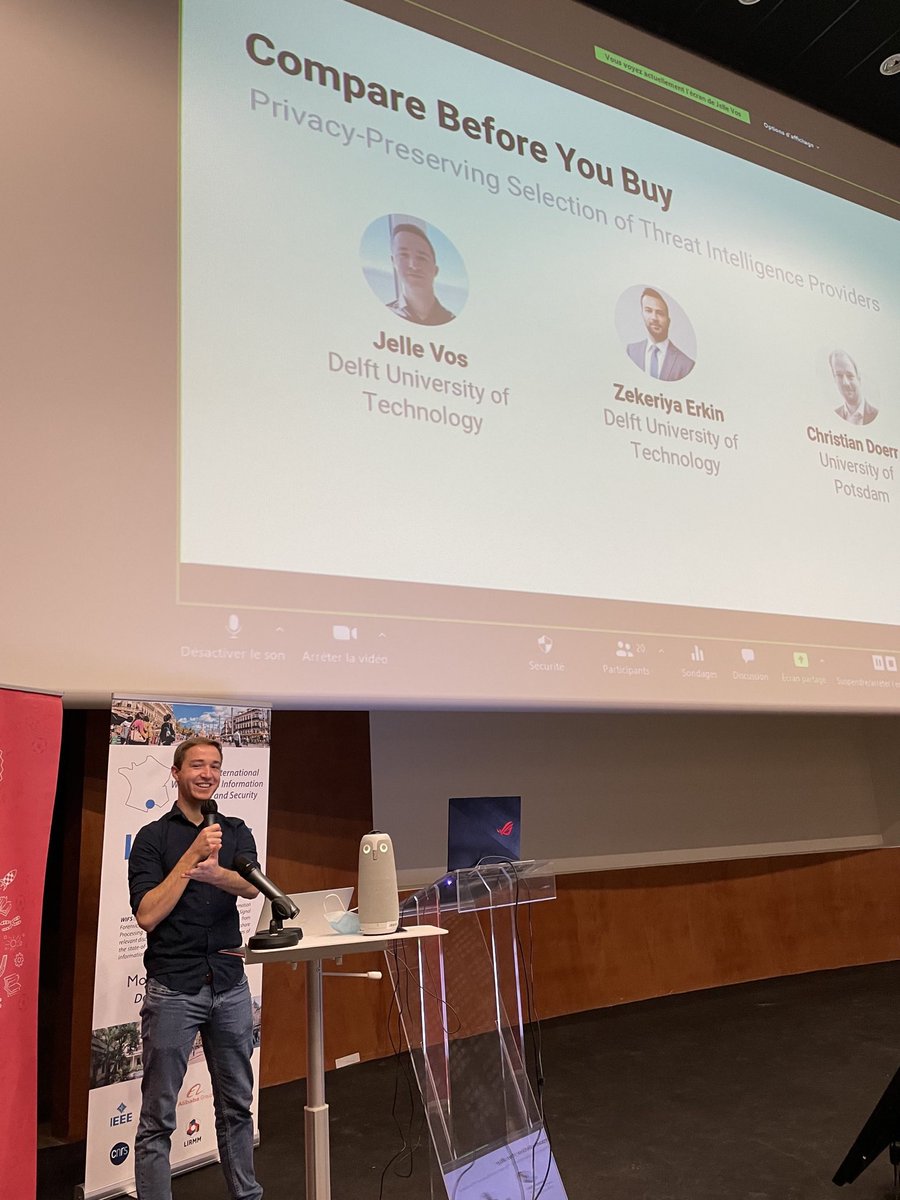
While the conference had to be organized in a reduced form, I am very happy to present our work at WIFS 2021! (Thanks for the photo @ZekiErkin)
I have written a thread about this work before for those who are interested. 🙂 https://t.co/8mDkTcRtZV
I am happy to announce the first paper on which I am the first author! 🎉 Our paper titled "Compare Before You Buy" will be published at IEEE WIFS. @chr_doerr@ZekiErkin
A short thread 🧵
@DucasLeo@BenjWeso Congratulations! 🎉 Would this require us to change the way we choose quantum-secure parameters for e.g. RLWE-based FHE cryptosystems? It is my current understanding that the homomorphic encryption standard uses the lwe-estimator for both LWE and RLWE.