Like many in this industry, I was drawn to crypto because I believe this technology can meaningfully benefit people when it is allowed to develop responsibly: by expanding access to financial services, giving individuals greater control over their assets, supporting open-source innovation that makes financial infrastructure more transparent and secure, and keeping the next generation of finance and the internet in the United States.
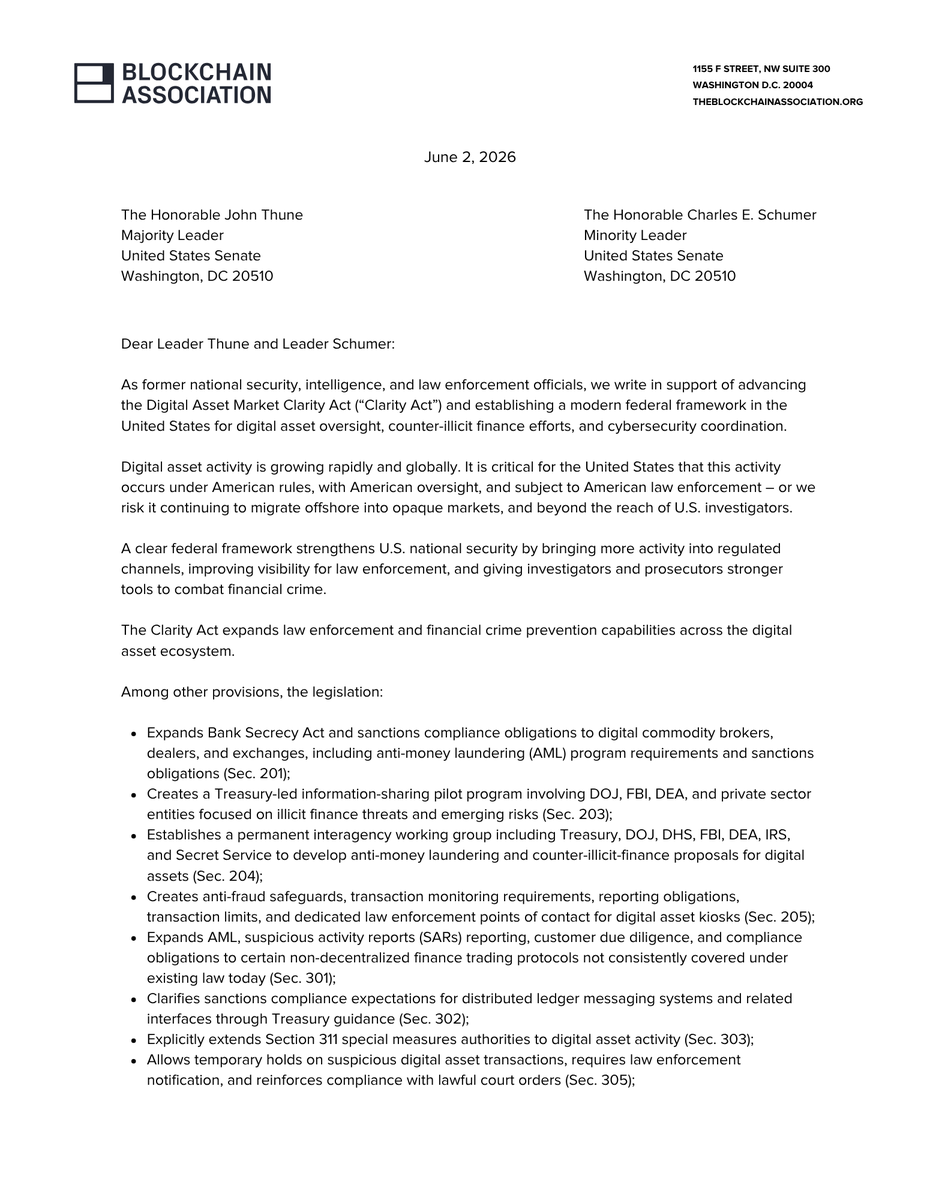
Reading this letter, there is a fundamental misunderstanding about what the Clarity Act does. As a reminder, the Clarity Act:
- applies BSA and sanctions obligations – including SARs reporting – to all digital commodity brokers, dealers, and exchanges (sec. 201)
- creates a new special-measure authority for digital asset-related illicit finance – which gives Treasury significantly stronger tools to combat illicit activity in the digital asset ecosystem (sec. 303)
- brings controlled, ‘DeFi in name only’ protocols into the regulatory perimeter (sec. 301)
- creates a safe harbor for temporary holds on suspicious transactions, allowing stablecoin issuers and digital asset service providers to place short, good-faith holds based on suspected unlawful activity or a written law enforcement request (sec. 305)
- strengthens seizure and forfeiture tools by adding digital assets to the definition of “monetary instruments” in the Bank Secrecy Act (sec. 307)
- requires intermediaries connecting customers to DeFi to maintain risk-management programs addressing money laundering, sanctions evasion, fraud, and market manipulation (sec. 308)
- establishes an information sharing program between private sector entities and federal law enforcement to share information about illicit finance risks and threats (sec. 203)
- creates a federal working group on illicit finance with the mandate to develop proposals to improve anti-money laundering efforts related to digital assets (sec. 204)
And Section 604 does one narrow thing: It prevents non-custodial software developers from being misclassified as money transmitters when they do not custody assets or control transactions.
It does not immunize criminals. It does not limit sanctions enforcement. It does not stop prosecutions for money laundering, fraud, or terrorist financing.
I agree with the signatories of the letter: Regulatory certainty should never come at the expense of accountability, transparency, victim protection, or public safety.
Fortunately, the Clarity Act does not force a choice between innovation and public safety.
Without Clarity, we are left with the status quo: gaps in oversight, no expanded BSA/AML obligations for key digital asset intermediaries, limited tools for federal agencies, and more activity pushed offshore and outside the U.S. regulatory perimeter.
That outcome serves no one. Not consumers, not law enforcement, not responsible innovators, and not the United States.
To the signatories of this letter: We share the same goal. We must hold bad actors accountable. We must protect consumers. We must ensure this technology develops under American rules.
The answer is to pass a framework that brings digital asset activity into the regulatory perimeter, gives law enforcement strong, effective tools, and makes clear that innovation and accountability are not competing values.
We held our largest ever fly-in today with dozens of our members across more than half of the Senate.
Our message: It's time for Clarity.
Thanks to all of our members for joining us today at this critical moment for the industry in Washington.
🇺🇸
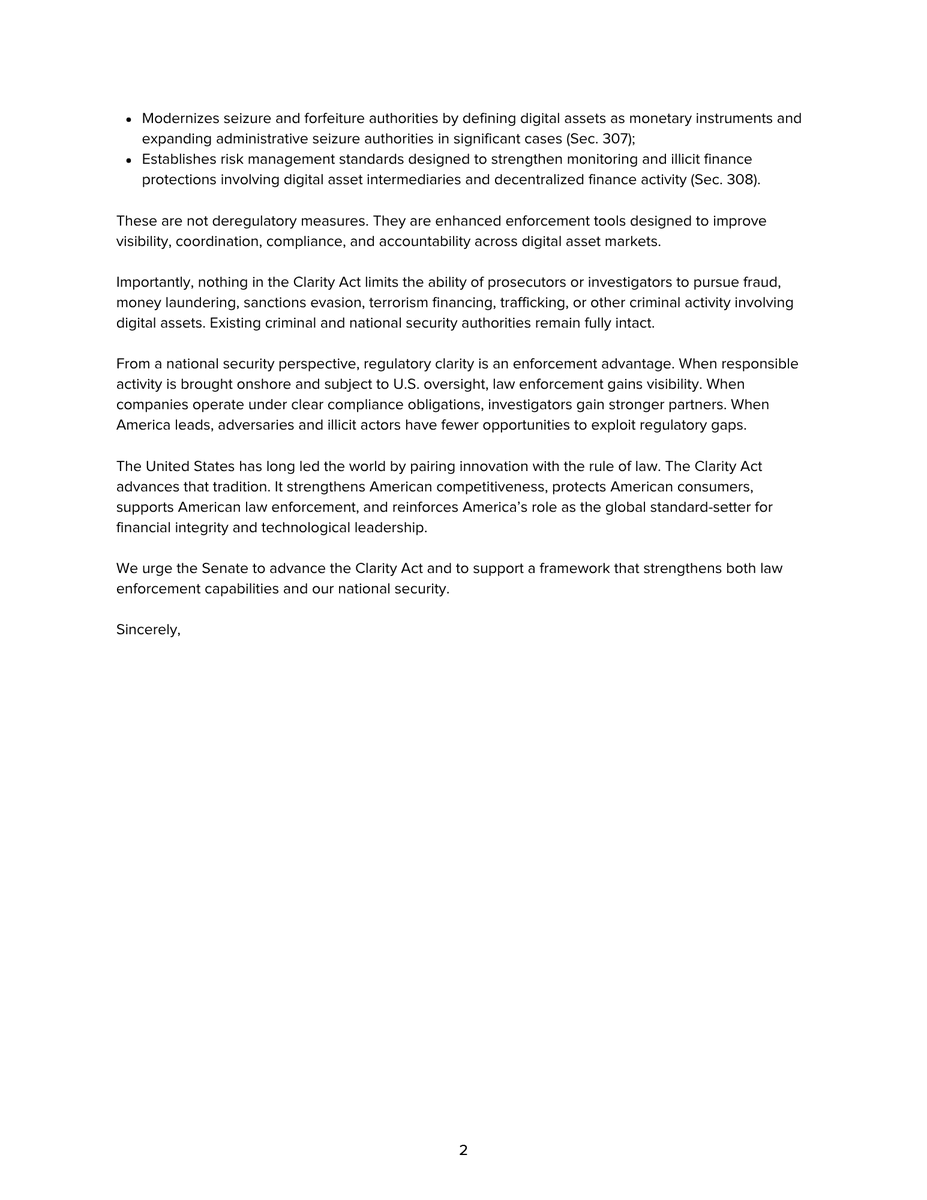
Of course we included members from our 100+ companies with law enforcement and prosecutorial backgrounds – and we clearly identified (page 2) those signatories as Blockchain Association members.
What your search omits are their backgrounds and credentials, which are exactly what make them relevant advocates and signatories on this letter…perhaps unknowingly, you’re discounting their experience and service to our country with your oversimplification below.
It’s a good thing that crypto companies hire former law enforcement, prosecutors, and national security professionals. It shows they take compliance, consumer protection, and security seriously.
1/ Today, we’re sending a letter to Senate Majority Leader Thune and Senate Democratic Leader Schumer signed by 160 former national security, intelligence, and law enforcement professionals in support of the Clarity Act.
https://t.co/1lSQkoaaXI
Thank you to Chairman @RepFrenchHill, Ranking Member @RepMaxineWaters, and the members of the @FinancialCmte for today’s hearing on tokenization.
My message was clear: tokenization can strengthen U.S. capital markets, expand access to investment, and support more modern financial infrastructure – but we need regulatory clarity that reflects how blockchain-based systems actually work.
The United States should lead in shaping these markets.
1/ BA and @vanderbiltlaw are excited to announce the inaugural Digital Assets & Emerging Technology Policy Summit on April 6 in Nashville, TN.
This event will bring together a small group of regulators, policymakers, industry leaders, and academics for a focused discussion on digital asset regulation and market structure.
Confirmed speakers include:
-@SenatorHagerty
-@SECPaulSAtkins
-@ChairmanSelig
Learn more👇
https://t.co/WSs7famZ6q