@JustinPetersMin Proverbs 18:17 “He that is first in his own cause seems just; but his neighbor comes and searches him out.” Principle: The first person’s account may sound convincing until the other person is heard and the claims are examined. Wise ol Solomon!
Exclusive. Regarding Steve Lawson.
We can confirm that the conference organizers advertised Lawson's participation without his knowledge or consent.
They invited him to be a speaker, but before hearing that he intended to decline, there was an internal misunderstanding that led them to assume he would agree.
As soon as he found out about it, he informed them of his declining the offer, and they promptly removed him from the line-up.
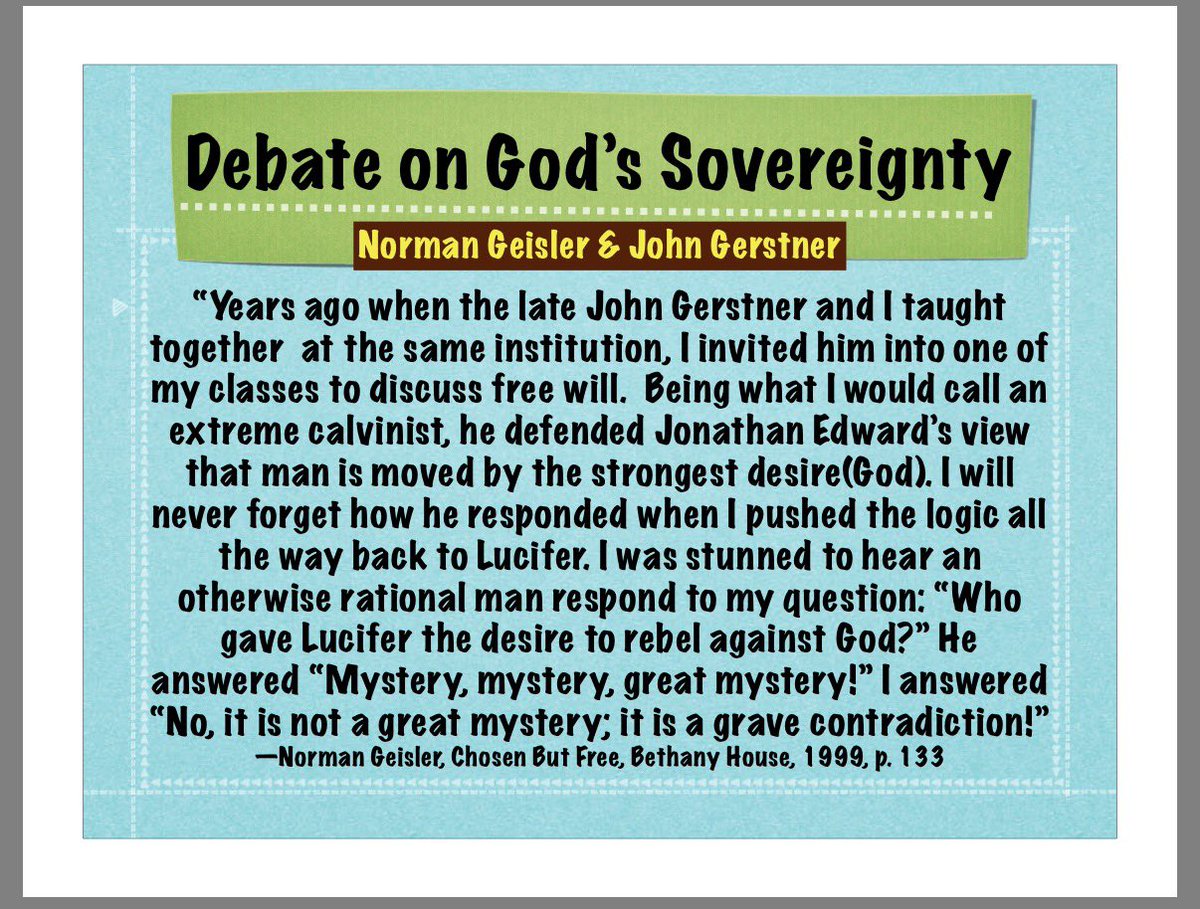
First, Turek slightly misstated the exchange between Gerstner and Geisler. John Gerstner did not argue that “God gives man the desire of his heart” in some crude, mechanical sense, as though desires are injected wholesale. He was defending the Edwardsian point that the will always follows the strongest inclination, and that God, as first cause, orders reality without being the moral agent of creaturely sin. That distinction matters, because it’s exactly where Geisler’s charge fails.
When Norman Geisler asks, “Who gave Lucifer the desire to rebel?” he is forcing a false dilemma. Either God directly authored the sinful desire, or the system collapses. But that dilemma only exists if you flatten all causation into a single category and deny the Creator/creature distinction.
Classical Christian theology has never done that.
Lucifer was created good, upright, rational, and mutable. The desire to rebel did not need to be positively created by God as an evil object. It arose from a finite will turning away from the highest good. God decreed the event; Lucifer authored the sin. Same event. Different causal orders. Different moral ownership. That is not a contradiction unless you’ve already assumed that God and creatures operate on the same moral plane.
Notice Geisler’s sleight of hand. Geisler hears “mystery” and translates it as “logical incoherence.” But mystery in classical theology does not mean “A and not-A.” It means the coherence exceeds our creaturely comprehension without violating logic. The Trinity is a mystery. The incarnation is a mystery. Providence itself is a mystery. If “mystery = contradiction,” orthodox Christianity collapses immediately.
What’s really happening is this, Geisler’s system cannot tolerate asymmetrical causation. If God determines outcomes, He must also bear moral blame, unless you allow for layered causality. But once you allow that, the Calvinist position is no longer incoherent; it’s simply biblical.
Ironically, Geisler’s own libertarian framework fares worse. If Lucifer’s desire to rebel was not determined by God or by prior nature or inclination, then it was either uncaused (pure randomness) or self-caused (which is incoherent). Either way, you’ve lost moral responsibility, the very thing libertarian freedom is supposed to protect.
So no, calling it a “grave contradiction” doesn’t make it one. It just signals where the philosophical pressure point is.
The real contradiction only appears if you refuse to let God be God and insist that creaturely freedom must operate independently of His decree. Scripture never grants that assumption. Neither should we.
@RealJamesWoods Thank you for the example you set in how you responded to a man who was on the opposite side of you politically. It’s ok and yes even right to love people you disagree with!
@TexasPreacher Jesus being infinite suffered on the cross in a finite period of time, what you and I being finite would suffer in an infinite period of time.
MacArthur on Christianity, voting, and politics:
"If you are a preacher of Jesus Christ and you are a pastor, you should be known for speaking the gospel and nothing else. It has no bearing on the Kingdom of God who the president of the United States is."
That time when a Muslim scholar mistook John MacArthur’s confidence of being ready for Heaven as self-righteousness and gave MacArthur a perfect opening to share Gospel truth…
John MacArthur criticizes the Reformers on baby baptism:
"You would have thought that if one of the great hallmarks of the Reformation was Sola Scriptura, they would have set aside infant baptism since it wasn't anywhere in the Bible."