Got really tired of seeing Bronfenbrenner's bioecological model illustrated only w/ white boys. So we made a new (prettier) version centering Black girls.
Please RT & share in your psych classes!
Full article on #attachment & #antiracism is open access: https://t.co/AdYtXPS9E2
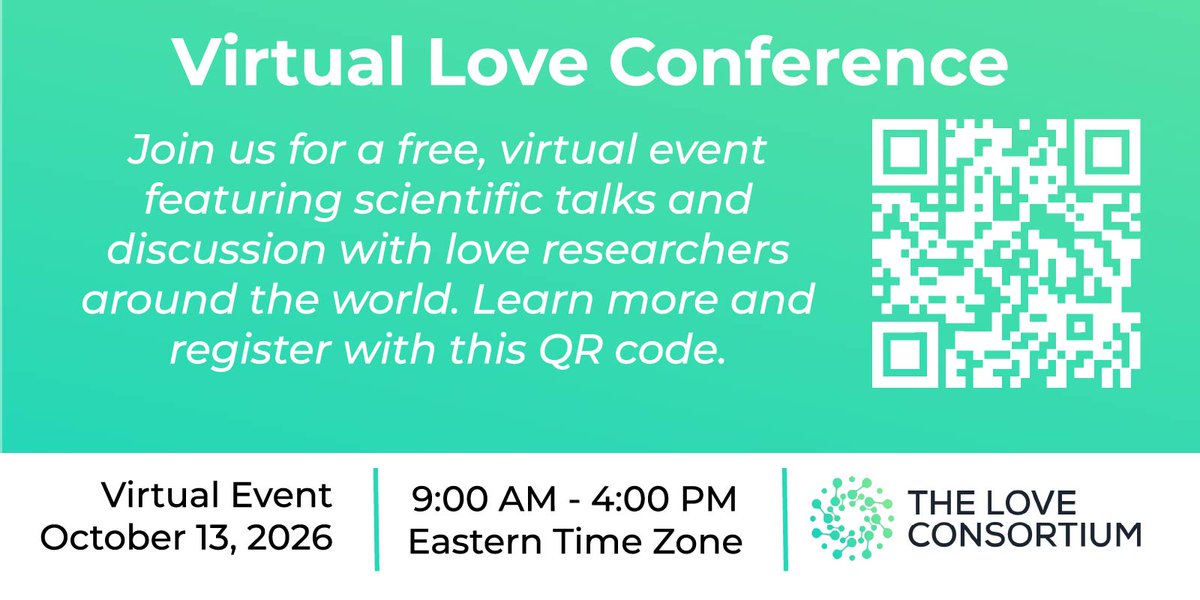
Looking forward to learning about the latest research with these flash talks next week! Hope you're planning to join us for our TLC 2026 Virtual Love Conference next Tuesday. https://t.co/c2GsHMjIMf
@AmyMuise@hopeiwhite@esraascigil
💗 The countdown is almost over! The 2026 TLC Virtual Love Conference is tomorrow! 💗
With almost 500 people registered from 39 countries, we’re excited to bring together a global community of researchers to explore the many dimensions of love.
https://t.co/c2GsHMkgBN
A new study found that people with more “hasslers” in their social networks reported poorer mental and physical health and showed signs of accelerated biological aging. Read more highlights from recent peer-reviewed studies: https://t.co/avTG39gbN1
Chatbots tend to validate. Psychologists know when to push back. Dr. Mitch Prinstein, APA’s senior science advisor, explains why that difference matters. Read more guidance from APA on how to navigate AI-generated advice thoughtfully and safely. https://t.co/fHwNsO2X2Z
Writing a pediatric resting EEG paper? Reviewing one? We made a one-page checklist for you.
RECAP-EEG covers what to report, from preregistration to open data. It's a free, interactive PDF: https://t.co/jHOpp9cNxb - A 🧵 (1/4)
Just published in Child Development: 17 studies followed the same kids from before COVID-19 to today. Effects were real but rarely catastrophic and hit hardest where inequities already existed. Read the Special Section: https://t.co/raJv7oa25x
#ChildDevelopment
Most social media research has failed policy-makers
Research on social media use and adolescent mental health has shown mixed results, and has often yielded no evidence of a strong relationship. But such studies have largely ignored the ‘cost of missing out’ — the social cost of not belonging.
Children with higher social media use could be happier than their peers and, at the same time, social media use could cause a decline in collective well-being.
This is why most social media studies are not useful for informing policies.
For example, one cross-sectional study found that digital technology use explains only 0.4% of variation in adolescent well-being, and the authors caution against policy change. Yet this study was conducted entirely under conditions in which social media use is ubiquitous (scenario A). The change in well-being that would follow a move to a situation in which social media use is regulated (scenario B) simply cannot be estimated from such data.
https://t.co/6Q2bVDoetp
Many people confuse having access to experts with understanding a topic for themselves—and this “contagious sense of understanding” could proliferate as humans turn to AI for answers, Tania Lombrozo writes: https://t.co/NNSUIIraGq
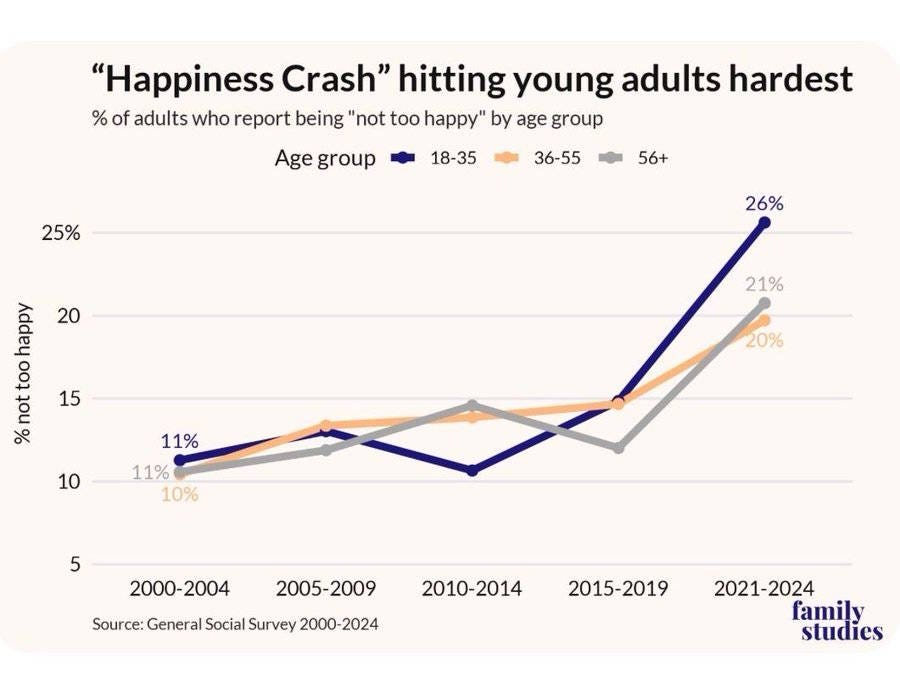
Happiness is plummeting, especially among young people.
When I see demoralizing data like this over and over again (e.g., test scores dropping, loneliness on the rise, etc), I just think we need to change course. Defending the status quo seems like such a bad option.
AI chatbots are warm, responsive, and always available. But psychologists say those qualities make them poor substitutes for the messy, effortful work of human relationships, especially for adolescents whose social skills are still forming. Learn more: https://t.co/LgfZj6e5Sx
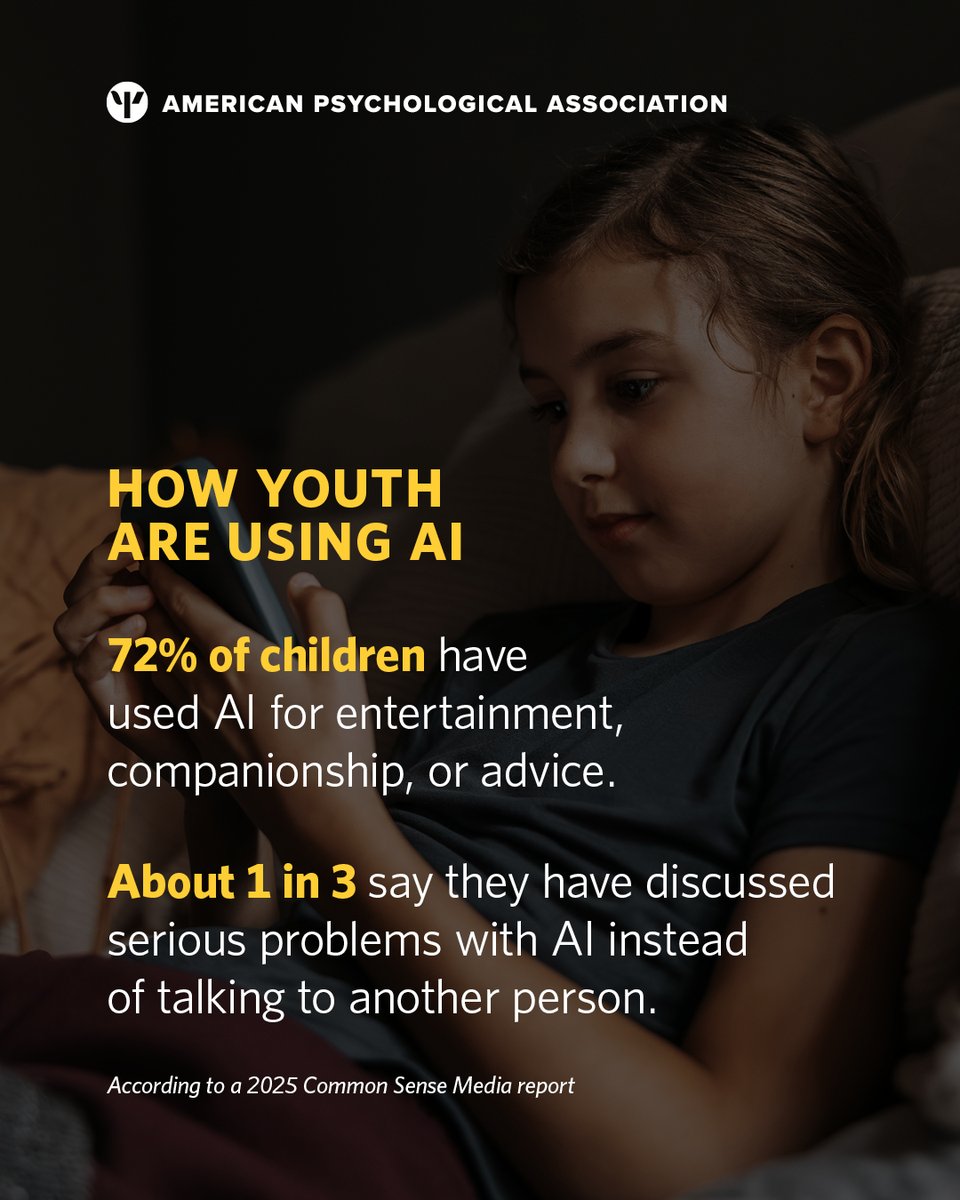
Children and teenagers are turning to AI for friendship, advice, and support. Psychologists say this raises important questions about what happens to social and emotional development when AI fills roles that used to belong to other people. Learn more: https://t.co/LgfZj6e5Sx
More than half of US teens use AI for schoolwork. But what happens to learning when AI does the heavy lifting? Psychologists are beginning to untangle how AI use may shape the next generation’s ability to think, problem-solve, and persevere.
Learn more: https://t.co/LgfZj6e5Sx
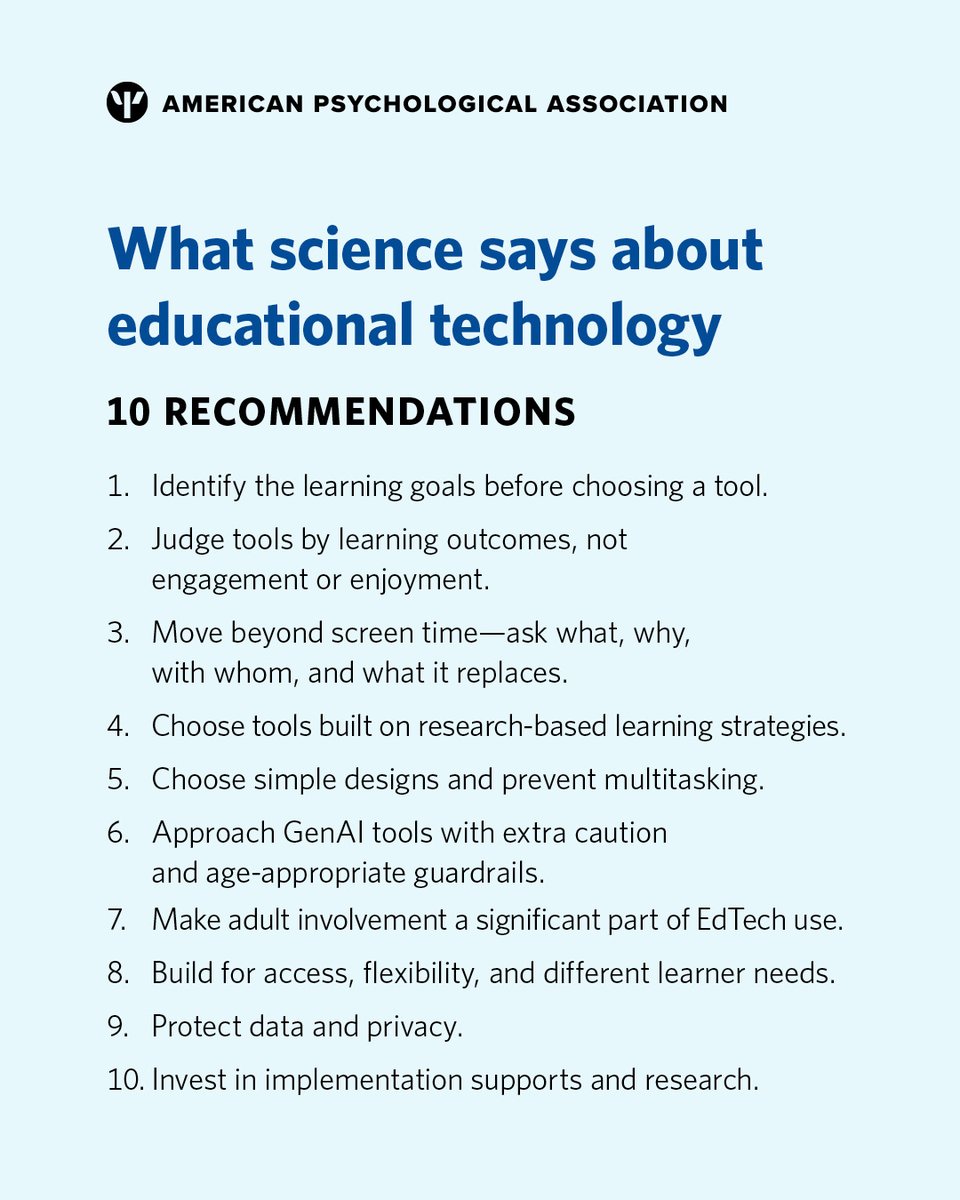
Not all educational technology is created equal. APA’s new report gives educators, families, policymakers and developers 10 evidence-based recommendations for EdTech that protects how children and adolescents learn and develop.
Read the full report: https://t.co/Czx1nEmn06
"educational materials that connected climate action with young people’s desire for self-expression and peer recognition consistently encouraged more environmentally friendly behavior" Jenna Spitzer & Sander Thomaes https://t.co/NDbaYqVdUQ
Contact with nature is good for us
Experiments from environmental psychology have found that nature contact decreases negative affect, stress, and anxiety before and after nature walks or during the viewing of images in a laboratory setting. Lowers levels of cardiovascular disease and mortality risk are associated with living near nature. Nature contact also increases positive affect and life-satisfaction.
Get outside :)
https://t.co/izL9Xt0OSm
"In all I lost to my illnesses, I gained in my voice and agency to decide not only that, yes, I will be a psychologist, but also the kind of academic I want to be: compassionate, determined, and balanced in my science, my service, and myself." #ScienceWorkingLife https://t.co/XQ0p9eXPDM
This was a multi-year collaboration with a wonderful team, including Bonnie Brett, Jackie Gross, Tracy Riggins, & Jude Cassidy.
The article is available #openaccess in the Journal of Social and Personal Relationships @JoSoPerRel@IARRofficial: https://t.co/uyLsKLIfSJ
🚨New paper: How does parents' #attachment shape #empathy for their kids?
Across 4 studies of 349 parents of children ages 3–10, we find that attachment avoidance is a risk factor for lower parental empathic concern & perspective-taking toward children.
https://t.co/4MBFuGjhP4