As congress enters the final weeks of the 119th Congress, we urge them to cooperate in completing important work on behalf of American farmers. Our top three priorities are passing the farm bill, providing additional bridge support with supplemental economic relief, and establishing the Buying American Cotton Act (BACA). Success in these areas will allow for the 120th Congress to focus on other big issues of common concern including global competition and market access, inflation, labor, CCC borrowing authority, & USDA services.
Last week, I traveled across The Natural State visiting with farmers and ranchers about the consequences for them and our rural communities when costs don’t pencil out year after year.
Those conversations reinforced the importance of getting Farm Bill 2.0 across the finish line. I remain committed to advancing these updated ag policies so farm country gets the certainty and support it desperately needs.
If there are no limits in place then the actively engaged problem becomes much smaller. A operation with a husband wife or one with twenty family members would be treated the same. Whatever safety net that is passed into law would go on every acre regardless of size of the operation. The argument about a family member marketing crop in Chicago then becomes null and void without payment limits.
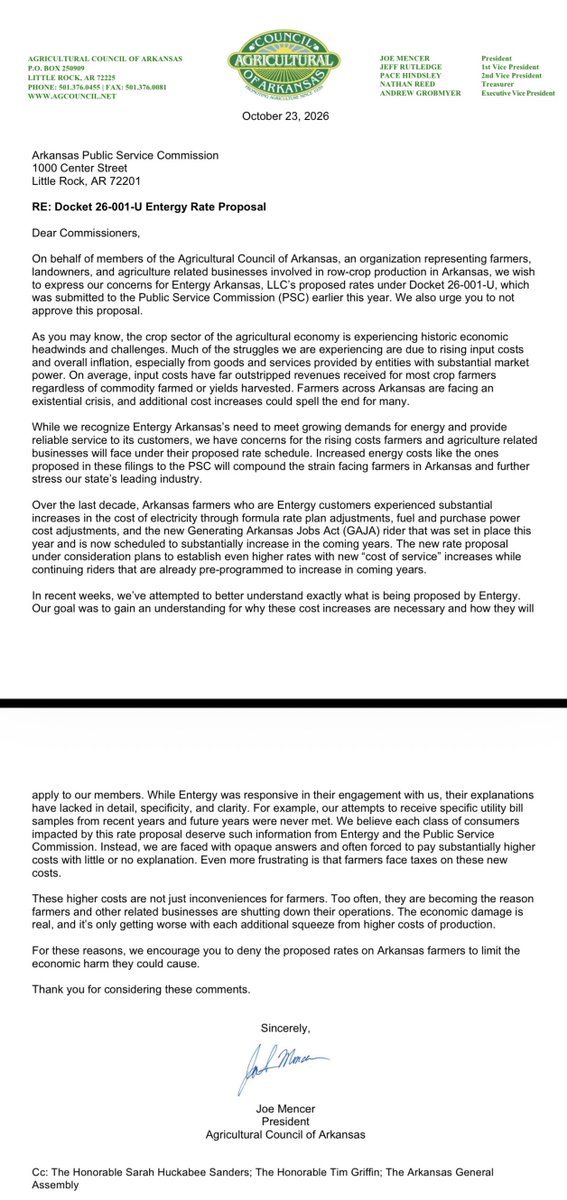
Today, the president of the Ag Council of Arkansas submitted a letter to the Arkansas Public Service Commission on behalf of our members expressing concern for proposed rates for @EntergyArk customers in a rate case filing pending before the commission.
In addition to the rate case pending, we also have serious concerns for how Entergy is implementing new utility bill riders under the Generating Arkansas Jobs Act of 2025 (GAJA).
To frustrate us even more, farmers are seeing these increased costs taxed at the state and local levels while data center customers of Entergy get special rates, avoid taxes on electricity, and capture renewable energy credits and other benefits in their dealings with Entergy.
We have concerns that farmers will also be forced to pick up the tab for Entergy's future needs to purchase power to meet demand for data center companies.
We encourage actions to provide relief to Arkansas farmers!
More: https://t.co/UBHFlI2KCY
If you want to know the primary reason 🇺🇸 farmers are suffering today, look no further than Brazil. They’ve decimated much of the planet’s most diverse and vital ecosystems in favor of converting that land to agricultural production. This timelapse showcases what that looks like. Sourcing from Brazil supports this land conversion activity and empowers China.
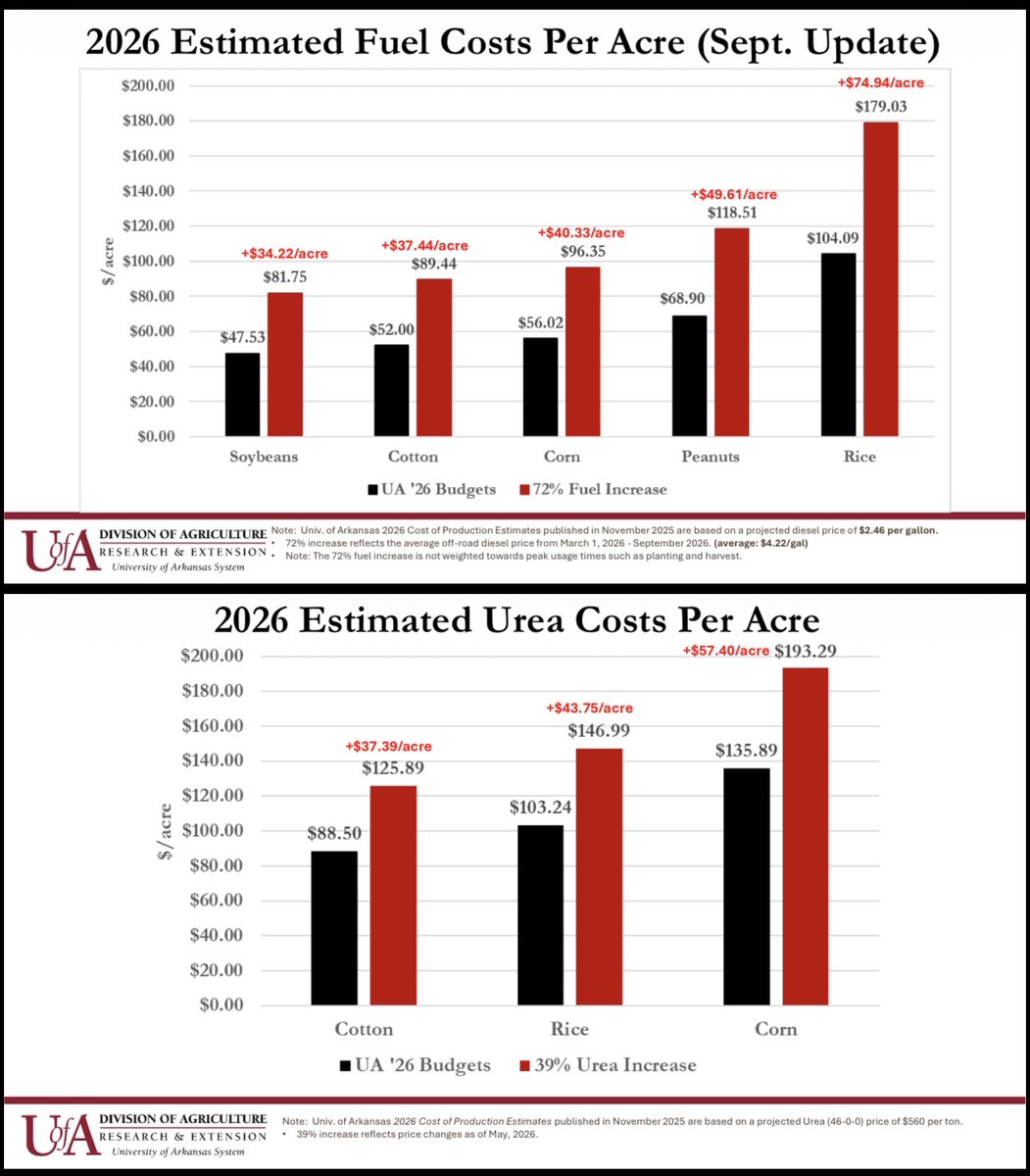
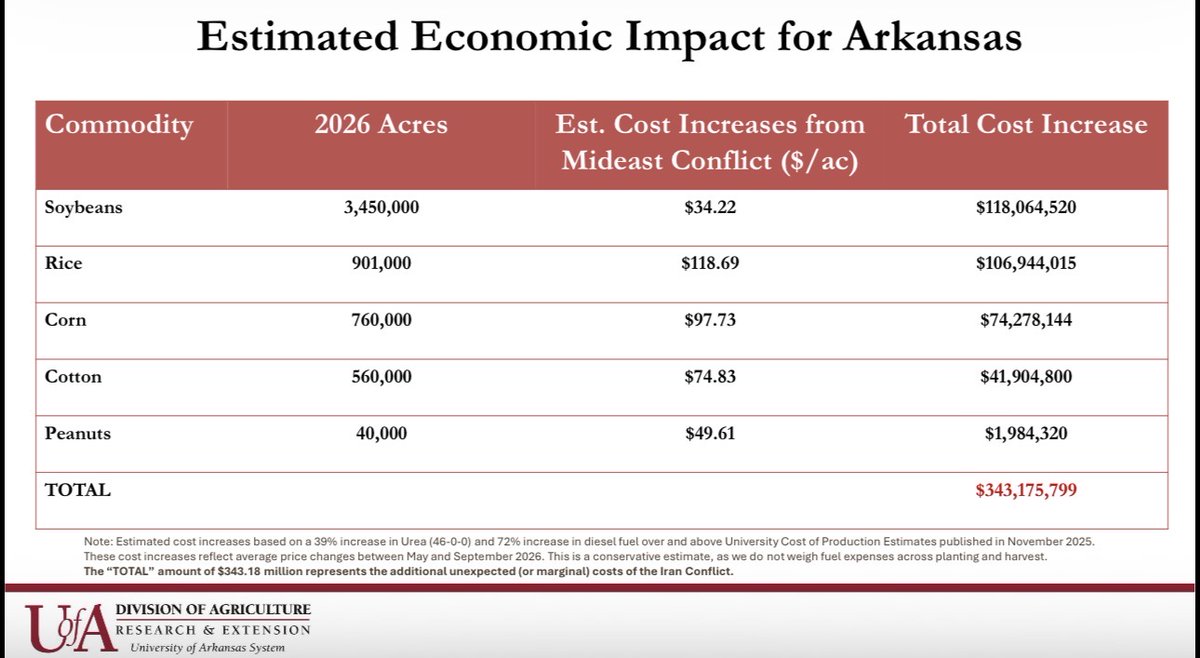
University of Arkansas Division of Agriculture @AginArk economists recently estimated the Iran War has increased cost of production for Arkansas crop farmers by over $343 million from crop budget estimates established prior to planting due to higher fuel & fertilizer prices. Unfortunately, crop farmers have no way to recover these costs, & in many cases they are absorbing additional cost increases from those who are passing on those costs. We urge inclusion of relief for these added expenses above amounts already proposed for farm bill bridge support, & we strongly encourage Washington to provide such support before the adjourning the 119th Congress. https://t.co/NbQpt3GuAr
Arkansas agriculture leaders were in Washington advocating for passage of Farm Bill 2.0, and yesterday’s successful committee vote moves us one step closer to getting the legislation signed into law.
Updating critical farm policies, including allowing farm storage loans to be used for fertilizer and other critical inputs, helps Natural State producers continue building a strong future while producing the food that feeds our nation. #BuiltForFarmers #ARinDC
NCC greatly appreciates the Trump Administration’s strong support for the Buying American Cotton Act. BACA puts American farmers and workers first by strengthening demand for U.S. cotton and supporting domestic manufacturing.
https://t.co/02z6f5bQj6
A new study by @NationalCorn found:
-U.S. corn seed prices averaged 68% higher than Brazil’s
-Insecticide prices averaged 87% higher
-Some fungicides cost more than double what Brazilian farmers paid
-Many herbicide comparisons also approached double Brazilian price levels
For NCGA President Jed Bower, an Ohio farmer, the findings confirm concerns many growers have held for years: “It sure doesn’t look like we’re the low-cost producer anymore,” Bower says. “The study shows the American farmer is really paying for all the innovation and research for the rest of the world to take advantage of.”
https://t.co/YJsSw7oNVJ
Additional bridge support is absolutely needed, especially given the fuel & fertilizer pressures faced this year, but it was truly needed prior to that input price shock. The Farm Bill 2.0 is also very important as are the demand support policies including E-15, Buying American Cotton Act, & Grown in America Act. All of these will strengthen the farm economy, uplift rural communities, & make our country more secure & resilient. 🇺🇸
I would argue if we didn't have payment limits on a good safety net policy then we wouldn't need the ad hoc programs. The Delta is suffering immensely. We feel the increase of every input cost. The PLC program which is "price loss" is a good policy. The payment limits are not. A loss is a loss regardless of 10 acres or 10,000 acres. We have allowed every segment of the agricultural world to consolidate yet punish large family farms.
@BDraddy@charliehulme Cotton farmer and avid golfer. Love the new push for natural fiber apparel. Keep it up! I will be wearing some in my clubs 4 ball this weekend!
NCC commends USDA @SecRollins for championing the interests of U.S. cotton growers in her recent House Ag testimony. Her commitment to American-grown natural fibers is key as we work together to drive rural growth and industry success.
🇺🇸 The Great American Cotton Plan represents the best of American agriculture.
Natural fibers over plastic synthetics. Cotton breathes. It lasts. It doesn’t leach microplastics.
Real American cotton = healthy skin, stronger farms, real jobs.
This is how you win: grown here, sewn here!
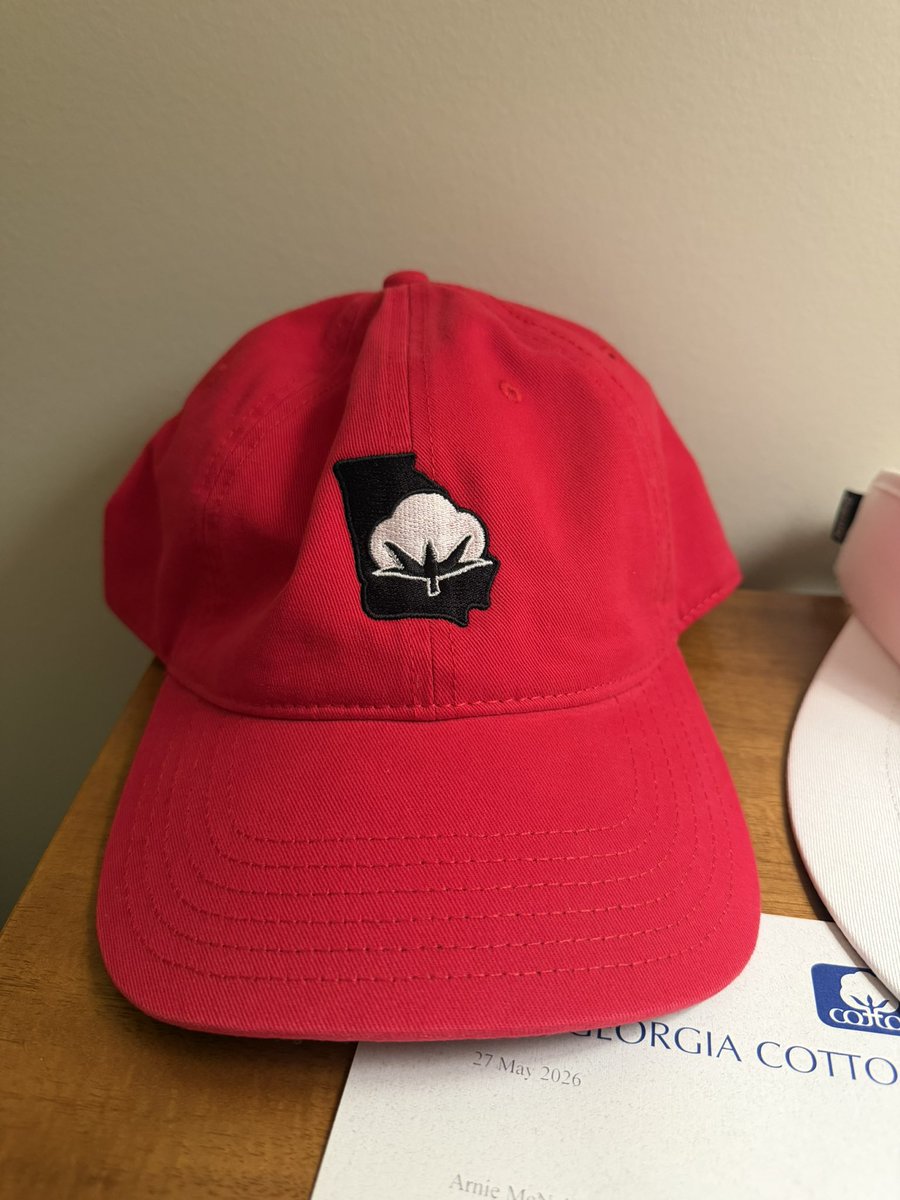
A real pinch-me moment that’s getting framed. I don’t care if ever make a dime from Arnie McNair because moments like these make it all worth it.
This letter from the Georgia Cotton Commission states that during a difficult period for the cotton industry, the commissioner shared some of my tweets in presentations to farmers as an example of “light at the end of the tunnel” in the face of tremendous “negative economic pressure.”
Cotton isn’t just a fabric. It’s American agriculture, American manufacturing, and generations of hardworking families.
As the letter states, “not only is cotton a natural fiber, but it is a fiber that supports family farms, promotes our environment, and sustains rural communities.”
We’re proud to build Arnie McNair around natural fibers and proud to support the people who grow them.
We’ll be working with the Commission to explore expanding our offerings to include Georgia-grown upland cotton alongside our Supima cotton products.
Pretty humbling for a small golf company that simply believes cotton is better for many reasons.
Also will be Georgia Cotton Commission visor mogging for the foreseeable future.
The MAHA movement doesn't stop with what we EAT — It's also about what we WEAR.
For decades, America offshored textile jobs and allowed foreign synthetic, plastic-based materials to take over the clothing market.
Together with @SecKennedy, the Great American Cotton Plan puts American-grown cotton FIRST again: supporting our farmers, strengthening U.S. manufacturing, and giving families a natural choice.
American-grown cotton accounts for just 4 of the 20 million bales used in the U.S. each year. I applaud President Trump and Secretary Rollins for promoting American cotton through the Great American Cotton Plan. Now Congress should pass the Buying American Cotton Act to support our farmers, rural communities, and American manufacturing.
https://t.co/t2ATilOPuT