Happy Halloween!
But did you know that every zombie you see tonight walked out of a Haitian cane field?
Under French rule, the enslaved Africans of Saint-Domingue were worked to death so fast that the colony had to import tens of thousands of new captives every year just to replace the dead.
The one escape was death itself. They believed that when you died, your spirit crossed the water back to Africa, to a place they called lan Guinée.
In Haitian Creole, lan Guinée still means heaven. Suicide was so common that planters mutilated the bodies of those who killed themselves, to frighten the rest into believing a broken body could not make the journey home.
Out of that world came the zombi. Not a flesh-eater. Not a plague. A person whose soul had been stolen by a sorcerer, a bokor, so that the body went on laboring in the fields with no mind and no will and no death to release it. It was the fear underneath every other fear: that you could die and still be a slave. A
fter independence, Haiti wrote the fear into law. Article 246 of the penal code treats drugging a person into a death-like coma as attempted murder, and as murder if they are buried afterward.
In 1929 an American travel writer, William Seabrook, published The Magic Island, with a chapter about dead men working the cane fields of an American sugar company.
Three years later Hollywood released White Zombie, with Bela Lugosi running a mill staffed by the walking dead. From there the word was taken, the meaning emptied out, and the slave's nightmare became a costume sold in a plastic bag.
So when you see the zombies tonight, remember what one actually was. A man who was promised that death would carry him home, and who was told that even that could be taken from him.
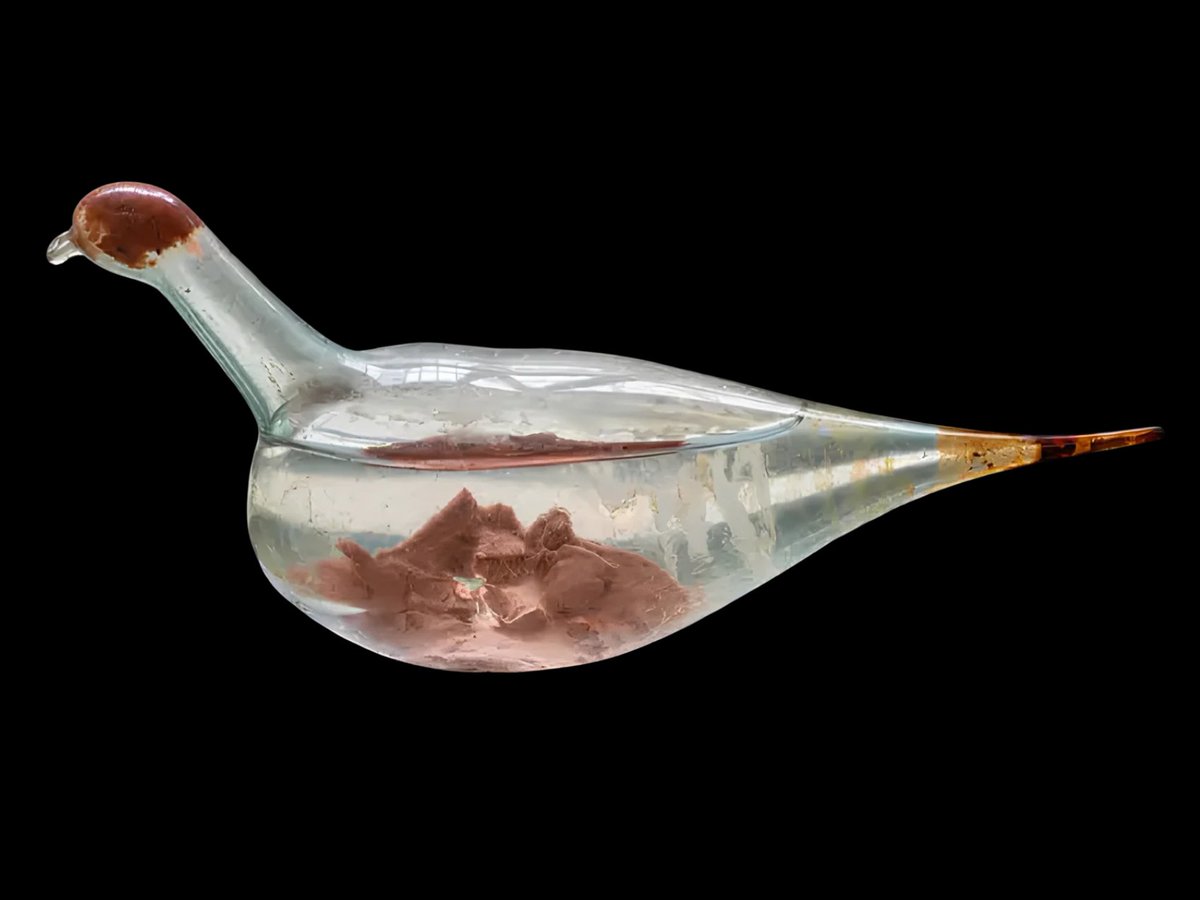
This bottle was never opened. Roman bird flasks like this one were filled at the furnace and then sealed shut by reheating the tip of the tail, with no stopper and no opening anywhere.
To use the perfume you had to snap the tail off. An intact bird is an unused bottle, which is why there is still liquid inside this one after 2000 years..
The Vegvísir was meant to help you find your way when the world around you became impossible to read.
It belongs to the Icelandic tradition of galdrastafir, magical signs recorded in grimoires. The earliest known Vegvísir appears in the Huld Manuscript of 1860. Its name means roughly “wayfinder”, and it was said to protect its bearer from getting lost during storms or bad weather.
Its purpose was magical, not navigational. The sign was believed to offer protection and orientation when ordinary navigation failed.
A later interpretation connects its eight outer arms and centre with the nine worlds of Norse cosmology, with Midgard at the centre and the other worlds around it. The pattern is also compared with Yggdrasil.
It turns the Vegvísir into more than a protective sign. In this later reading, it becomes a symbol of orientation within the cosmos.
Image source:
“Vegvisir-huld-p60” (c. 1860), Geir Vigfússon. Source: Wikimedia Commons / National and University Library of Iceland. Version checked: 11 March 2015. License checked: 9 October 2026 - Public Domain.