قیامت
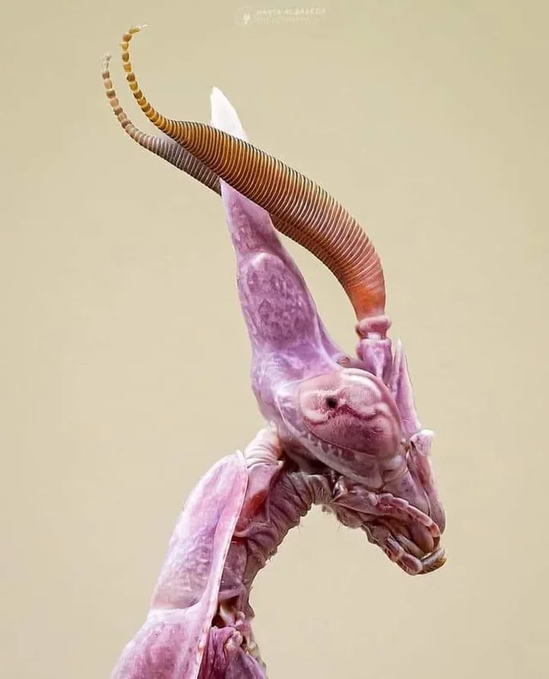
"The fifth angel sounded his trumpet, and I saw a star that had fallen from the sky to the earth. The star was given the key to the shaft of the Abyss. When he opened the Abyss, smoke rose from it like the smoke from a gigantic furnace..."
"only those people who did not have the seal of God on their foreheads. 5 They were not allowed to kill them but only to torture them for five months. And the agony they suffered was like that of the sting of a scorpion when it strikes...."
Stardust Man
"you are made of stardust. When you look up at the night sky, you are looking at your origins the same cosmic matter that shaped you is still shining as stars above....; you are an active part of it, living proof of how matter can become aware of itself"
Every part of you, from your bones to your heartbeat, is built from atoms that have existed for billions of years. These atoms were not created on Earth. They were formed long before our planet existed, deep inside ancient stars that lived, exploded, and scattered their elements across the universe. The iron in your blood, the calcium in your bones, and the oxygen you breathe all came from these cosmic events.
Scientists estimate that the human body contains around 7 octillion atoms that’s a seven followed by 27 zeros. These atoms constantly move, connect, and exchange energy, making you part of an endless cycle of cosmic transformation. Every breath you take and every meal you eat adds atoms that once belonged to stars, planets, and even other living beings.
The age of your atoms is staggering. Hydrogen, one of the most common elements in your body, is nearly as old as the universe itself about 13.8 billion years. Heavier elements like carbon and nitrogen were forged in the hearts of stars before being spread across space by powerful supernova explosions. Eventually, these elements gathered to form new solar systems, including ours.
This means you are, quite literally, made of stardust. When you look up at the night sky, you are looking at your origins the same cosmic matter that shaped you is still shining as stars above. The universe didn’t just create you by chance; you are an active part of it, living proof of how matter can become aware of itself.
So, when you think about your place in the world, remember this: you are not small or separate from the cosmos. You are the universe, organized into human form, carrying within you the timeless story of creation written in every single atom.
⚡ Nikola Tesla was right. The universe isn’t solid — it vibrates.
Quantum physics now shows reality is built not from matter, but from vibration and waves.
Nikola Tesla once said, “If you want to find the secrets of the universe, think in terms of energy, frequency and vibration.”
Far from a metaphor, his insight aligns strikingly with what modern physics has revealed. At the quantum level, reality isn’t made of solid particles but of vibrating energy fields.
Every particle—from electrons to protons—has its own frequency, and these wave patterns determine everything from chemical bonds to the colors we see. Light, heat, and sound are all forms of energy defined by vibration and frequency.
Even spacetime itself isn’t still. In 2015, scientists confirmed that black holes can create ripples—gravitational waves—that travel across the cosmos, carrying energy through the very fabric of the universe. Tesla may not have had the equations, but his intuition was remarkably prescient: everything, from atoms to galaxies, moves in patterns of vibration and resonance.
🇷🇺 Putin wants a new SCO bank that Washington can't touch.
The SCO is the China and Russia-led group spanning India, Pakistan, Iran and much of Central Asia, pitched as a counterweight to the West.
Speaking to SCO leaders, he called for a Development Bank that would operate outside systems he says are increasingly being used as political weapons, an obvious reference to sanctions hitting members like Russia and Iran.
He also pointed to Russia’s trade with SCO countries, which topped $400 billion last year.
A sanctions-proof bank for the countries most in the crosshairs of sanctions.
Writer: Julie
🇷🇺 Putin is touting the SCO as the biggest regional bloc on the planet.
The Shanghai Cooperation Organisation is a China and Russia-led political, economic and security group that has grown to include India, Pakistan, Iran and much of Central Asia, widely seen as a counterweight to Western alliances.
"SCO started as an organization of just a few countries, but now it is the largest regional group in the world.
Its member countries account for almost half of the world's population and about a third of global GDP."
Writer: Julie
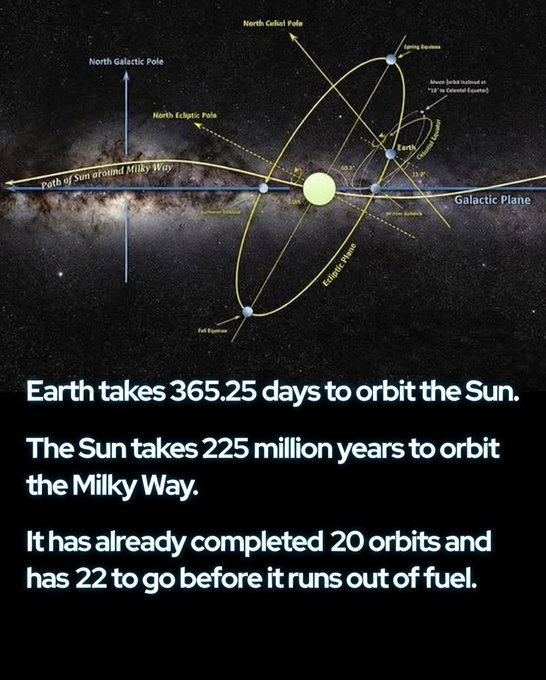
The Sun has only 22 galactic orbits left.
Earth races around the Sun at ~67,000 mph (107,000 km/h), giving us our familiar 365.25-day year and changing seasons.
But the Sun is in motion too, hurtling through the Milky Way at ~514,000 mph (828,000 km/h) on a grand orbit around the galactic center. One complete lap, known as a cosmic year, takes roughly 225–230 million years.
When the Sun finished its most recent galactic orbit, the earliest dinosaurs were just beginning to roam Earth.
Since its birth ~4.6 billion years ago, our star has completed about 20 such orbits.
Stellar models predict the Sun will keep fusing hydrogen in its core for another ~5 billion years before it swells into a red giant and eventually fades into a white dwarf. At its current orbital speed, that leaves roughly 22 more laps around the Milky Way.
Each cosmic year sweeps the entire Solar System tens of thousands of light-years across the galaxy, through dense spiral arms rich with star-forming regions, past ancient globular clusters, and amid countless other stars.
Continents drift, mountains rise and erode, entire species evolve and vanish, all within a tiny fraction of one galactic circuit.
Human civilization, from the first cities to today’s digital age, has existed for less than 0.001% of a single cosmic year.
We are passengers on a star halfway through its ~10-billion-year galactic journey across a 100,000-light-year-wide disk, witnessing just the briefest sliver of one ongoing lap in an unimaginably vast cosmic dance.
🇮🇷🇺🇸 Prof. Mohammad Marandi: If Trump’s sanctions actually work, war may become inevitable
Iran's economy is unquestionably worse than before the war, he says. Infrastructure is damaged, sanctions hurt, and Tehran is shifting toward a wartime economy.
But Iran isn't thinking about surrender. It's preparing for another war.
Marandi argues Tehran has spent decades preparing for exactly this confrontation, building underground facilities while developing missiles and drones. And he believes Iran is now rapidly expanding those capabilities during the current lull.
That creates a nasty paradox for Trump's “Economic D-Day.”
If the sanctions fail, Iran can simply absorb the pressure and wait.
If they succeed in seriously damaging Iran's economy, Marandi believes Tehran will retaliate, potentially targeting American economic and military interests across the Gulf.
And Iran still has another lever: Hormuz.
Marandi argues Tehran could gradually tighten the flow of oil and other critical commodities, increasing pressure on global markets without immediately returning to full-scale war.
So Washington's problem is becoming increasingly uncomfortable.
Sanctions that don't work accomplish very little. Sanctions that do work may restart the war.
And Marandi's conclusion is remarkably simple: if Washington is serious about using economic pressure to overthrow the Iranian government, renewed conflict is “inevitable.”
@s_m_marandi
Straight of
Hormuz
A Lifeline
"All it takes is for the Strait of Hormuz to cough, and Western markets catch pneumonia.But oil is just the appetizer.
The real nightmare is called fertilizer... Brussels can sanction geography, it has still not managed to sanction photosynthesis. "
HUNGER: THE ULTIMATE PEACE TREATY AMONG EMPIRES?
By @BPartisans
The West may have finally found the weapon capable of putting an end to its endless wars: its own stomach.
For thirty years, bombing was relatively comfortable. Iraq, Afghanistan, Libya, Syria… Missiles were launched, press releases about the “international order” were issued, and citizens quietly went about filling their shopping carts. War was great as long as it took place 4,000 kilometers away from the pasta aisle.
Then came Iran.
And suddenly, a shocking discovery in the foreign ministries: the global economy still relies on ships, ports, gas, oil, minerals, and a few sea lanes that can be blocked.
All it takes is for the Strait of Hormuz to cough, and Western markets catch pneumonia.
But oil is just the appetizer.
The real nightmare is called fertilizer.
For while Brussels can sanction geography, it has still not managed to sanction photosynthesis. To grow wheat, you need nitrogen, potash, phosphates, and a tremendous amount of energy, not a European Parliament resolution.
Europe has already moved away from cheap Russian gas, is complicating its trade relations with Russia and Belarus, while the war is undermining Ukrainian agricultural exports. Now add a Middle East in crisis, strained shipping routes, and more expensive raw materials.
You end up with this strategic masterpiece: sanctioning your suppliers, financing a war, losing trade routes, and then discovering that farmers don’t fertilize their fields with speeches by Ursula von der Leyen.
Meanwhile, taxpayers are asked to smile.
More expensive electricity? For democracy.
More expensive fuel? For our values.
More expensive fertilizer? For freedom.
More expensive food? Probably Putin again.
But there is a limit that even the best propaganda cannot push back forever: the grocery bill.
A people can tolerate a war they watch on television for a long time. It’s much harder to tolerate a war that empties their wallets. And even harder to tolerate a geopolitical situation that ends up emptying their plates.
So perhaps the question is no longer: How long will these wars last?
But rather: How many meals will people have to sacrifice before they ask why they must grow poorer to support imperial ambitions they never voted for?
Empires believe themselves immortal because they possess aircraft carriers, missiles, and central banks.
Then comes a much older enemy.
The price of bread.
And unlike foreign armies, it can enter every home.
A Guide to All The Ways the Universe Could End:
The universe has been expanding for 13.8 billion years, but it won’t last forever.
Modern astrophysics outlines several distinct paths for the cosmic finale, depending on the behavior of dark energy, gravity, and quantum physics.
1. The Big Freeze
As the universe expands, matter stretches thinner and thinner. Over trillions of years, galaxies drift too far apart to interact, and gas clouds deplete. Without new fuel, stars gradually burn out one by one. The universe becomes a vast, cold graveyard of black holes and dead stellar remnants, slowly approaching absolute zero.
2. Heat Death
Often confused with the Big Freeze, Heat Death is governed by thermodynamics. Over an unfathomable timespan, the universe reaches maximum entropy. All energy distributes perfectly evenly across space. Because there are no temperature differences, no work can be performed, no structures can maintain themselves, and all atomic motion permanently ceases.
3. The Big Rip
If the phantom dark energy accelerating the expansion of the universe continues to strengthen, it will eventually overpower gravity and atomic forces. Space will expand so violently that it will first tear apart galaxy clusters, then strip planets from stars, and finally rip individual atoms apart down to their subatomic particles.
4. Vacuum Decay
This scenario is a random quantum event that could happen at any moment. Our universe may exist in a "metastable" false vacuum. If a single point in space transitions to a lower, more stable true vacuum state, it will trigger an expanding bubble. Moving at the speed of light, this bubble will instantly rewrite the laws of physics and obliterate all matter in its path.
5. Proton Decay
Even if the universe avoids a violent collapse, its building blocks might have an expiration date. Some grand unified theories predict that protons—the stable particles inside atomic nuclei—are not permanently stable.
Dive into the future of hydration with The Sound Theory and Water Pearl Japan! & Unveiling a groundbreaking fusion of sound frequencies and water technology.
By harnessing precision-engineered ultrasonic waves, this innovation transforms H20 into crystalline "Pearl Clusters," optimizing molecular structure for enhanced absorption, energy, and purity.
How it works: Resonant frequencies align water molecules into pearl-like formations, unlocking nature's full potential. Think *sound healing*, but for your hydration-sustainable, revolutionary, and 100% science-backed.
If you can use frequencies to manipulate the water, don’t forget about the water in YOU!
✨ GOLD NANOPARTICLES COULD HELP BRING SIGHT BACK
Imagine living in darkness—and then seeing light again.
Scientists are exploring a remarkable approach that uses tiny gold nanoparticles placed inside the eye. Instead of replacing damaged photoreceptors with surgery, these particles may help stimulate surviving retinal nerve cells when activated by near-infrared light.
The idea sounds almost like science fiction: microscopic gold + special light = signals that could reach the brain and create visual patterns.
But there’s an important catch—the technology is still experimental and has not yet proven that it can restore normal vision in people.
Could gold become part of the future of artificial vision? The answer may be closer than we think.
Source: Gold nanoparticles and retinal prosthesis research. Nature Nanotechnology.