They’re telling each other to only smash European-owned shops.
Making this weekend the biggest racially targeted attack on commerce in Europe since the Night of Broken Glass in 1938.
At least 1500 looted.
Algunos pensará que esto es una exageración retórica. Otros pensarán que soy un animal que no conoce o aprecia otras culturas.
Lo cierto es que, por ridículo que os suene, yo escucho habitualmente gamelán de Bali, qawwali de Pakistán y música tradicional de Ghana. Tengo un podcast de historia musical en el que hemos hablado de son cubano, de city pop japonés y de blues de Texas, pero no de Haydn ni de Schönberg. Precisamente porque la alta cultura europea está más que glosada en la academia y su historia contada en mil libros, y a mí me interesa hablar también con algo de rigor de todo ese otro mundo popular.
Todo lo humano me interesa y lo aprecio sinceramente de formas que sospecho que la mayoría de los majaderos de la multiculturalidad ni imaginan.
Y borraría todo eso de un plumazo si fuese necesario para preservar la cultura compartida de los pueblos de Europa porque es la más alta cima estética, moral y civilizatoria que la especie humana jamás haya alcanzado.
Pero también porque es la nuestra.
Un físico turco se pregunta honestamente qué pasa con el esfuerzo intelectual tras resolver en con Claude en 10h lo que le costó más un año de trabajo de su tesis doctoral.
Pasa lo que siempre debió pasar pero que las élites y los nichos profesionales rechazaban. Que el valor no está en el esfuerzo, sino en el valor añadido.
1° el mayo del 68 es otro aquelarre de hijos de puta y niñatos frívolos que siguen hoy destruyendo Francia y Europa.
2° Argentina
3° Que los europeos discutamos o incluso peleemos violentamente sobre qué hacer con nuestros países no es lo mismo que una horda que se siente totalmente ajena al legado y patrimonio de nuestra cultura destruyéndola por diversión.
Pregunta: creéis que se debe seguir recortando el gasto en Transporte, Educación y Vivienda para seguir subiendo las pensiones conforme al IPC como ha pasado los últimos 20 años?
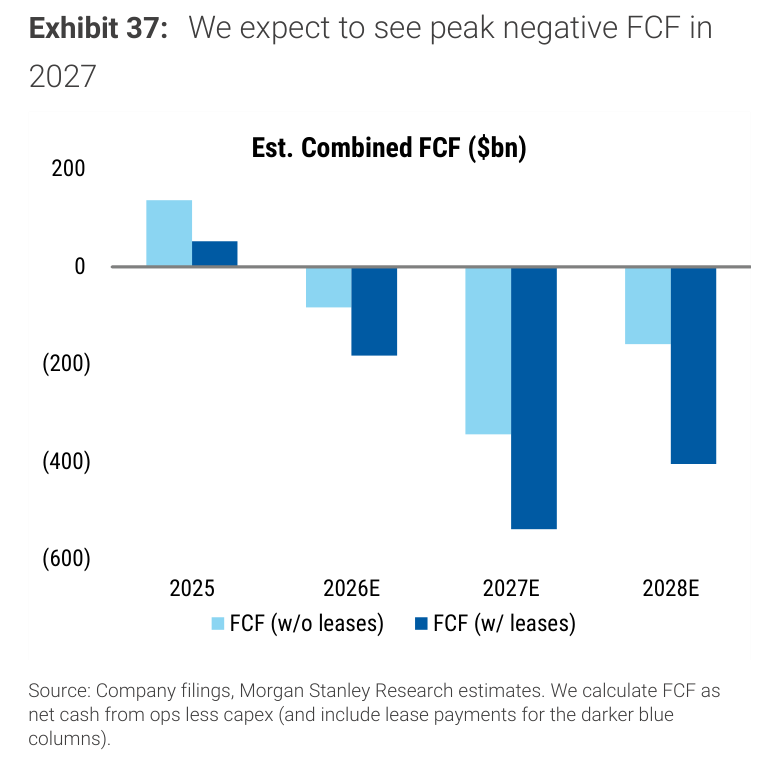
2027 is about to get crazy: according to Morgan Stanley, hyperscaler and neocloud free cash flow to hit its most negative point in 2027, with the shortfall even bigger once lease payments are include: just shy of $600BN in cash burn.
In other words, the year with the biggest capex bill is also the year with the biggest funding gap.
Asi por recopilar lo que sabemos de Ceuta:
1- Sabían que venían los invasores
2- Abrieron la valla
3- Casi 100.000 invasores
4- Buques de guerra marroquíes en aguas españolas
5- Dejan quedarse al que quiere
6- Alimentan a los invasores
7- Dan techo a los invasores
8- Los echan en vísperas de elecciones
Estos son los que van a quemar España mañana (como hoy arde Francia).
¿Me dejo algo fuera?
Por otro lado, la izquierda podría darse cuenta de que, en este orden de cosas, no habrá nunca más protestas fuertes por nada.
Cualquier protesta fuerte que incendie las calles se verá okupada por negros saqueando negocios y vandalizando (cuando no destruyendo) símbolos occidentales.
Y, en consecuencia, el único debate que habrá será ese, el de la inmigración y la imposibilidad del encaje de esa gente en nuestra sociedad.
¿Una huelga por condiciones laborales? Lo siento, ahora es un debate sobre negros. ¿Una reclamación quizá legítima estudiantil? Lo siento, ahora es un debate sobre negros. ¿Una manifestación por las pensiones? Lo siento, ahora es un debate sobre negros.
La inmigración está arrebatando a nuestros hermanos más tontos la capacidad de desfogarse que siempre tuvieron. Y por el camino nos quitan una herramienta que siempre fue útil aunque poco usada por el resto, ojo.
J’ai entendu dire que la France était finie, qu’il était trop tard pour la sauver.
Mais la France est toujours aussi belle, enviable même. Sa grandeur n’a pas disparu, elle ne demande qu’à renaître.
Nous avons surmonté en un an un problème cent fois plus grave, sans avoir les moyens dont dispose la France.
La France pourrait y arriver en une semaine.
I spent 35 years building banking systems for banks worldwide, including central banks. I know how banks decide where their money goes.
When you build systems, you have to make them work, so you have to know how they work.
The Basel Committee de-industrialised the countries that adopted its rules. It's that simple: I explain the whole complicated mechanism in my essay. They simply regulated it away because that was the most profitable thing to do. It was implemented in such a systemic global way, and nobody seemed to notice
Capital is what a bank must hold before it can lend, the way a manufacturer or miner must hold supplies before it can sell. No miner doubles their costs to serve one group of customers. But that's what the banking system does to miners and manufacturers. Since 1988, the Basel rules have required banks to hold twice the capital against a factory loan as against a home loan, and under Basel III the gap reaches five times. So banks lend less to industry and more against houses. It should be stopped tomorrow.
Manufacturing's share of GDP fell in ten of the eleven countries I examined. In Australia it fell from 13.7% to 5.4%. Every other country that followed fell as well. The only truly crafty ones were the Koreans, who did a good job of offsetting it.
Regulators were warned in writing that the rule would steer credit, and they adopted it anyway. No parliament voted for it, and it's simply too dumb to keep doing, but we do . Not today; there is no justification. Yet from India, across Europe, across the US, including Australia, sanctions against industrial capacity. Financialization has gone too far it needs to be reviewed .
The charge is manslaughter by gross negligence. The mechanism is proven.
Same Rules, Different Ruins:https://t.co/n2jflhFw2S
when Rome was sacked, most people living in the Roman Empire didn't notice much of a difference in their daily lives
the farmers kept farming, the merchants kept trading, the normies kept norming. life went on
Rome still fell
the fact that you can walk down your street and get a croissant doesn't tell you much about the state of your civilization
but it tells a lot about you
Some people thought they knew ‘what GDP was for’ - or rather what it *wasn’t* for.
Then their utopian, ahistorical, we-misread-early-Fukuyama, self-serving stance was demolished by ‘history returning’.
Which was always inevitable, as some of us have been trying to say for 25 years or more.
The world system the BIS lorded over was ONLY built by U.S. military strength in WW2 and the Cold War - and then the global U.S. dollar they allowed to develop.
But that global U.S. dollar meant fewer and fewer U.S., then Western, factories over time; so a weaker U.S. and Western military.
And guess what? Everybody else didn’t get the message that history had ended and that was that and we could all drink champagne and toast the future. They had other ideas about what GDP is for.
So, now the old global order is over and the U.S., and some of the West some of the time, is trying to rebuild something new yet far more Old School:
Neomercantilism will replace neoliberalism, even if it will take the likes of The Economist years to be able to fully understand and then summarise it like that.
Logically, one way or another, that is going to mean the inverse of what Craig describes below - lending for manufacturing being incentivised over finance and function over frivolity.
Or, the U.S. and West can make even less stuff, be weaker and poorer, and end up severing drinks to those who understand the dynamic described above and below.
All else is commentary.
Europe gives them free healthcare, free housing, free education, every social program, and a quality of life they could never have back home… yet they will still loot and destroy the West into the third-world.
There is no magic soil.
A nation is simply it’s people.
This chart illustrates Germany’s structural economic decline compared with its peers really well.
Industrial production is down roughly 11% since 2015 (about 15% from the 2018 peak), with sharp losses in manufacturing, energy-intensive sectors, autos, and machinery. Public investment is up over 20%, and public/near-public employment has surged by hundreds of thousands of jobs since 2023, while the private sector has shed jobs. The private sector has subtracted from growth, only state consumption and investment prevented outright contraction.
By contrast, Poland’s industrial production rose 54% and Switzerland’s 36% over the same period, reflecting competitive cost structures, investment, and (in Switzerland’s case) high-value sectors rather than deindustrialization.
Public spending can temporarily paper over weakness but cannot replace a shrinking productive base. Without deep structural reforms addressing regulations, bureaucracy, and overtaxation, Germany won’t remain prosperous forever. Unfortunately nothing is happening, and the current government has just increased taxes for entrepreneurs throttling growth potential and innovation even further.
Hace unos años leí un librito de 1998 sobre la crisis demográfica y concluía con esto:
“De la recuperación demográfica de la población autóctona de los países occidentales dependerá buena parte de la articulación de los posibles escenarios. Si esta recuperación no se da, las tasas de soporte (número de individuos activos en relación a los pasivos) se tornarán insoportables; a menos que se mantengan dos ciudadanías: la población autóctona y la población inmigrante, con derechos laborables y civiles diferentes. Esta situación comportaría una revisión del sistema político occidental y de sus valores intrínsecos, tales como el ideal de igualdad, solidaridad, etc.
Asimismo entraría en crisis el propio concepto de “nacionalidad” y exigiría la redefinición de todo el sistema conceptual legitimador del poder democrático. Ante ello, la precaria estabilidad democrática que exige un constante consenso entre los poderes políticos y económicos se quebraría. La inestabilidad política sería la tónica general en las democracias occidentales, junto a la incapacidad de abordar grandes proyectos. […]
Si esta inmigración pertenece a un mundo cultural suficientemente compacto como el mundo islámico se producirá un rechazo de los valores y categorías occidentales, pero con la necesidad económica de permanecer en Occidente. Se irán configurando en Europa lo que Chaunu denominó estructuras sociales de guerra civil.”
Las ideas políticas de la Revolución francesa están en crisis. Y los cambios de era no suelen ser pacíficos.
Estos ya nacieron todos allí eh?
Si ya hoy en día tienes a gente diciendo que no se puede deportar a nadie si no te da la dirección de su casa, imagináos cuando sean todos nacidos aquí.
Paralizados mientras destrozan un país creado por siglos de resistencia frente a todos.