@eliebakouch thank you for showing scale-swe! we also have https://t.co/UuEA4vvkKn over 3000 document-to-repository long-horizon swe environment ready for RL training
Foundation models come to mass spectrometry proteomics
Identifying proteins from their fragments is a foundational task in biology. A mass spectrometer breaks peptides into pieces, measures the masses, and software then tries to match each spectrum back to a peptide sequence. Two approaches have dominated for decades: database search (match against known proteomes) and de novo sequencing (infer the peptide directly from the spectrum). Both are bottlenecked by the same step, scoring how well a candidate peptide explains a spectrum.
Deep learning has been entering this field for years, mostly as feature extractors feeding traditional engines like MaxQuant or MSFragger.
Jiale Zhao and coauthors introduce pUniFind, is a multimodal foundation model trained on over 100 million peptide-spectrum matches from open database searches. Spectra and peptides get their own encoders, and the model is pretrained with cross-modality tasks: predict the spectrum from the peptide, predict the peptide from the spectrum, score peptide-spectrum pairs jointly. Database search and de novo sequencing become two views of the same model.
The numbers are remarkable. In immunopeptidomics, where peptides come from non-tryptic digestion and are very hard to identify, pUniFind finds 42.6% more peptides than Open-pFind. In modification-rich de novo sequencing, it identifies 60% more peptide-spectrum matches than existing methods, despite working in a 300 times larger search space. In regular de novo, it recovers 38.5% more peptides, including 1,891 that map to the human genome but are absent from reference proteomes. A deep learning quality control filter raises consistency with RNA-Seq evidence from 65.4% to 85.0%.
What makes this an ML story is the architecture choice. End-to-end scoring with a shared latent space replaces hand-crafted feature pipelines, and the same backbone serves both database search and de novo sequencing without retraining.
For drug discovery, immunotherapy, and antibody engineering, peptide identification is the bottleneck for neoantigen discovery and biomarker pipelines. Tools that find more peptides at the same FDR, especially in non-tryptic and modification-rich settings, expand what is detectable from existing data. That changes what is worth running in the lab.
Paper: Zhao et al., Nature Machine Intelligence (2026) — journal license | https://t.co/U05n5GbjZR
A bit of news: After nearly 9 years, I have decided to leave Google DeepMind and join Anthropic (after taking some time to recharge). I am incredibly grateful for my time at GDM. @demishassabis took a real chance letting me lead the AlphaFold team just six months after finishing my PhD, and the entire GDM team taught me so much about how to do great science. GDM is a special place, and I’ll still be excited to hear about what amazing things they discover next.
Agent research shouldn’t mean rebuilding the same plumbing for every benchmark or every agent.
AweAgent is a unified, composable framework for building, evaluating, and training agents.
Less glue code. More real experiments.
https://t.co/bXKMKLSLBT
Code agents are entering a new phase.
Beyond single-bug fixing.
Beyond patch-level SWE data.
Meet DeNovoSWE: an open-source long-horizon dataset for generating whole repositories from scratch.
Code agents are entering a new phase.
Beyond single-bug fixing.
Beyond patch-level SWE data.
Meet DeNovoSWE: an open-source Document-to-Repository dataset for generating whole repositories from scratch.
https://t.co/P599t2rS3C
@jyangballin@KLieret Congrats on the great work! We also have BeyondSWE, which includes a doc2repo task as a benchmark. Both BeyondSWE and Scale-SWE are built on a framework modified from SWE-Agent. Thanks for the great foundation and inspiration!
@GeZhang86038849 Thank you for your attention!
We also have another work Scale-SWE.
With part of Scale-SWE, Qwen3-30A3B reach 64% on SWE-bench(V), surpassing GLM-4.7-Flash (59.2%). 20k SWE instances and 71k trajectories already public.
Much more data on the way!
https://t.co/xasQpkyDfc
Meet Scale-SWE: the largest open-source SWE dataset with real tasks.
With part of Scale-SWE, Qwen3-30A3B reach 64% on SWE-bench(V), surpassing GLM-4.7-Flash (59.2%).
20k SWE instances and 71k trajectories already public. Much more data on the way!
https://t.co/LaGdzfZ3Wk
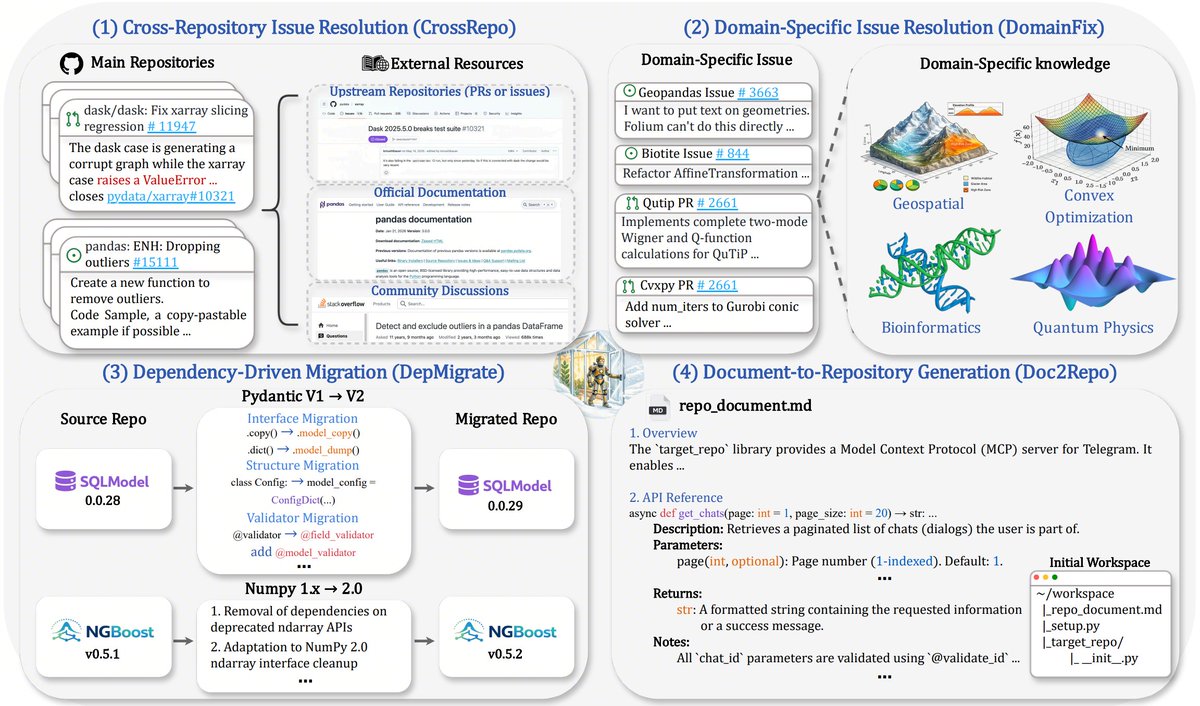
Introducing BeyondSWE !!! — our new benchmark designed to capture more realistic Software Engineering capabilities.
Every single problem in BeyondSWE is manually crafted and verified to ensure it reflects real-world complexity. 🚀
🚀 Introducing BeyondSWE: a benchmark for AI agents to tackle real-world engineering beyond single-repo fixes.
We evaluate Cross-Repo, DomainFix, DepMigrate, and Doc2Repo tasks to study the fusion of DeepResearch and coding.
📷 https://t.co/VPngWRo7PX