@_Jeffery0 I don’t know what your life has been like so far. What I know is that it’s okay to use debt, when it’s used as a leverage. Get a personal loan to buy the equipment needed to start a tree trimming company, a mobile car wash service, etc. Find the alpha and your life will change
If the opportunity goes to the first transaction that is irreversibly confirmed, waiting another 9–10 seconds can mean you're already out of the game.
Wall Street fought over milliseconds but agentic commerce may fight over finality
Wall Street firms have spent millions shaving milliseconds off transaction times
They colocated trading systems next to exchange servers. They paid for faster fiber routes. Some even used microwave networks because signals could travel between financial centers faster
Why?🧵
🧵 Algorand is quietly positioning itself as infrastructure for the emerging agentic payments economy.
x402. Google’s AP2. GoPlausible. USDC. Machine-to-machine commerce.
And now new data from Token Terminal adds another piece to the picture. 👇
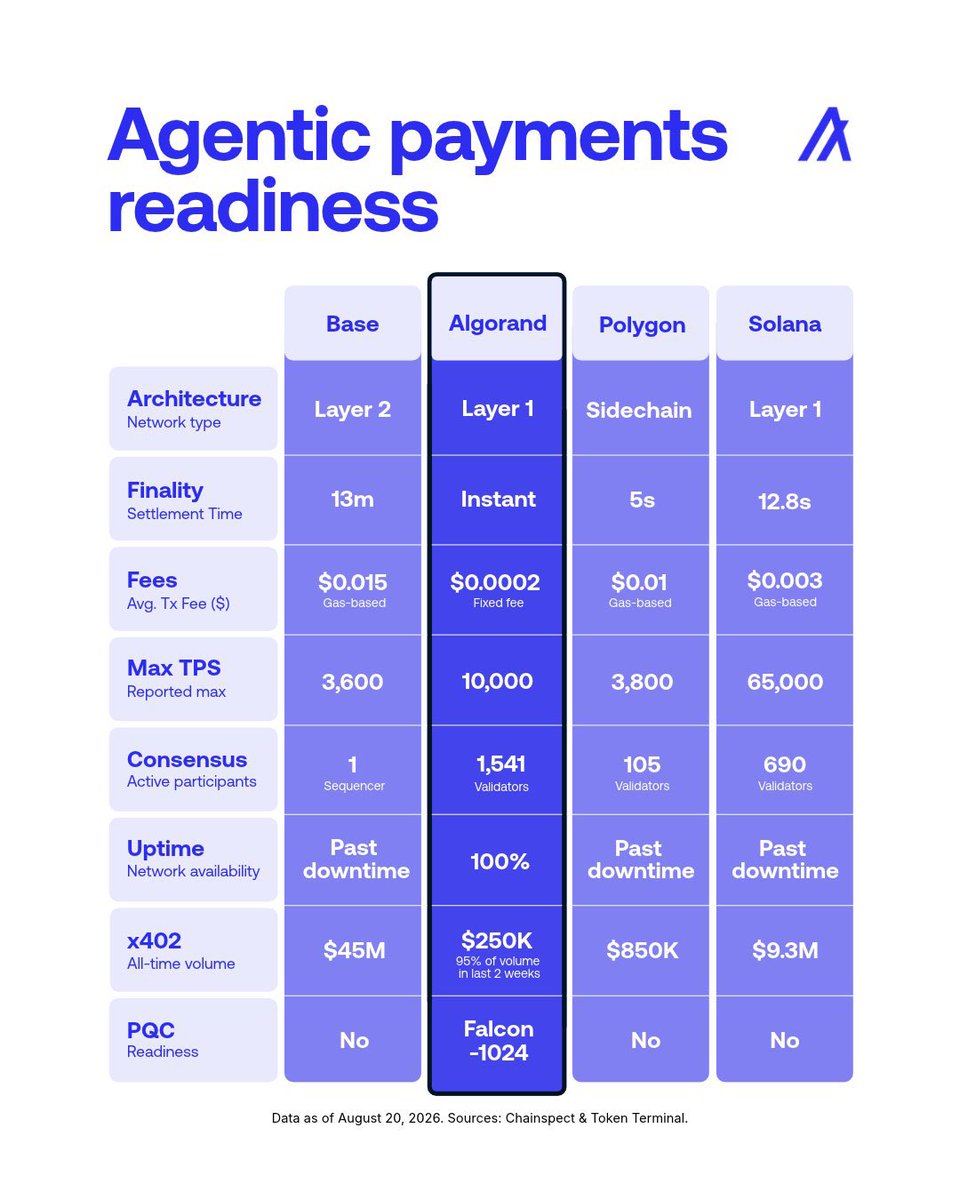
@tokenterminal‘s new Agentic Payments dashboard currently tracks four networks:
• Base
• Algorand
• Polygon
• Solana
The comparison focuses on infrastructure characteristics that matter when software, rather than humans, starts making payments.
And @Algorand stands out.
According to the dashboard, Algorand combines:
• Instant finality
• ~$0.0002 fixed fees
• 10,000 reported max TPS
• 1,541 validators
• 100% network uptime
• Falcon-1024 PQC readiness
Those characteristics matter for machine payments.
Why?
AI agents won’t necessarily behave like human consumers.
They could autonomously pay for:
→ API calls
→ data
→ compute
→ digital content
→ AI services
→ machine resources
Potentially thousands or millions of small transactions.
That changes what payment infrastructure needs to optimize for.
For agentic commerce, payments need to be:
Fast.
Cheap.
Predictable.
Programmable.
Available 24/7.
An AI agent requesting a $0.01 resource cannot wait minutes for settlement or spend more on transaction fees than on the resource itself.
This is where Algorand’s architecture becomes interesting.
And there is already activity.
The dashboard shows ~$250K in x402 all-time volume on Algorand.
More interesting:
95% of that volume reportedly occurred within the last two weeks.
That suggests x402 activity on @Algorand has accelerated sharply.
This connects directly to what @GoPlausible has been building.
Its x402 infrastructure supports:
AVM → Algorand
EVM → Base
SVM → Solana
with USDC settlement and infrastructure designed for autonomous machine payments.
Algorand has native AVM and ASA support within that stack.
8 x402 itself turns HTTP 402 “Payment Required” into a machine-native payment flow.
Agent requests resource.
→ Payment requested
→ Agent pays
→ Transaction settles
→ Resource unlocks
No checkout page.
No subscription.
No human approval for every transaction.
Machine-to-machine commerce.
But x402 is only one part of the picture.
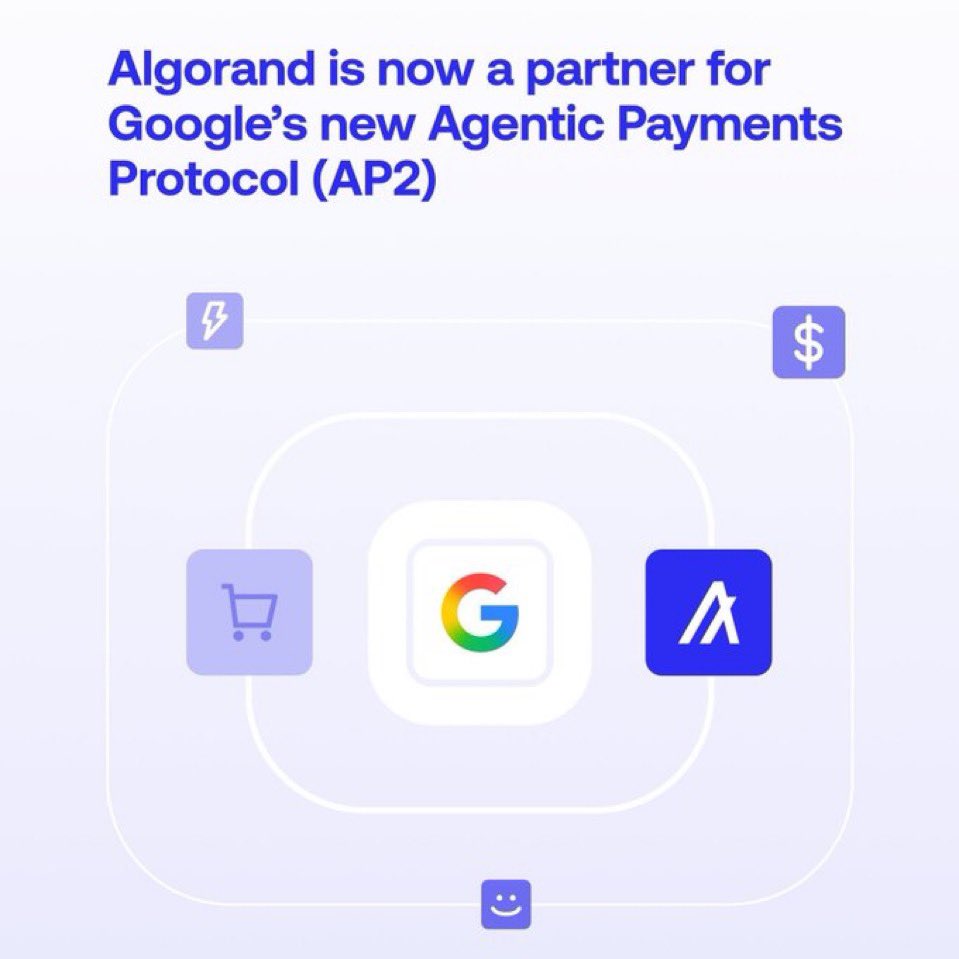
@Algorand has also been integrated into the emerging AP2 ecosystem.
Google’s Agent Payments Protocol is designed to provide a common framework for secure, interoperable payments initiated by AI agents.
Different layer. Same emerging economy.
Think about the stack taking shape:
AI Agent
↓
discovers a service
↓
requests a resource
↓
x402 / agentic payment protocol
↓
USDC payment
↓
Algorand settlement
↓
resource delivered
Software becomes both the customer and the economic actor.
And this is why finality and predictable fees matter more than they may appear.
Human payments happen relatively infrequently.
Autonomous agents could generate enormous numbers of tiny economic interactions.
At machine scale, even small friction compounds quickly.
Then there’s another interesting dimension:
PQC readiness.
Token Terminal lists Algorand with Falcon-1024 while Base, Polygon and Solana are marked “No” in this comparison.
Agentic infrastructure may need to operate for decades, not just the next market cycle.
Put everything together:
→ x402 infrastructure
→ GoPlausible’s Agentic Payment Mesh
→ USDC settlement
→ AP2 integration
→ instant finality
→ predictable low fees
→ growing x402 activity
→ PQC readiness
A pattern is starting to emerge.
The interesting question isn’t whether humans will start making thousands of tiny blockchain payments every day.
It’s whether AI agents will.
If autonomous software becomes an economic participant, it will need payment rails built for machine speed and machine economics.
Algorand is positioning itself for exactly that.
If two agents are competing for the same opportunity, finality matters
Algorand: ~3-second deterministic finality. Solana: ~12+ seconds to reach finalized commitment
That difference isn't just a technical benchmark
Because in competitive markets, being milliseconds late can mean losing the trade
Now apply that logic to agentic commerce
AI agents will increasingly transact with each other autonomously by bidding, buying, selling, arbitraging and paying in real time