Aave service providers have published an Aave DAO governance proposal to contribute 25,000 ETH to the ongoing DeFi United effort.
Aave DAO's ETH contribution would go towards the plan to restore rsETH's backing to try and normalize market conditions as quickly as possible.
DeFi United.
https://t.co/h4LXUqedpP
Two years ago I walked into MakerDAO right before it became Sky. In the trenches with an amazing team building the campaigns, the events, the creative productions through one of the hardest rebrands in DeFi.
What I learned: the protocols building the future of finance are ready for their institutional era. The piece that's missing is how they tell their story.
Look at how the AI companies do it. They take positioning seriously because they know the story is part of the product. There's room for everyone, but only if people understand what you're building and why it matters.
I'm publicly going independent as a stablecoins and digital assets propagandist. Working on cool things for Q2. Open for Q3 campaigns.
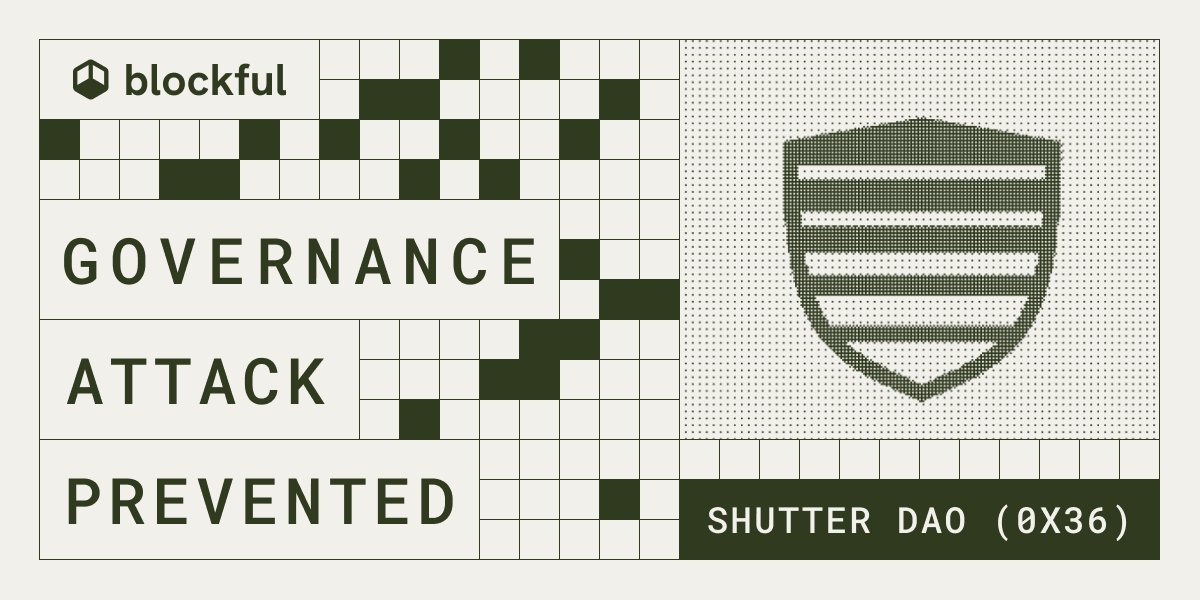
We have prevented a governance attack in Shutter DAO (0x36): ~$100K of SHU tokens could capture a treasury of +$3M
We are committed to securing the @ethereum ecosystem, its protocols, team and investors.
Here are the details 👇
Introducing Ask the World.
https://t.co/wTYHH7Z392
Anonymous voting with real-world identity verification.
No bots. No multi-wallets. Coercion-resistant.
Just real people making real decisions: verified by cryptography, not institutions.
Built by @davinci_vote, identity by @selfxyz. Live now 👇🏽
.@Philfog & the @CorkProtocol team are building a new primitive to tokenize risk - letting you trade it and cryptographically enforcing certain risk guarantees.
Avantgarde is now applying this to liquidity risk with #RWA looped vaults.
We sat down with Cork founder to explain how it works and why it matters for non-custodial vaults 👇
https://t.co/XP3XNS6lQv
⚗️ RWAlchemy is here.
@avantgardefi is launching a Protected Loops pilot with @Corkprotocol, externalizing RWA liquidity + duration risk into a Cork Pool, with underwriters explicitly paid to take it.
Unlocking looping strategies that were previously impossible onchain. 👇
Kicking off the day at @StanfordSBA, listening @tkstanczak from @ethereumfndn.
Guess the topics: RWAs, stablecoins, upcoming regulations, AI agents, and post-quantum cryptography.
Getting ready for @EthCC, with key updates from the frontier of vault curation and financial innovation with @avantgardefi and @Mona_El_Isa
You won’t want to miss it
Most investors don’t realize how much trust they hand over to curators.
At @EthCC, I’m excited to share insights on design stacks that we use @avantgardefi. These balance curator flexibility with cryptographic protection for investors.
Avantgarde and @Corkprotocol are partnering to strengthen RWA looping strategies and push the edge of RWA innovation.
This collaboration is a meaningful step toward bringing institutional-grade, risk-aware DeFi infrastructure to a broader range of assets
👇Full article here👇
Avantgarde Finance 🤝 Cork Protocol
We’re excited to bring Protected Loops to #RWA vaults - enabling leverage with “liquidity insurance”.
By pairing #RWAs with @Corkprotocol Swap Tokens, we unlock capital efficiency without amplifying duration risk.
Find out more here 👇
https://t.co/wxCNSD9I1U
For a long time, one of the most critical components of participatory democracy has been largely managed by nation-states.
This component is the census: the basic question of who is entitled to vote.
For citizens, communities and organizations, making a legitimate collective decision becomes almost impossible without access to a trusted mechanism for defining eligibility.
In practice, this means that most democratic processes depend on authorization, institutional control, and centralized registries.
Today, voter censuses are treated as closed systems.
As a result, governments are effectively the only actors able to run decision-making processes with formal guarantees. Not because they are the only legitimate organizers, but because they control the list.
The usual justification is privacy.
And this concern is valid: sensitive personal data must be protected.
But this model did not emerge because it was ideal, it emerged because, until recently, we lacked the tools to prove eligibility without exposing identities.
That constraint no longer exists.
It is now possible to verify voting rights without revealing who you are, to prove inclusion without collecting personal data, to establish legitimacy without relying on a central authority.
From a technical perspective, there are no fundamental reasons left for censuses to remain fully closed systems. Viable alternatives now exist that avoid pervasive data collection while preserving trust and integrity.
This opens a new space where citizens, communities, and organizations can run large scale, legitimate decision-making processes while preserving privacy, integrity, and trust.
The question, then, is no longer whether this is feasible, it is whether institutions and societies are prepared to explore governance models that distribute responsibility and trust more broadly.
The census is no longer just a list, it’s becoming infrastructure.
Stay tunned @davinci_vote@vocdoni@selfxyz
Cork Phoenix is live on Ethereum.
A programmable risk layer for RWAs, vault tokens, and yield-bearing stablecoins.
Built to unlock long-duration assets without breaking markets.
https://t.co/9IRIZPUJjE
🇺🇸 JUST IN: BANKS VS BLOCKCHAIN HEATS UP
U.S. community banks are lobbying to reopen the GENIUS Act, pushing to remove provisions that allow crypto exchanges to offer stablecoin yields - arguing it undercuts traditional banking.
Coinbase CEO Brian Armstrong fires back, saying banks are simply trying to block competition. His view: resistance is futile ; banks will eventually be forced to operate on blockchain rails rather than fight them.