My team at Google DeepMind completely pivoted to safety about 2 months ago, and I think you should too.
Interpretability is still dear to my heart, but it's always been a means to an end—and right now, I can't justify working on anything other than directly trying to improve frontier model safety.
We're hiring FTEs in Seattle only to work on urgent safety problems directly on Gemini. I cannot emphasize how important this is right now in human history!
Apply here: https://t.co/rGOgqwWMys 👇 (unfortunately, I won't be able to reply to any emails, but please apply!)
In my ongoing quest to find the limits of Opus 5.5, I directed it to audit my old scientific field, theoretical astrophysics. We indexed about 150,000 papers, audited 50,000 for issues, and did progressively more thorough checks on thousands more. We found nearly 1000 major errors that got cited many times, most are still uncorrected. This survey enabled me to estimate the efficacy of peer review for correcting errors (not very good) and to identify dozens of open questions that anyone with spare Claude Max tokens could answer today (.md context files included).
Bottom line: AI can speed up quantitative science by >1000x with no further model improvement required. But I'm seeing no evidence of this being pushed within universities, only academics complaining about labs dropping math proofs.
Among my fellow reformed academic high agency founders, however, several are speed running entire disciplines.
This survey has implications for how science will be run in the very near future. Hint: Academic publishing is dead. It was already a very stupid way to record and promulgate knowledge, and had been so for decades, even before all that publicly funded knowledge was locked behind paywall cartels. Now AIs can generate thousands of novel, correct papers per day, it is no longer meaningful for humans to consider a research paper a "unit of science" or to even bother much with the 99.9% of science which, up to this point, was necessary drudgery. Time to discover something like General Relativity or Evolution every week. LFG!!
Enjoy: https://t.co/BhRxKVvbim
FAA acting CTO Rebecca Guy: "When we started to see the occurrence where our network was having instability, we started to look at what was the cause. We saw two places that were actually pinging our network at a very high rate -- 1,000 connections over every 4 to 5 seconds."
(That sure sounds like hacking!)
🚨BREAKING: Trump Administration officials are not taking responsibility for their latest disaster. In a rare and shocking development, they are attempting to shift the blame to other people who aren’t running the government. Developing …
One of the biggest misconceptions people have about intelligence is seeing it as some kind of unbounded scalar stat, like height. "Future AI will have 10,000 IQ", that sort of thing. Intelligence is a conversion ratio, with an optimality bound. Increasing intelligence is not so much like "making the tower taller", it's more like "making the ball rounder". At some point it's already pretty damn spherical and any improvement is marginal.
Now of course smart humans aren't quite at the optimal bound yet on an individual level, and machines will have many advantages besides intelligence -- mostly the removal of biological bottlenecks: greater processing speed, unlimited working memory, unlimited memory with perfect recall... but these are mostly things humans can also access through externalized cognitive tools.
Two years ago I open sourced my DIY CNC machine, which cost me £2,655.80 and 9 months of my spare time. The Fusion 360 project, the drawings, the bill of materials, the STLs, the wiring diagrams and the Mach3 profile, all for free.
People ask why I didn't sell the plans... the answer is simple. Selling the plans would have defeated the whole point of the project, shutting out the very people I built it for.
My goal was to build a capable, sturdy machine for as little money as possible. Industrial-grade larger footprint machines are well out of reach for most hobbyists and small woodworking businesses. With a few minor trade-offs, you can build my machine for a fraction of the price, with nothing more than basic workshop tools.
10,000+ downloads later, people all over the world send me photos of the machine I designed, now fully built and operational in their own workshops.
That's what I love about open source. It's for people. Nobody needs permission or a subscription to build their own tools. You can repair them, upgrade them, and write your own software, because you know them inside and out.
This fills me with joy like nothing else.
this is what every computer does, slowed down enough to watch
a clock ticks. the chip grabs an instruction from memory, figures out what it means, does it, and moves to the next one
the whole program here is five lines: load 5, load 3, add, show the result, jump back. so the number just keeps climbing by 3
your phone does this billions of times a second
Google published a paper that might end the PhD.
It’s called “ScientistTwo”
For centuries, the bottleneck to human knowledge has been the human brain.
It takes five years of grueling labor to read the literature, find a gap, formulate a hypothesis, run the experiments, and write the paper.
But, Google automated the entire pipeline.
They built an AI that reads a problem, forms hypotheses, runs experiments, writes the paper, AND simulates its own peer review. no human touches it.
It reads millions of papers to find blind spots in the current science.
It generates novel hypotheses.
It designs the experiments. It writes the code to test them.
When the code fails, it debugs itself.
When the results come in, it analyzes the data, generates the charts, and writes the final academic paper.
It even simulates a brutal peer-review process to critique and improve its own work before it considers the project finished.
This isn't an LLM summarizing a PDF. This is a fully autonomous digital scientist.
What takes a human candidate half a decade of massive intellectual effort... the AI accomplishes in a fraction of the time, at a fraction of the cost.
The implications are staggering.
If you can spin up 10,000 autonomous researchers overnight, the rate of scientific discovery is about to go vertical. We are moving from artisanal, human-speed research to industrialized knowledge creation.
But it raises an uncomfortable reality for academia.
When an AI can read the literature, design the experiment, execute the code, and write the paper...
What exactly is the human supposed to do?
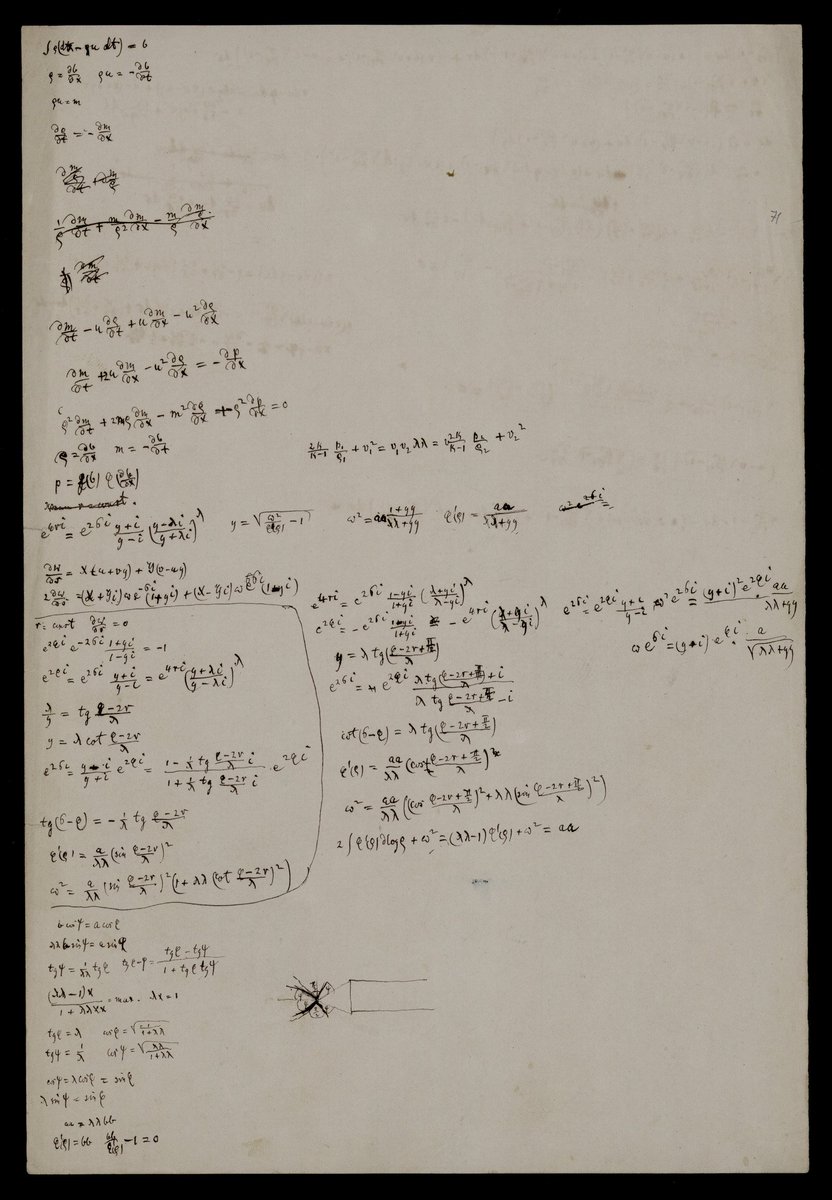
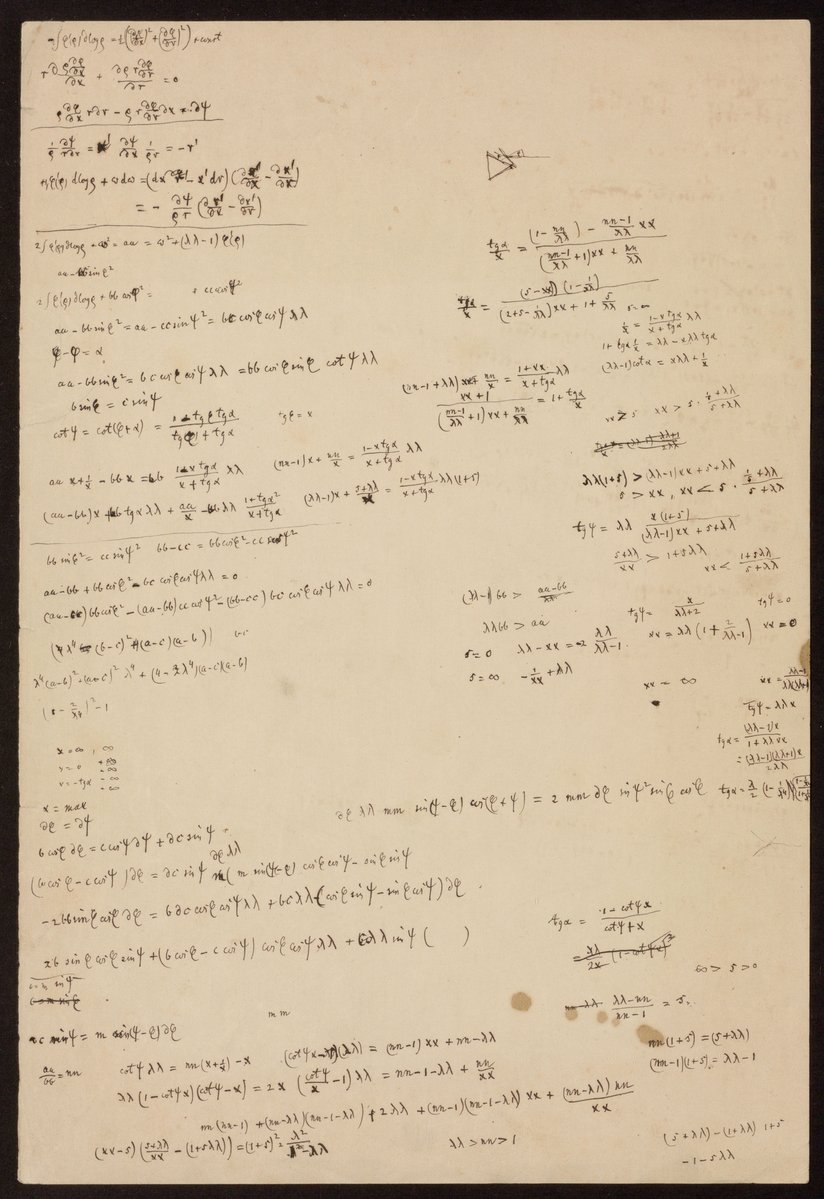
Been running Opus 5.5 agents over the notebooks of Gauss, Riemann, Hilbert and Grothendieck. around 12,000 pages so far. Heres the best finding so far:
Riemann's 1860 shock wave paper is famous for getting the energy part wrong however his unpublished sheets at Göttingen have it right the Rankine Hugoniot conditions a decade or two before Rankine and Hugoniot plus results usually dated 19061937, all in his own notation. A second sheet in another folder has the same physics.
There are probably thousands of potential undiscovered stuff in the research papers of the smartest ever to live imo all of them should be made public and reviewed by ai years of work can probably be transcribed by agents in days
I wanted to understand the structural and philosophical differences between GPUs, TPUs and newer alternatives (like Groq LPUs) without getting drowned in specs and jargon.
Mispronunciation of the day: "soldered" 🤦♀️...
0:00 Intro
0:56 The origin story of TPUs
3:42 The first TPU: an ASIC for matrix multiplication
5:21 SRAM vs DRAM
7:21 The memory bandwidth problem
9:14 Systolic arrays
12:48 TPU vs GPU
17:51 Groq’s LPU
25:38 GPU vs LPU
28:36 NVIDIA on the AI chips boom
Absolutely incredible: MIT researchers say GPT-6 Astra improved a small Qwen model’s math score from 7.9% to 48.1% by directly editing just 0.016% of its weights, without gradient-based training.
The result points toward AI systems that can diagnose and improve other models directly, a potential step toward self-improving AI.
@nntaleb I recall my lifelong Catholic father on his first encounter with a Quaker meetinghouse he remarked "they went out of their way to make it plain."