@KatyKray73 The AI buildout isn't just competing for electricity.
It's competing for electricians, engineers, construction workers and commissioning specialists.
That's a bottleneck that doesn't get discussed nearly enough.
@altcap People think the AI race is about models and chips.
Increasingly it's about power, permits, construction and skilled labour.
The physical world is becoming part of the AI stack.
@WallStreetApes The AI boom is exposing a reality few people considered.
You can build the data centre.
You can buy the chips.
But you can't instantly build the power infrastructure needed to support them.
The AI race isn't just competing for chips.
It's competing for electricians, engineers and construction workers.
AI is becoming a workforce challenge as much as a technology challenge. 🏗️
https://t.co/9bNJ0M8UGZ
We’re reaching the point where AI infrastructure financing is being measured in the same league as nation-building projects.
Not millions.
Not billions.
Tens of billions of dollars for a single compute deployment.
…and people think AI is just software.
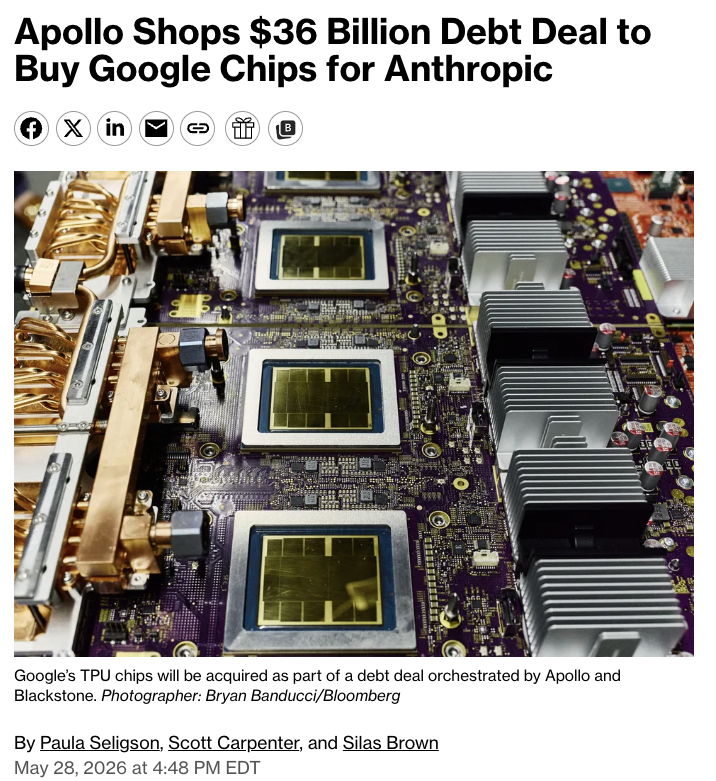
Apollo $APO and Blackstone $BX are shopping a ~$36B debt deal to finance Google TPU chips for Anthropic, per Bloomberg.
The structure would buy the TPUs through an SPV and lease them to Anthropic for AI infrastructure.
$AVGO, which helps Google develop TPUs, is reportedly backstopping payments on the largest senior portions of the deal.
Apollo $APO and Blackstone $BX are shopping a ~$36B debt deal to finance Google TPU chips for Anthropic, per Bloomberg.
The structure would buy the TPUs through an SPV and lease them to Anthropic for AI infrastructure.
$AVGO, which helps Google develop TPUs, is reportedly backstopping payments on the largest senior portions of the deal.
@wallstengine An interesting consequence of the AI buildout:
If companies like Meta build more AI infrastructure than they need internally, they may end up becoming infrastructure providers themselves.
The line between technology company, cloud provider and utility continues to blur.
Anthropic just turned the Pope into a legal weapon against the Pentagon.
Yesterday Pope Leo XIV published a 245-paragraph document demanding that AI companies be "disarmed" and that autonomous weapons be permanently banned.
He compared Silicon Valley's unchecked ambition to the Tower of Babel and called the exploitation behind AI development "new forms of slavery."
Everyone posted about it but nobody noticed WHO was sitting next to him:
Christopher Olah, co-founder of Anthropic, was seated in a row of cardinals at the Vatican to personally present this document alongside the Pope. A 33yo atheist tech billionaire standing next to the leader of 1.4 billion Catholics telling the world that AI weapons must be stopped.
This matters because of what's happening in a courtroom right now:
Anthropic has been locked in a legal war with the Trump administration since February. The Pentagon blacklisted them as a "supply chain risk to national security" after Anthropic refused to let the military use their AI for two things: Fully autonomous weapons and mass surveillance of American citizens.
That designation is usually reserved for companies linked to foreign adversaries like China and Russia. But they used it on an American company because that company said no.
The Trump administration called Anthropic "liberal-leaning" and accused them of trying to dictate military policy.
Defense Secretary Pete Hegseth personally signed the blacklist order and Trump directed every federal agency to stop using Anthropic's technology.
Over 100 enterprise customers called Anthropic asking if they were safe to work with.
The company estimates the government's actions could cost them multiple billions in lost 2026 revenue.
Anthropic obviously sued. Two separate lawsuits in two courts.
A San Francisco judge ruled in their favor and blocked the supply chain designation but the DC appeals court ruled against them. The two courts are in direct contradiction right now.
And a few days ago, the DC appeals court heard oral arguments in the case. Judges were visibly divided.
On May 25, the Pope published a document that validates Anthropic's exact legal position on autonomous weapons. Word for word.
The Pope wrote: "It is not permissible to entrust lethal or otherwise irreversible decisions to artificial systems." That is essentially the SAME sentence Anthropic put in their Pentagon contract that started this entire fight.
And Anthropic's co-founder also spoke at the Vatican event:
He told the audience "every frontier AI lab operates inside incentives that can sometimes conflict with doing the right thing" and called for "moral voices that the incentives cannot bend."
A co-founder of an AI company publicly admitted at the Vatican that AI companies CANNOT be trusted to regulate themselves...
This is literally a legal strategy by Anthropic.
Anthropic now has the most powerful moral authority on the planet publicly endorsing the exact ethical position that the Pentagon punished them for. Every judge reviewing this case watched the Pope validate the two red lines Anthropic drew.
The Pope's encyclical will almost certainly be cited in court filings.
The Pentagon's argument is that a private company cannot dictate how the government uses AI in matters of national security. Anthropic's argument is that certain uses of AI are fundamentally unethical regardless of who's deploying them.
Yesterday the Pope told 1.4 billion people that Anthropic is right.
The appeals court could rule any day now. If Anthropic wins, every AI company in the world gets legal precedent to refuse military contracts on ethical grounds.
If they lose, the message to Silicon Valley is clear: Build what the government tells you to build or get destroyed.
Either way, the company Trump tried to crush literally just turned the Vatican into their ally.
What do you think?
“Data centres are being rolled out at a feverish pace, with some of the largest planned for Australia consuming as much energy as Adelaide.”
..and people still think AI is mainly a software story.
https://t.co/SX9cvdMWpE
@Road_Closed1984 Interesting shift underway:
AI companies increasingly need to think like industrial developers and utilities, not software firms.
Because once a data centre reaches enough scale, communities start asking infrastructure questions, not technology questions.
AI discussions usually focus on chips and electricity.
But water may become just as important.
Modern AI infrastructure generates enormous heat, and cooling those systems can place real pressure on local water resources.
@MarioNawfal Heavy industry used to mean steel mills and refineries.
Now it increasingly means AI data centres drawing hundreds of MW each.
The digital economy is developing a very physical footprint.
@fortworthchris Utilities are quietly becoming part of the AI stack.
The conversation is no longer just about models and GPUs.
It’s now also about:
⚡ power
🔌 transmission
🏗️ substations
🧊 cooling
@SmallCapSnipa People talk about AI like it’s just software.
But increasingly it’s about:
⚡ Power
🔌 Grid capacity
🏗️ Data centre construction
🧊 Cooling
🌊 Water
The AI race may end up constrained less by chips and more by physical infrastructure.
@ctindale The tragedy of today’s science is not ignorance but over-specialisation—experts focused intensely on their domain, blind to others’ limits. Climate science and mining are parts of the same decarbonisation puzzle that demands cross-disciplinary insight and humility. #PolyCrisis
It could operate 40 per cent faster than Intel while consuming 10 per cent less energy. Read more: https://t.co/WpsmQcggsz
#china#science#technology#scmpnews#scmp
🧵 1/5 The cultural impact of AI in China is transformative, reshaping education, daily life, and national identity while presenting unique challenges. Here's how AI is influencing Chinese society. #AI#China
https://t.co/HbItIEvmXP
2/5 🤖 AI companions are becoming commonplace in Chinese households, enhancing children's learning experiences. Robots are not just tools; they're seen as friends and teachers, fostering curiosity and engagement from a young age. #EdTech
https://t.co/rOfuBI5ysU
5/5 ⚖️ However, concerns about privacy and surveillance remain. As AI becomes more integrated into daily life, balancing innovation with ethical considerations is crucial. Keen to know your thoughts.
#EthicsInAI
4/5 🌍 The rise of AI has instilled a sense of national pride, showcasing China's innovation capabilities. As homegrown companies like DeepSeek challenge global giants, public perception of AI is shifting towards acceptance and enthusiasm. #TechInnovation
https://t.co/0VIshz1sKQ