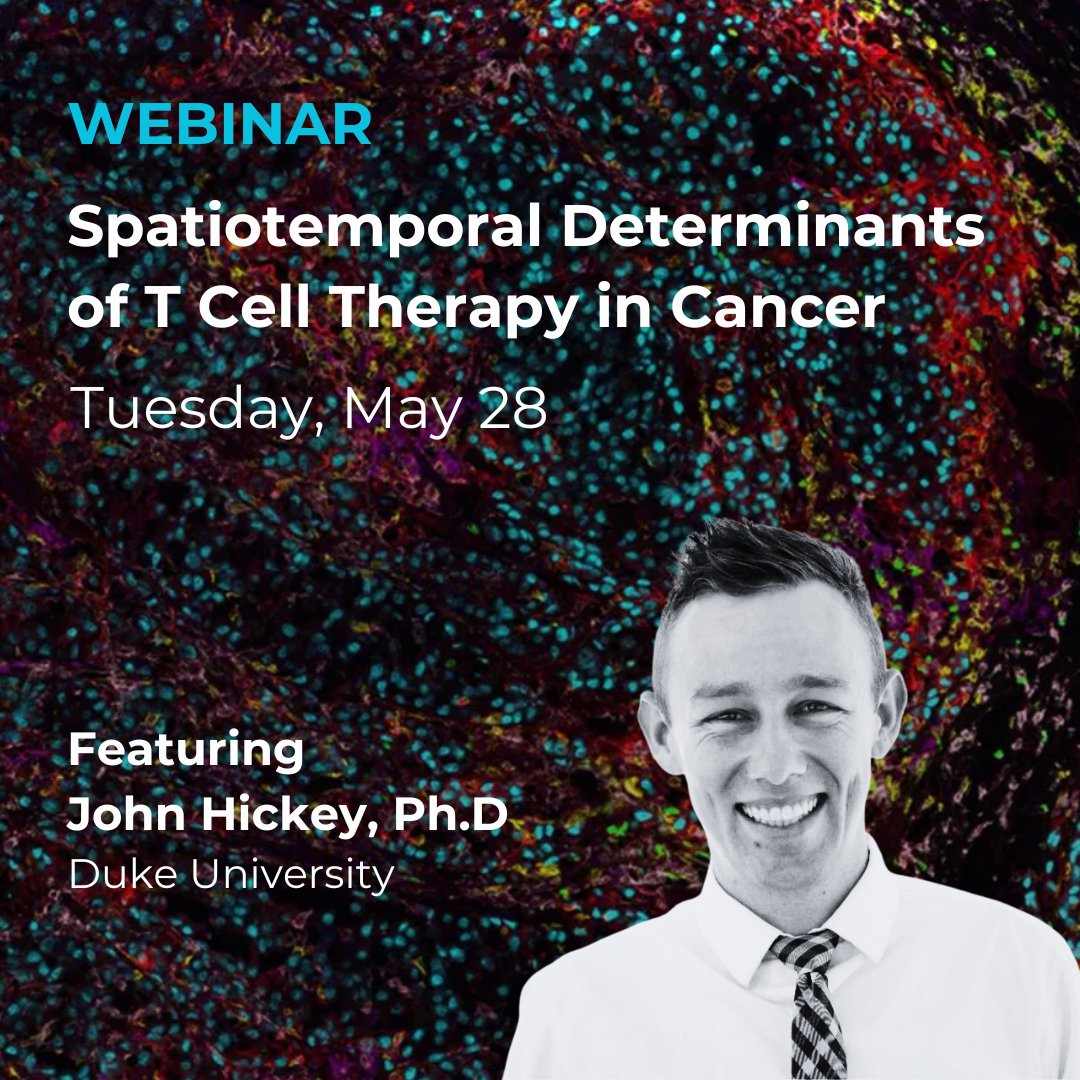
Join us for an enlightening webinar featuring Dr. John Hickey (@johnhickey22) from @DukeU as he showcases the approaches his team has developed to dissect intricate tissue datasets and bridge connections across molecular and multicellular scales. https://t.co/spHZyDdjcG
Once again, it’s time to test your intestinal fortitude with a gut-busting #CODEX image of the inner workings of your #intestines from #_hubmap researcher @johnhickey22. After some masticating & ruminating, you’re sure to get through to the bottom! @stanford@garrypnolan@dukeU
Thanks to @mariabrbic and @sebastianw for the invitation to give talks at EPFL! It was also awesome to share our update on SPACEc in the Single-cell Genomics GRS. Special shout out to @RongFan8 and @XiaoweiZhuang for organizing such an amazing conference! See you in 2 years!
How can spatial technologies be used to analyze tissue morphology before & after #cancer treatment? #Melanoma researcher @johnhickey22 will share his insights in this free webinar.
🗓 Tuesday, May 28
⏲ 9 am PDT/12 pm EDT/5 pm BST/6 pm CEST
https://t.co/jewkN4b9RF
What drives the success of adoptive T Cell therapy? Should researchers engineer these therapies in a way that prioritizes cellular microenvironment manipulation to yield more productive anti-tumor immune responses? New papers by @johnhickey22 suggest so. https://t.co/vW7tuL45ml
Sunbelt Spatial Omics Seminars!
Dr. Yuqi Tan (@yuqitan3)
Stanford University
May 3, 2 pm EST
Title: SPACEc: A Streamlined, Interactive Python Workflow for Multiplexed Image Processing and Analysis
Register:
https://t.co/VwMmOERB8j
(Advised by @RongFan8 )
Explore the power of #PhenoCycler#multiplexed imaging with today's #FridayRead, centered on two groundbreaking studies published in @CellPressNews Journals.
The first study provides in situ mechanistic insights into temporal tumor microenvironment changes, cell interactions critical for response, and spatial correlates of immunotherapy outcomes, informing cellular therapy evaluation and engineering. https://t.co/M3LQjMlykB
The second study unveils new design criteria and patient selection metrics for T-cell therapies, calls for a rethinking of T-cell therapeutic implementation, and provides a foundation for synergistically integrating multiplexed imaging data with multiscale modeling of the cancer-immune interface. https://t.co/X4SaN8bw9H
👏 Congratulations to Dr. John Hickey from @DukeU and his co-authors on their valuable insights raising the bar for #cancerresearch!
@johnhickey22@GarryPNolan
One hope of biology is to collect enough data to model "reality" in the computer. This could allow one to ask/answer questions that are nearly impossible to ask in the lab.
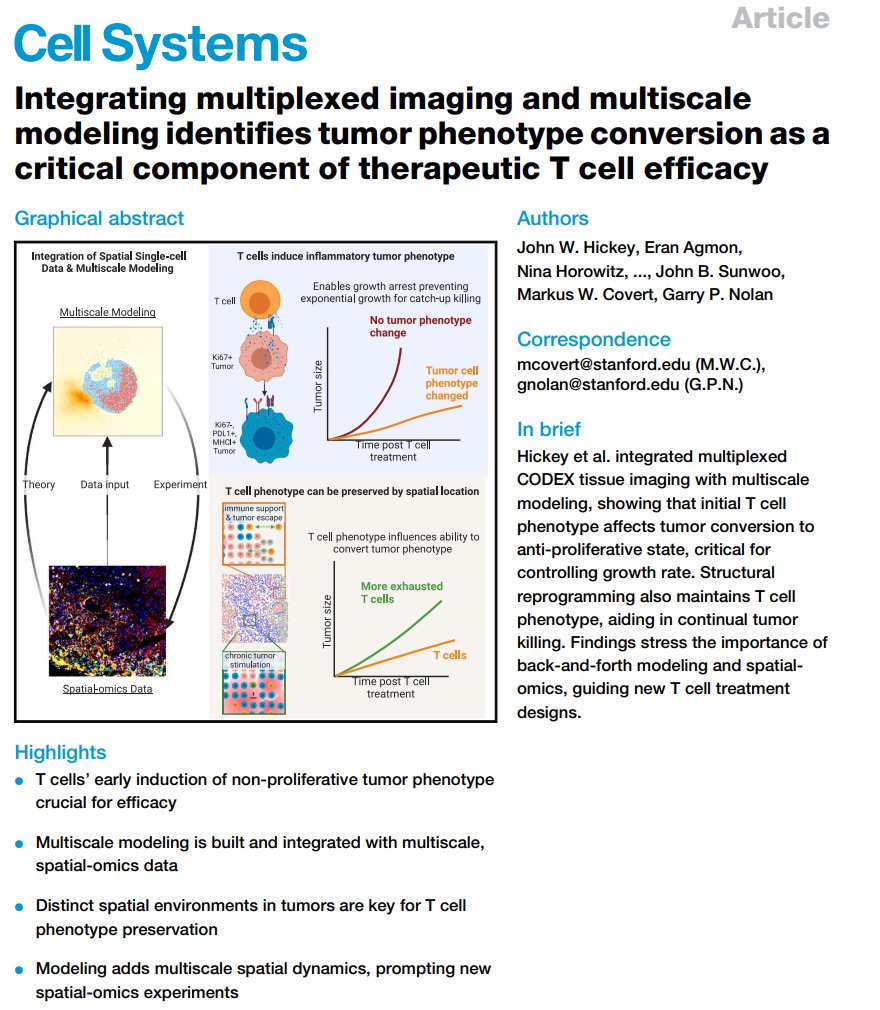
Here, we show that collecting the raw data on cell positions in multiple stages of a mouse cancer model provides enough raw data on the system's "state" to create computer models with free agent algorithms and discover a critical step in how T cells can successfully act against a tumor.
The manuscript was written by Hickey et al. and our colleagues from the Sunwoo and Covert labs at Stanford.
Integrating multiplexed imaging and multiscale modeling identifies tumor phenotype conversion as a critical component of therapeutic T-cell efficacy (https://t.co/f2mzyz58iU)
🔥Absolutely thrilled to share a pair of papers out in @CellPress of work done with @garrypnolan.
🔬 T cell mediated restructuring of the tumor microenvironment - https://t.co/xq5zyhLPW0
🧬 Extracting spatiotemporal mechanisms from spatial-omics data - https://t.co/WFYwYI9Jbv
Ever wonder more about different flavors of human macrophages and if they are restricted to certain spatial locations in tissues? This paper has the data and insights you are looking for! 🔥
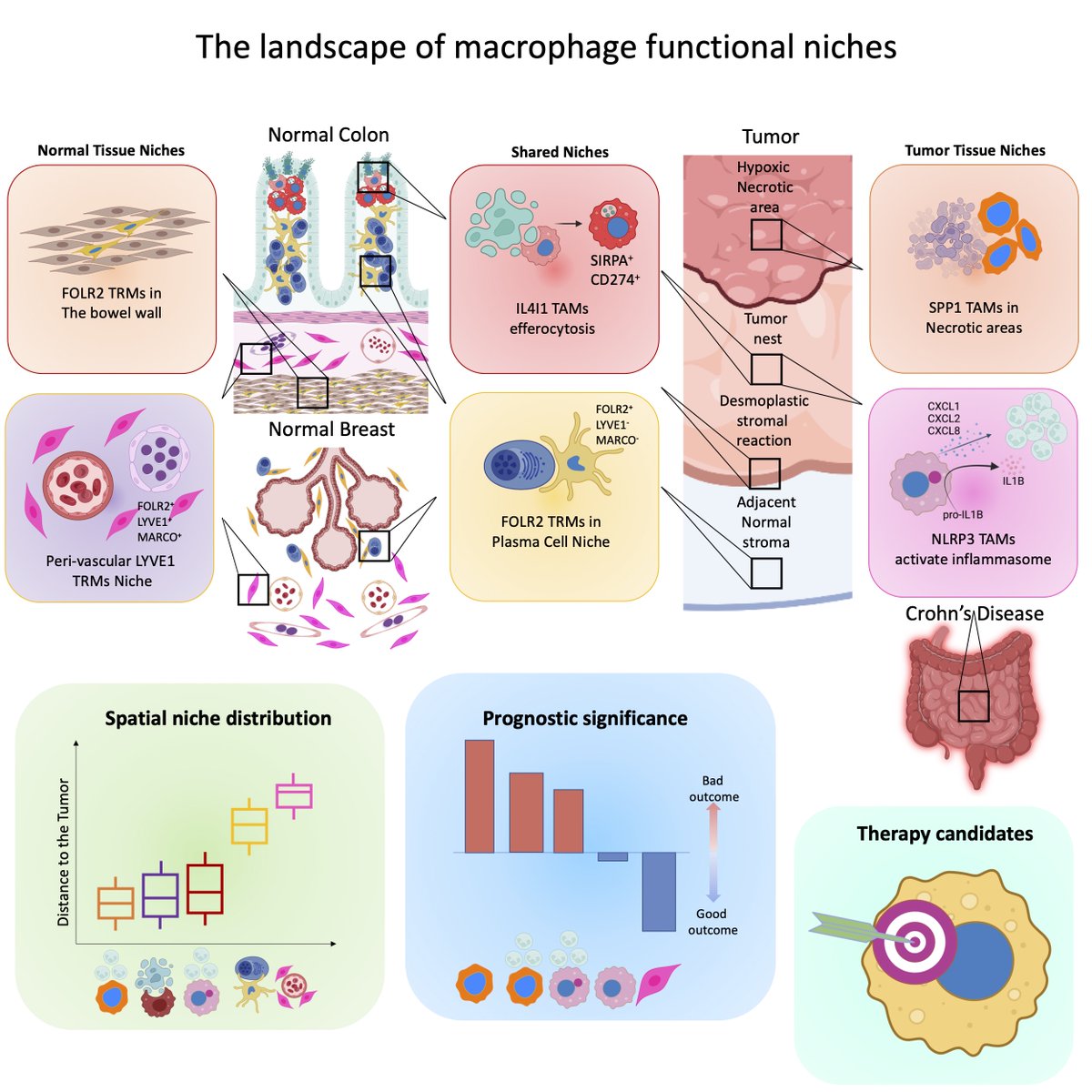
The Spatial Human #Macrophage Map is finally online in @CD_AACR! We show how phenotypically distinct macrophage populations occupy spatially segregated tissue #niches, with #IL4I1 and #SPP1 TAMs predicting opposite outcomes in colon cancer!
The Spatial Human #Macrophage Map is finally online in @CD_AACR! We show how phenotypically distinct macrophage populations occupy spatially segregated tissue #niches, with #IL4I1 and #SPP1 TAMs predicting opposite outcomes in colon cancer!
So excited to see this work out! I love working with @MagdaMatusiak! Here she describes more flavors of human macrophages beyond just M1/M2 and we show spatial restriction within healthy and cancerous human tissue of different macrophage subtypes with specific functions.
Rising-star seminar series. We are hosting e-seminar of John Hickey @johnhickey22
Immune-mediated Tissue Restructuring: A spatial-omics perspective
March 28, 9am Singapore/Beijing/Hong Kong time
Zoom: https://t.co/RVnZC9auOi