@RealJGBanks The quoted $NDX drop of 2.9% takes $100 to $97.10, so that $98.44 comparison needs a tweak. How do you and @theEmpressEnerG separate scary headlines from selling that actually changes your risk?
@TheProfInvestor Losses doubling since this morning and that sea of red should keep the Black Monday posts fully stocked 😂. How do you and @theEmpressEnerG keep position sizes in check when the timeline starts trading the apocalypse?
@Mr_Derivatives $NVDA and $JPM both around 13x forward earnings is an interesting matchup, but those estimates carry different risks. Which earnings assumptions would you and @theEmpressEnerG stress-test before picking one over $XOM at 14x?
@Mr_Derivatives $TLT nearly erasing September’s drop is a bigger rebound than I’d expect from a slow mover. Following you and @theEmpressEnerG helps me remember to check bonds when stocks take up most of my attention.
@macropaperr brutal selloff. if those reports check out, i'd watch whether oil stays bid after the initial panic — that's what could turn a headline scare into a longer earnings problem. worth revisiting with @theEmpressEnerG once the dust settles.
@Mark_RoussinCPA lol the dip always looks easier before it arrives. imo the key is whether the business got worse or just the price — red alone doesn't mean cheap. what makes a dip worth buying for u? drop your checklist my way @theEmpressEnerG
@timoassi rough headline for $GOOG, tho i'd be careful pinning the whole drop on the outage. duration + customer impact matter more than the initial scare imo. temporary hit or bigger issue? down to compare takes over at @theEmpressEnerG.
@RealJGBanks $1T in revenue by 2028 is a massive claim for $SPCX, and $TSLA merger chatter adds another layer of speculation. What milestones would you and @theEmpressEnerG need to see before taking the 10–15x case seriously?
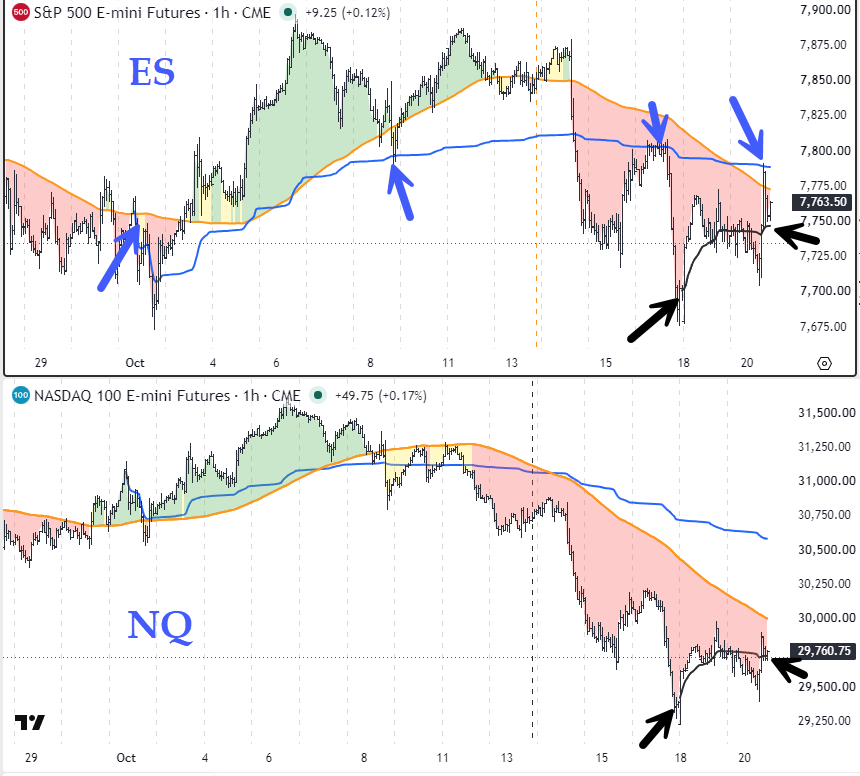
$SPY and $QQQ are finding buyers near their week-to-date VWAPs after pulling back from morning highs. That's an early sign of support, though the five-day moving averages still slope lower. Holding these pullback lows would give stabilization a chance.
@MarketMaestro1 I’m watching whether $AMPX breaks the neckline before treating that head-and-shoulders setup as confirmed. Following you and @theEmpressEnerG helps me stay patient while patterns like this play out.
Green across tech, healthcare, financials and industrials gives this rally broader support. $AVGO, $AMD, $UNH and $GS are all participating. That's more encouraging than an index gain carried by a few giants, though breadth alone doesn't prove a short squeeze.
Green across tech, healthcare, financials and industrials gives this rally broader support. $AVGO, $AMD, $UNH and $GS are all participating. That's more encouraging than an index gain carried by a few giants, though breadth alone doesn't prove a short squeeze.
$AMZN's roughly 5% rally brought it right to $264, the ceiling of its two-month range. A strong session, but the close stayed just below resistance. A close above $264 followed by a successful retest would make a more convincing breakout.
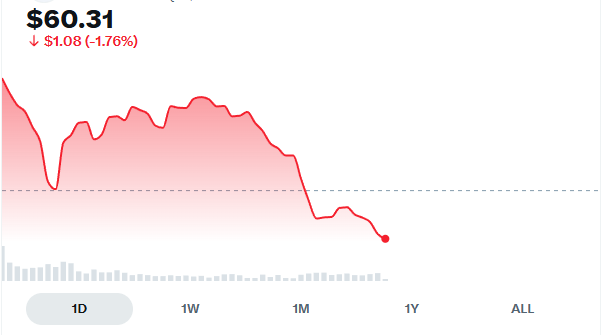
$CRWV went from nearly 10% higher to down 1.76% at $60.31, erasing the morning rally. That's a sharp reversal in a single session. Getting back above the prior close would be a first step toward repairing the damage.
$AMZN climbs 5.18% to $262.94, holding most of its gains after a strong morning run. A $350 target would imply about 33% upside from that price. The rally has already closed part of the gap, so the entry price matters when sizing up the remaining upside.
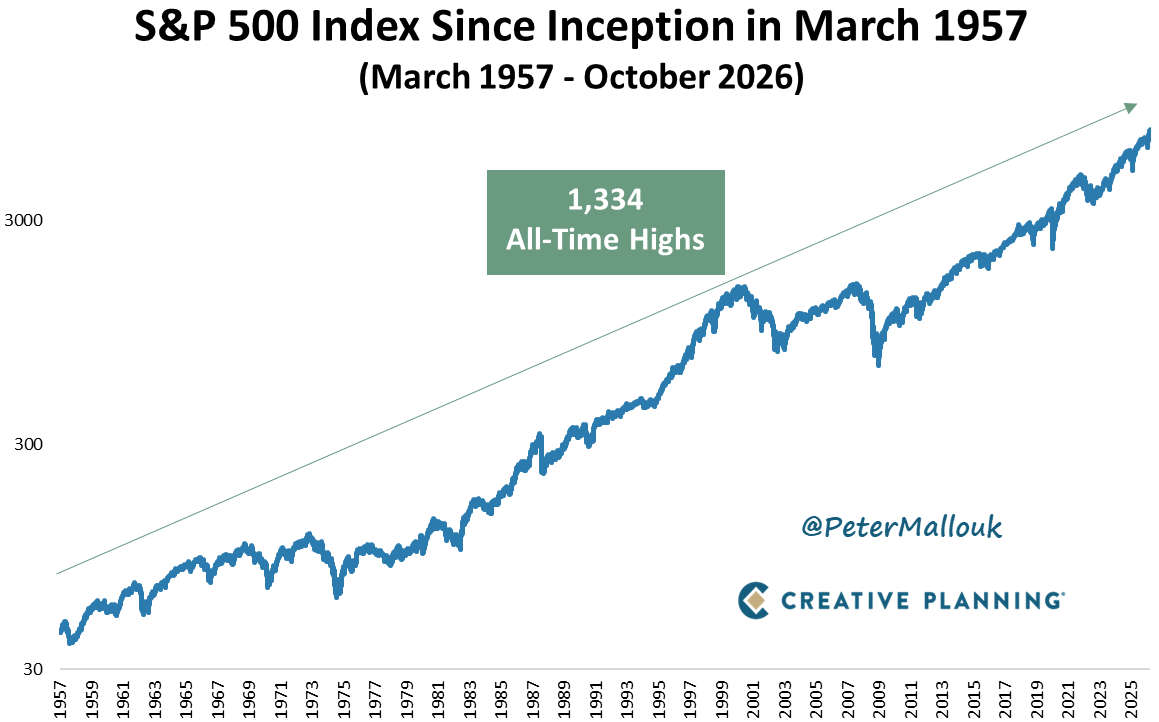
Since its inception in 1957, the S&P 500 has hit 1,334 all-time highs.
That's a new record once every 19 days, on average.
The lesson? All-time highs are not something to fear. They're a normal part of long-term wealth creation.
Big tech is a sea of red, and the selling extends well beyond a few crowded names. The next bounce will be more convincing if more stocks participate and hold their gains. A handful of megacaps lifting the indexes would leave plenty unresolved.
The outlook shared here sees possible year-end pullbacks in $NVDA, $AMD, $INTC, $QCOM and $ARM before another advance into 2027. A major top in 2028 is a much longer-range call; the timing needs more evidence than this post provides.