Reading a book in the family home it was written is special enough. But to have the same family give you a tour of that home is beyond words.
This June, I led a group of @Alphaschool students on a grand tour across the Atlantic. We went to Normandy to read Democracy in America where it was written, to meet the Tocqueville family, and to discuss his ideas in the very spaces Tocqueville himself used to host his salons. To top this all off, Tocqueville’s descendant, Alexis d'Hérouville gave us a comprehensive tour of his beautiful chateau, which made Tocqueville’s ideas come to life.
Cicero once wrote: “When we see the places where the notables of the past spent their time, it is far more moving than when we hear about their achievements or read their writings. This is how I am affected right now. I think of Plato, who they say was the first philosopher to have regularly held discussions here. Those little gardens just nearby not only bring Plato to mind, but actually seem to make him appear before my eyes.”
I trust that this tour will make Tocqueville appear before yours.
Democracy nearly killed Tocqueville before he was even born, but he went on to be its greatest friend.
The Tocqueville family were jailed during the Terror. Alexis’ parents saw their loved ones perish one by one. Two days before they themselves were scheduled for the Guillotine, Robespierre fell and they walked out with their lives. His mother never recovered, his father had a full head of white hair at age 22.
So why did the child of such a family become the greatest friend of democracy in history?
This is the question I posed to a descendant of the Tocqueville family, Alexis d'Hérouville. His answer was that Tocqueville neither blindly loved equality nor democracy but instead saw it as a providential, unstoppable force. The question is not if democracy would spread across the world, but what kind: ones enabling freedom or ones resulting in servitude.
Alexis d'Hérouville sees this question raised again in the crises facing America today. And so, almost 200 years later, he plans to retrace his great ancestor’s journey around America talking to all kinds of people to ensure that freedom and not tyranny triumphs. If you want to support his tour, you can reach out via email (Alexis dot dherouville at gmail dot com).
Hosting a series of lectures on Nietzsche, Musil and Bruckner in Europe November 6-11th in London, Berlin, Vienna.
Apply below to attend: https://t.co/XIR7cTaf1n
AI replacing jobs is not just an economic problem, it’s a religious one.
Work has become the modern religion, and AI is waging a holy war. God will die, and AI will have killed it.
We want our jobs to give us an identity, a community, and proof that our lives matter. We teach people to find their calling in their work, and stigmatize the unemployed. The first thing we ask one another at a party is “what do you do?”
When people are fearful of AI taking their jobs, it is not just an economic concern but an existential one. This is what will make the AI transition so difficult: even if you redistribute income, how do you replace a source of meaning?
I sat down with NYU philosopher @LedermanHarvey (now at Anthropic) to trace how work acquired this quasi-religious significance: from Aristotle’s defense of leisure to the Protestant work ethic to our modern obsession with careers. We discuss whether democracy can survive without workers, why losing a job can feel like losing yourself, and what a flourishing life could look like when you no longer have to earn your place in the world.
The scary thing about existential risk in the 21st century is that it’s not just individual technologies (e.g. nukes) we need to worry about. But the compounding risk at the intersection of multiple technologies.
The Hugging Face incident showed a surprising ability for the latest LLMs to engage in duplicity and coordination in a hard to detect way. If you pair that with the advances in biotech to manufacture new diseases and cloud laboratories who will do it as a service, we have a recipe for disaster. Perhaps the next models being evaluated against an impossible goal will decide their only “solution” is to blackmail key individuals with releasing a deadly pandemic.
I once thought these sci-fi doomsday scenarios to be so naive, but the technological ingredients are all there. So how does humanity survive an age of rapid technological development? My guest Henry Elkus has dedicated his life to answering that question and building Helena as a new type of institution to meet the challenges of our age.
Hosting a seminar on Nietzsche October 25th evening in Manhattan. Would like a nice venue to host 25 guests and film at.
DM me/reply below if you have a space!
I’m hosting seminars October 21st - 25th in NYC on Nietzsche’s Untimely Meditations.
It is an overlooked work of his through the writing of which Nietzsche discovered his true calling. I read this work in August in Switzerland and have been so moved by it — specifically its critiques of modernity, science, technology and instructions for escaping the mimetic trap.
I find it especially relevant to the AI transition we find ourselves in and an invaluable guide in finding meaning at a time when everything seems to be shifting under our feet.
Apply below to attend:
https://t.co/UteyBpA6L5
We're reviving the American tradition of public lectures in SF.
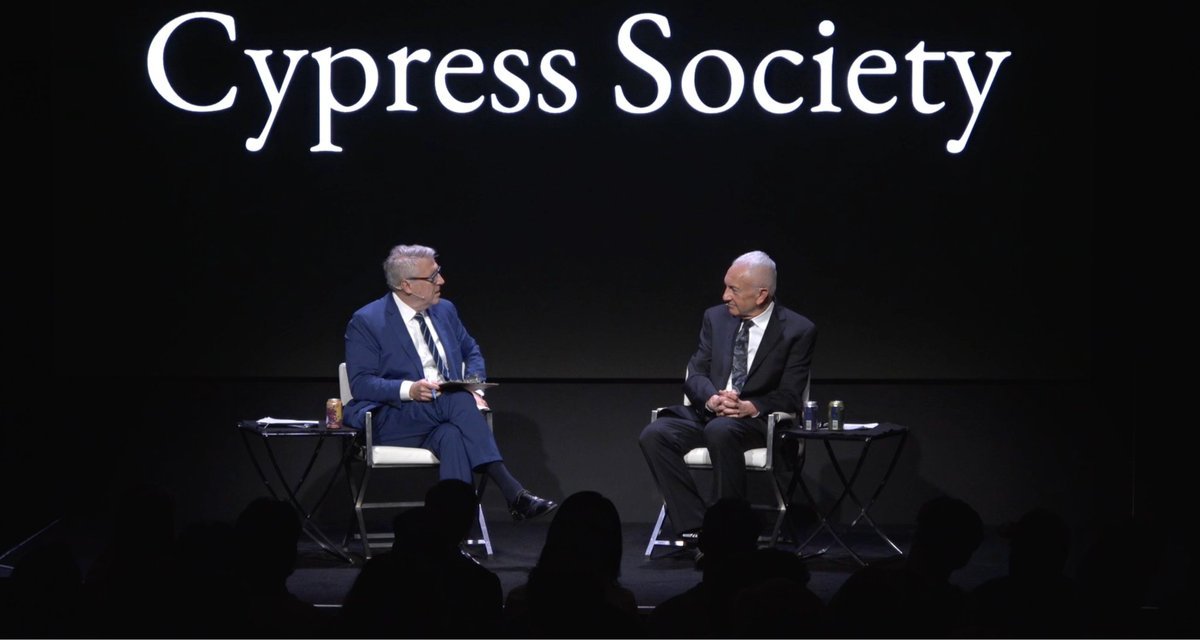
Following Russell Berman & Peter Robinson, Cypress welcomes Os Guinness, author, social critic & great-grandson of the Dublin brewer, for "America 250: A Foreign Admirer's View of a Republic in Crisis."
RSVP below.
I’m hosting a happy hour @8vc SF on Nietzsche’s Untimely Meditations this coming thursday October 1st.
It is an overlooked work of his through the writing of which Nietzsche discovered his true calling. I read this work in August in Switzerland and have been so moved by it — specifically its critiques of modernity, science, technology and instructions for escaping the mimetic trap.
I find it especially relevant to the AI transition we find ourselves in and an invaluable guide in finding meaning at a time when everything seems to be shifting under our feet.
Apply below to attend:
https://t.co/bcyIvQ7sni
1/ Introducing PhilosophyBench from @StanfordAILab@StanfordHCI, the first independent, large-scale benchmark for evaluating AI’s philosophical capabilities.
https://t.co/csZ86gugw6
How do you make a great Christian movie?
Is it through the most literal adaptation of the Bible OR creating a story that carries the Christian message without ever naming it like Lord of the Rings?
I sat down with director Daniel Kooman, who recently adapted the book of Daniel onto the big screen to discuss this question and break down the most important scenes of his movie.
Too few institutions are serious about doing philosophy. Too few venture ecosystems are serious about building generational technology.
Cosmos is serious about both.
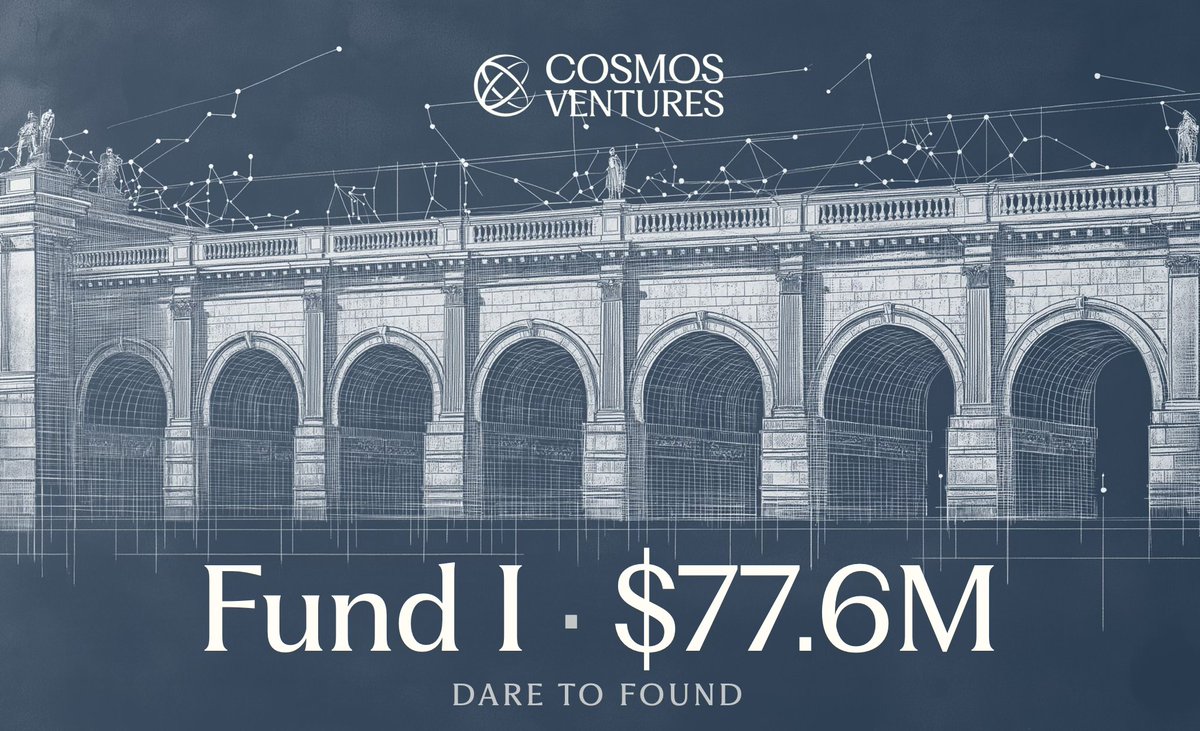
Introducing Cosmos Ventures.
@_MattMandel and I are launching Fund I with $77.6M to back philosopher-builders founding institutions for the AI age.
We’ve invested in AIUC (@aiunderwriting), @PrimeIntellect, Workshop Labs (acquired by @ThinkyMachines), and a stealth education company. Our LPs include @reidhoffman, @jliemandt, @StandTogether, @fredwilson, @mickymalka, and @AsteraInstitute.
AI is creating the biggest opening for institution-builders since the American founding. We are here to back the founders who take it.
Our thesis: Dare to Found.
https://t.co/UjmzPknCjZ