Epistemological sovereignty in AI is the 21st century’s nuclear revolution: a self-help national security project of vital importance, in which the winner, once again, tries to kick away the ladder behind them.
Epistemological sovereignty in AI is the 21st century’s nuclear revolution: a self-help national security project of vital importance, in which the winner, once again, tries to kick away the ladder behind them.
I'm still not quite sure why people seemed to think that if they created powerful ai systems that power would stay with them, rather than being instantly expropriated by the structure designed to crush threats.
As for Britain, as I was saying last year: we're in a bad place
@edwardstrngr65 Isn’t that becuase unmanned systems are additive, but not yet alternatives to (still) necessary legacy systems? The real problem is government framing X% of GDP on defence as the output, instead of an input.
Lord Hermer is Keir Starmer's most senior legal adviser.
He worked with a convicted fraudster to drag British soldiers through the courts over false claims.
Now, he wants to let activist lawyers do the same to veterans who served in Northern Ireland.
@blagden_david@EconomicgrowthE@BearJFK Russia invaded Georgia in 2008. Obama to Romney in 2012: 'the 1980s want their foreign policy back.' Hindsight, foresight, or insight? The Davos Disciples of ILO-woo wouldn't face reality then, and many still refuse to now. It's a big problem.
@ElMonoGran42994@CbruntCo@Microinteracti1@maxbergmann AEW, AAR, C2, ISR, strategic lift, sensing, cueing & comms from space. Then there’s the lack of industrial throughput. We have big system-enabling gaps. That most Europeans don’t realise this is a problem. People who don’t know can’t make political noise about closing them, asap.
@CbruntCo@Microinteracti1@maxbergmann No, we won’t. Not on current time/investment lines anyway. Unless we are very honest about our current system critical failings and gaps, there’s zero chance we close them in time.
@Microinteracti1@maxbergmann You post much sense, but this is cope. It’s not about numbers on spreadsheets, it’s about the enablers that pull the system together so those forces can fight, survive, and repeat. Europe is catastrophically short of enablers and that’s where remedial focus should be - right now.
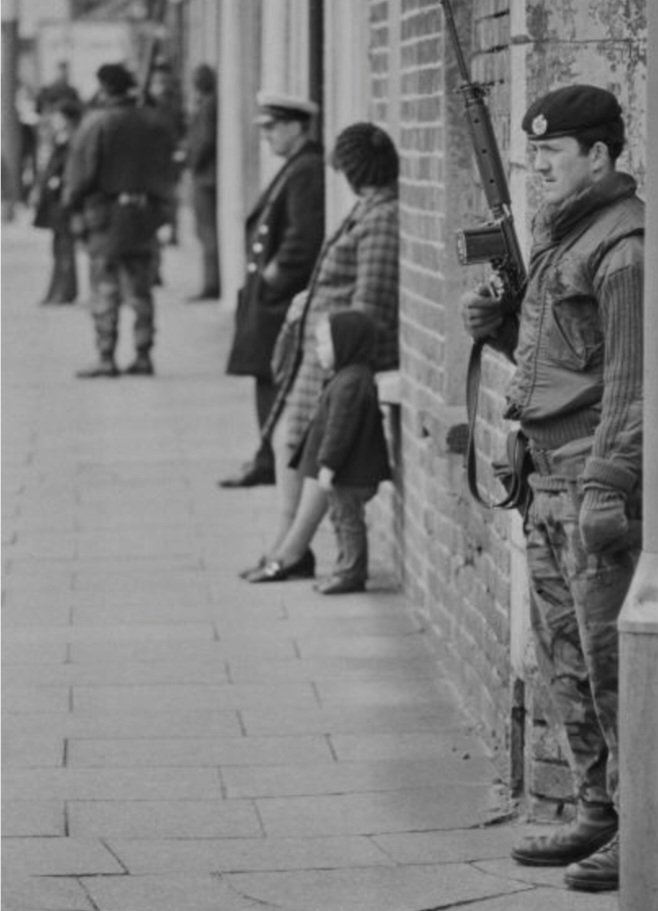
Three former soldiers will appear at Belfast magistrates court on April 20th. One is charged with a killing that took place in May 1972. He is not accused of acting outside his orders. He is accused of acting within them. The distinction no longer appears to matter.
This is the reality behind Labour's Northern Ireland Troubles Bill, a piece of legislation dressed in the language of reconciliation that functions, in practice, as an engine of persecution. The state that sent these men to Northern Ireland, that gave them their orders, that relied on their judgment in circumstances no minister has ever faced, is now the state that funds the machinery pursuing them through the courts half a century later.
That is not a technicality. It is the central fact. Taxpayer money flows to the lawyers challenging the actions of soldiers whose actions were sanctioned by the taxpayer. The government calls this justice. General Sir Peter Wall, who commanded the British Army for four years, calls it something without moral backbone. He is right.
The operational consequences are already visible. Elite soldiers are leaving the SAS and SBS rather than face the prospect of prosecution decades hence for missions carried out under government orders. The crisis has become sufficiently acute that reservists are being brought into the regular SAS to fill roles vacated by those walking out. Britain's most capable fighting force is being quietly hollowed out by a bill whose architects appear indifferent to the result. Seven former SAS commanders have warned that the legislation is doing the enemy's work, that operational secrets exposed through inquiries give hostile states a narrative of lawless troops. Moscow, Tehran and Beijing do not need to discredit British special forces. Westminster is doing it for them.
The asymmetry at the heart of this legislation is not incidental. It is structural. IRA members were released under the Good Friday Agreement. Many destroyed evidence, stayed silent, or received letters guaranteeing they would not be pursued. Soldiers kept records, gave statements, and remained traceable. Decades later, only one group remains available for scrutiny. Not because they are more culpable, but because they are more reachable.
The Coagh ambush of June 1991 illustrates the logic perfectly. Three IRA men were stopped by the SAS on their way to murder someone. A coroner ruled the force used was justified. Years later a family challenged that ruling, arguing the soldier should have paused after each shot to consider whether to fire the next one. A judge described that argument as ludicrous and utterly divorced from reality. The challenge continues, funded by legal aid, heard at the Court of Appeal just days ago. No verdict ends the process. The process is the punishment.
Keir Starmer has said publicly he is absolutely confident there will be no vexatious prosecutions. Three soldiers will be in a Belfast court in sixteen days. His confidence has not reached them.
The government insists its bill provides robust protections for veterans. General Sir Nick Parker, who oversaw the final operations in Northern Ireland, says ministers do not understand the duty of the state to stand by those who serve it. The duty to stand by those who serve is contractual, not sentimental. A soldier who follows orders in a war the state authorised cannot later be offered up as payment for political convenience.
What is being constructed here is not a legacy process. It is a permanent legal industry, sustained by public money, targeting the most traceable participants in a conflict the state itself waged. The soldiers kept their records. That is now their liability.
A serious country does not behave this way. This one, apparently, does.
"Keir Starmer has said publicly he is absolutely confident there will be no vexatious prosecutions. Three soldiers will be in a Belfast court in sixteen days. His confidence has not reached them."
@FTusa284@arisroussinos Agreed, & hopefully Plan B is classified up the ying-yang. M51 not a technically practical option, though. The larger immediate problem is a state in complete denial over defence writ large. Without urgent and brutal public accountability for HMG the rot will simply continue.
@blagden_david 15% of British AAR capacity lost to 1 extremist with an electric scooter, a fire extinguisher, and a can of paint. Yes we need hardened shelters at primary and dispersal sites, but just having a monitored perimeter fence would be a start.
@Bbmorg Not a single new frigate ordered from 1997-2017. That is systemic incompetence. Meanwhile, new hulls are being sold off abroad before they've even left the build hall.
If Putin fears the SMO is going badly & Russia's strategic position in occupied Ukraine is under growing threat, a horizontal escalation (when Trump is distracted, hating NATO, & unlikely to honour Article 5) may appear a viable route to wider war termination/defeat avoidance.
The "Narva People's Republic" now has a flag, a coat of arms, and a Telegram network. Ukraine saw this playbook in 2014 – now it's appearing in a NATO member state.
The same "People's Republic" branding that preceded Russia's Donbas occupation is targeting Estonia's border region.
https://t.co/a6OewkHBu4
If it is agreed that the so-called ‘rules based order’ is dead, is it logical to have that dead order govern our decisions in disorder?
During the Cold War there was no ‘rules based order’; there was balance of power, regulated by arms control.
Now we have neither; and rules cannot be enforced.
International law is no longer ‘fit for purpose’. It is out-dated, not least because it does not account for non-state actors or so-called grey area threats.
A period of harsh realpolitik will inevitably re-shape international law.
In the meantime, as international law is honoured more in the breach than in the observance, it cannot be the decisive factor in determining national security policy.
That pains the liberal conscience, but is consistent with the liberal lament that the ‘rules-based order’ is dead.
@gregbagwell Better described as a flat refusal to look the facts in the face. This outcome has been on rails since 7th October attacks. Hamas, then Hezbollah, then Iran. Israel couldn’t live with the threat Iran posed. Specifics are/were variable, but the direction of travel was not.
An “independent” mission still relies on US airspace control, intelligence and logistics in the Gulf. If you use that architecture, you’re not independent. If you don’t, you’re blind and risking fratricide. It’s politically neat, operationally incoherent. Embarrassing stuff. 3/3
You cannot stand up a brand-new Franco-British command structure in the middle of a missile exchange and expect it to function immediately. C2, deconfliction, airspace control and ISR takes weeks to build, the war is moving in hours. 1/3
A clear British position is:
1. We do not support and will not support an operation aimed at regime change.
2. We will do everything to protect as the Foreign Secretary said our 300,000 citizens in the Gulf and our allies there.
3. To do that we will strike at incoming Iran targets all the way back to the source and support operations that do that.
What I’d be proposing:
4. We will work with France to establish an independent defensive mission to protect our citizens and civilians in the Middle East that is not under American command.
“Strike back to the source” isn’t a defensive slogan, it’s a counter-force campaign. Without deep ISR, tanker support and integrated air planning, it’s either symbolic or escalatory. There is no clean line between that and joining the wider war. 2/3