Here at [famous scientist’s name].ai, we’re developing tools to accelerate science. Unlike academia, which has stifled the production of high quality scientific work by demanding it be correct, here at [fsn].ai, we know that you can just do (wrong) things.
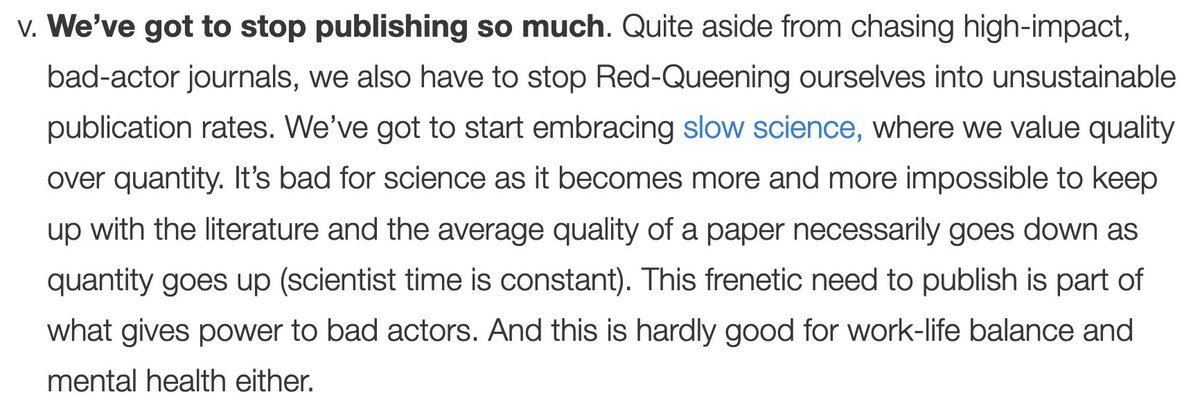
When it comes to problems with academic publishing we are in fact the baddies. So many scholars really think pre-pub peer review works as quality control & published stuff is trustworthy. There is no easy fix to the quality problem, but ending publication as target is a beginning
If you'll be at Cosyne 2024 this week, please come by our posters:
We have 3 presentations, by Paul LaFosse, Remy Yovanno&Bradley Akitake, and Ciana Deveau.
All about what the recurrent network of sensory ctx does.
Looking forward to seeing others' science at the meeting too!
This is a new preprint we are excited about. @CianaDeveau will be talking about this work w/ Zhishang Zhou at Cosyne - please stop by.
We'll post a tweet thread next week after Cosyne.
#Cosyne2024#cosyne24#neuroscience#neuroai
On Ciana and Zhishang's work on sequence processing in the cortex, here is a teaser of a graphical abstract for the poster, which is on Saturday at #SfN23.
We find the visual cortical network in L2/3 selectively _filters_ sequences of inputs to populations of neurons.
Tough times in the world right now, but will share this:
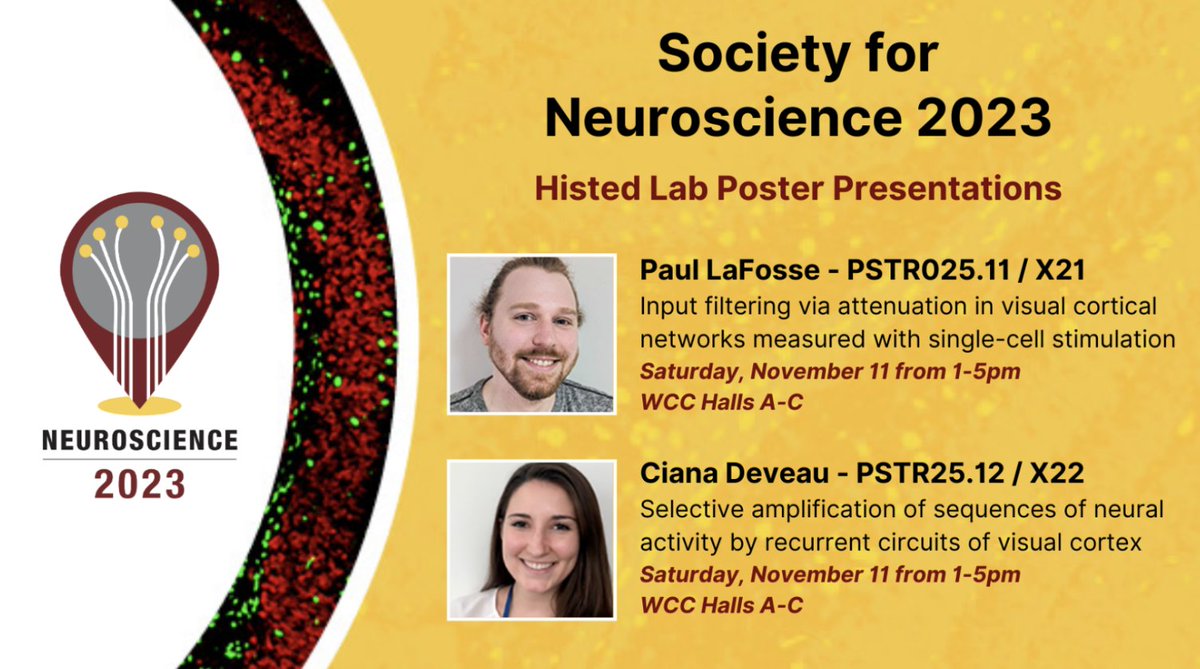
If you're attending SFN in DC this wknd, we have 2 posters on Sat I'm excited about.
@pklafosse is presenting work on activation functions in cortical neurons,& @CianaDeveau on cortical recurrent nets 'doing sequences.'1/2
🚨Our latest out @NatureComms! 🚨
Why are drugs like Ritalin therapeutic when taken orally, but highly addictive when taken intravenously?
We used simultaneous PET-fMRI with drug challenges to see how the rate of dopamine increases affects drug reward!
https://t.co/gPDg41VdA7
just got the first (expected) message advising me not to be so open abt my mental health struggles—especially addiction—pre-tenure.
as if I’m the only academic who’s an addict.
if academia doesn’t want an honest version of me, I’ll go elsewhere. I have a lot to offer.
New work with @APalmigiano, Tuan Nguyen, @kendmil, and Nicolas Brunel at @NeuroCellPress : Unveiling the Mechanisms Behind Reshuffling Visual Responses via Optogenetic Stimulation in Mice and Monkeys 🐭🐒 (thread follows) https://t.co/HiAH4MUUCw
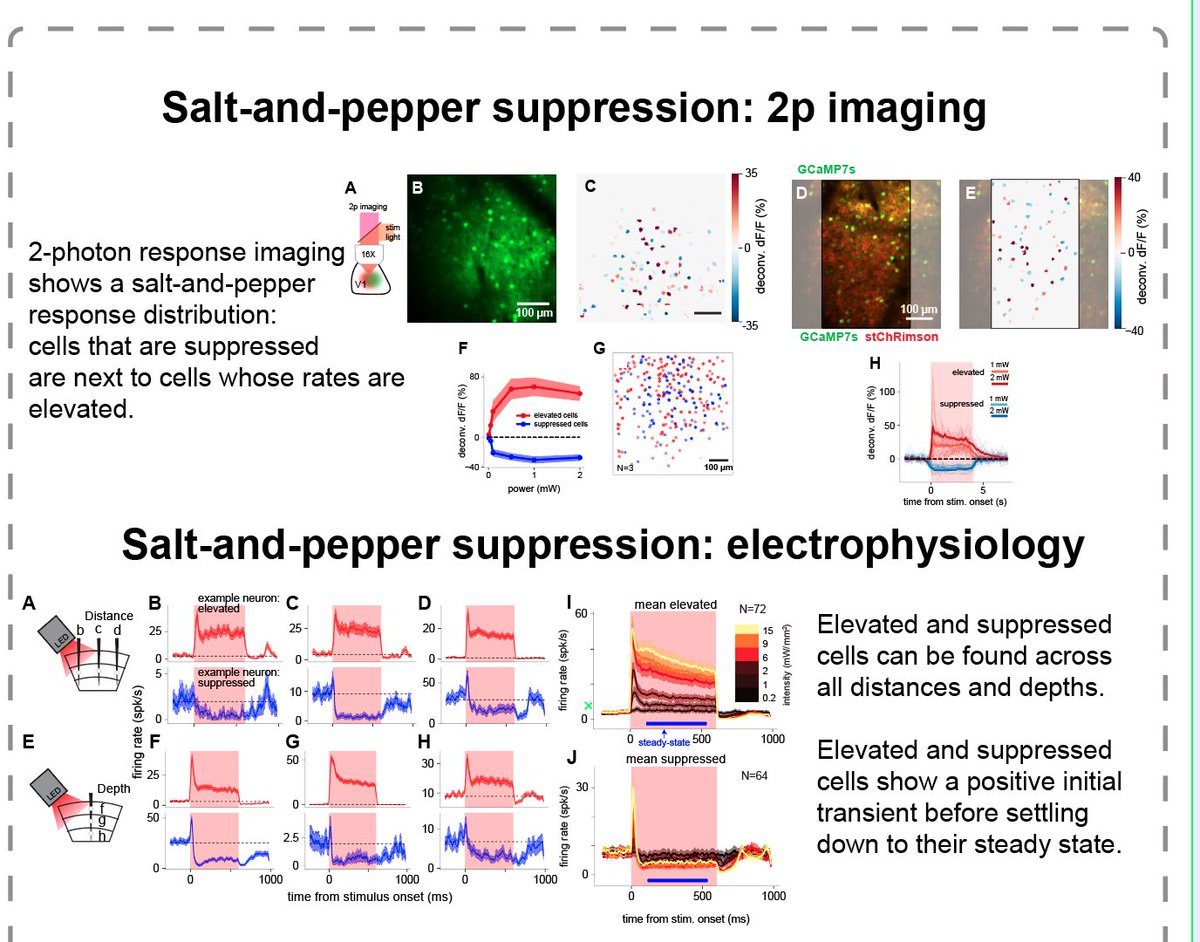
🧠🚨: Our latest paper is out today in @NeuroCellPress! Led by @JonORawe, we show salt-and-pepper excitation& suppression in mouse V1 arises from purely exc opto input.
That means the excit-excit recurrent connections in cortex change how neurons respond to input. 1/3
New preprint! “Activity in primate visual cortex is minimally driven by spontaneous movements”, https://t.co/pnfBJNjg0h, by amazing team led by @BharathTalluri & Incheol Kang, with Adam Lazere, @NickKaliss, @mightyrosequinn, & wonderful collaborators @jcbyts & @NeuralCodeUMD. 1/8
Sharing new preprint from our lab: @biorxiv_neursci.
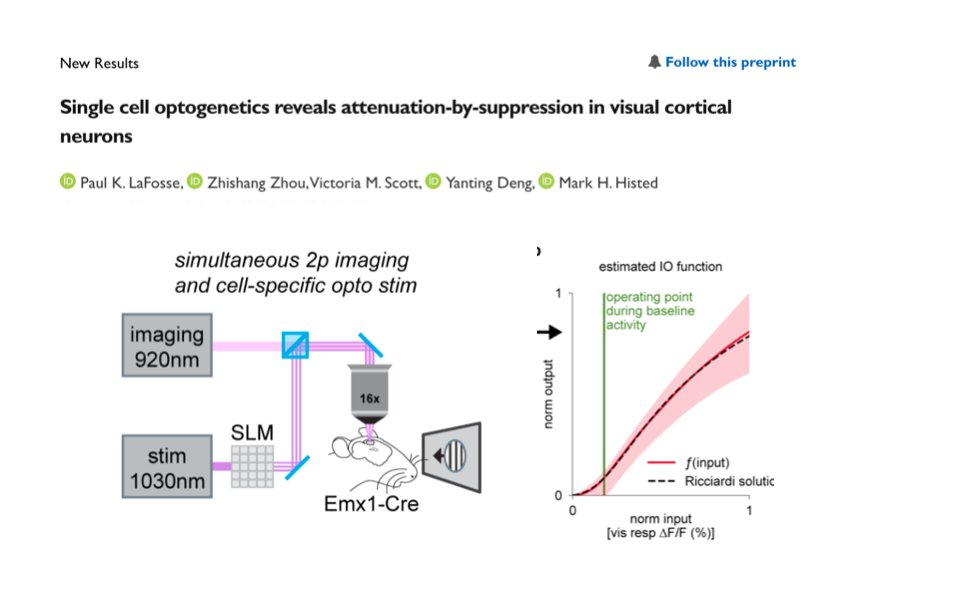
Led by @pklafosse, we show neurons in the awake🧠can filter out inputs: attenuation-by-suppression.
Also: real neurons’ activation function share features w/ #ai systems (eg ChatGPT). #neuroscience
Comments welcome!
1/15
New work investigating a surprising phenomenon we discovered in the visual cortex of mice and monkeys: optogenetic stimuli strongly modulate single neuron visual responses but weakly affect the overall activity of the network! Thread -> https://t.co/PdmwyUUnCU
Inspired by @KanakaRajanPhD tweet–
@JonORawe from our lab will present at #cosyne22/#cosyne2022. Stop by the 2nd poster sess., Fri Mar 18th, to discuss the results with him—on recurrent cortical suppression explained by a balanced-state cortical model.
thx to @AlessandroSzeni/1