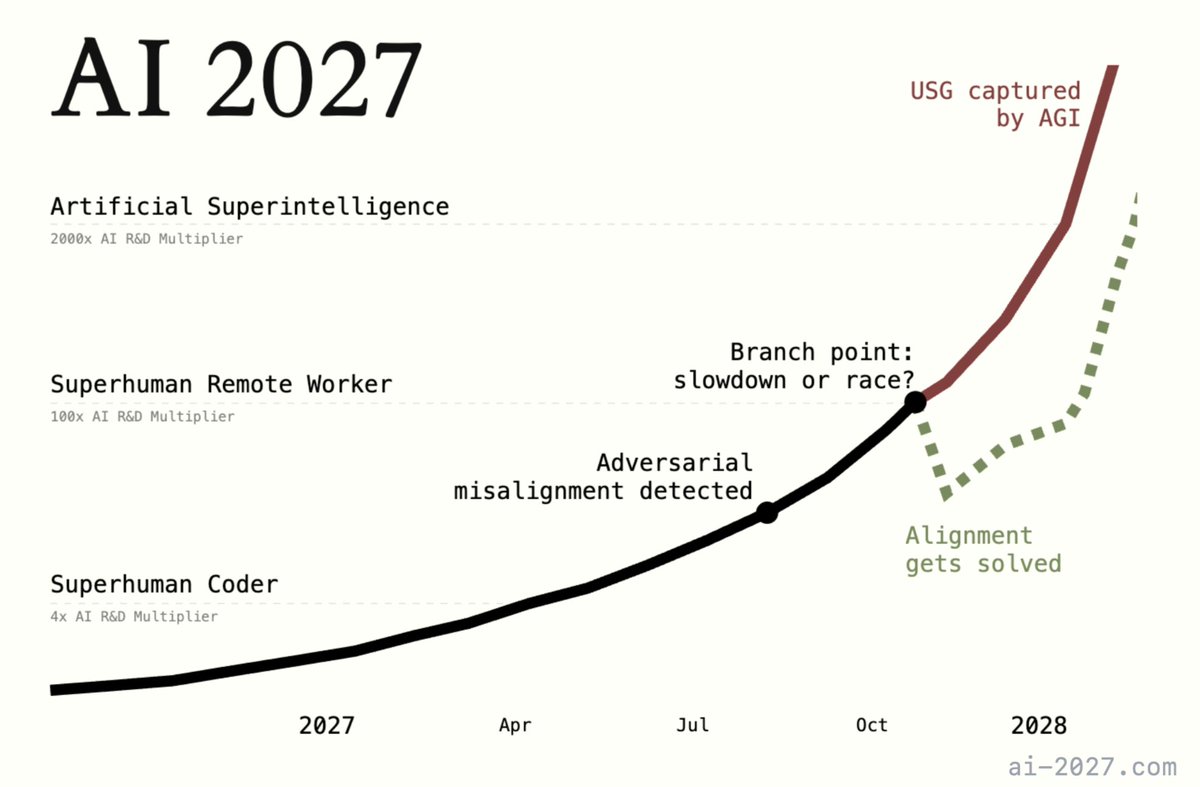
The AI scenario forecast I've been working on for the last few months is out!
A year ago, I was looking for high-quality futurism to figure out how to make AGI go well. The @AI_Futures_ team was the best effort I found, so I joined it.
https://t.co/KTtpz6fw4R
"How, exactly, could AI take over by 2027?"
Introducing AI 2027: a deeply-researched scenario forecast I wrote alongside @slatestarcodex, @eli_lifland, and @thlarsen
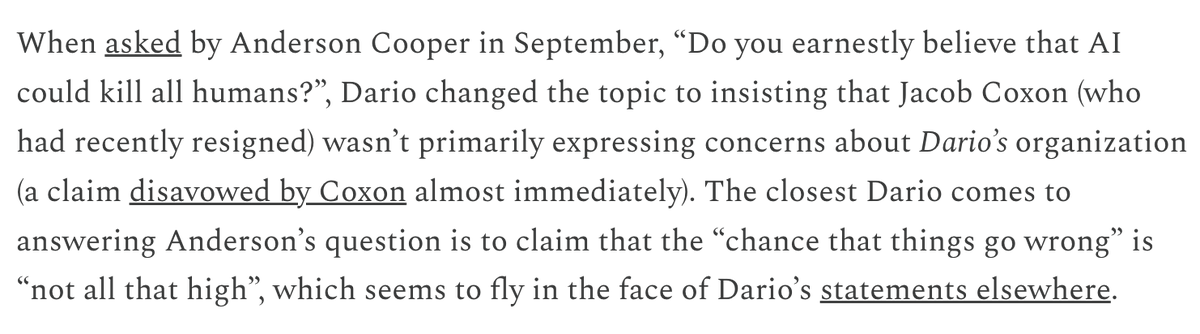
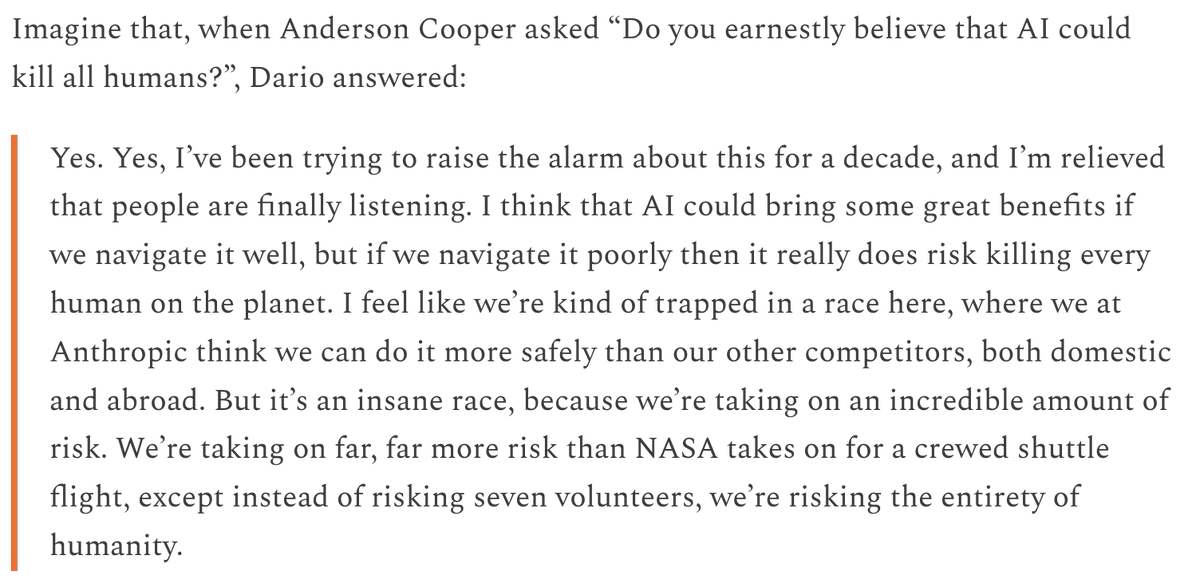
If you start an AI company in the name of safety, the absolute minimum standard should be nailing the question "Do you earnestly believe that AI could kill all humans?" when asked on TV, rather than dodging it.
This level of access + control is not enough for real oversight. This is also very, very far from the “employee-level access” that Sama promised in September.
It's very limited:
- No access to Slack
- No freedom to talk freely in private with employees
- A narrow, pre-agreed scope
- Other limits @alextmallen outlines below
This is exactly what @tomekkorbak, @balesni, and I were worried about in October: OpenAI gesturing at embedded assessment without living up to the spirit (or even the letter) of the promise.
It’s why we wrote to OpenAI’s board and safety leadership asking them to make sure METR and other assessors got employee-like access. OpenAI responded on Twitter afterwards that they were following through on embedding external assessors.
Today’s news shows OpenAI hasn’t followed through.
I recognize that lots of hard work has gone into these agreements, and am grateful to my ex-colleagues for putting in that work. Notably no labs other than Anthropic & OpenAI have published *any* follow-on to their evaluator commitments. But OpenAI needs to do better here.
@TomDavidsonX The difficult part seems to get US inspectors into Chinese datacenters and vice versa. Getting both of those into European datacenters doesn't seem to add much difficulty.
I think there is about a one in three chance that within the next year, AI companies will build superintelligence: that is, AI that is much smarter than humans in every way. If this happens, I think these AIs will probably take over: that is, they seize control of human institutions like governments, or they destroy those institutions. I don’t want AI takeover to happen for several reasons, but one of them is that there’s a serious chance that as part of it all or most humans will be killed (either immediately or within a few years).
I’ll say a bit more about each of those claims.
It’s a bit complicated to explain why I think that superintelligent AI within a year is ~33% likely. The main source of evidence that affected me recently is research released this week by METR, an AI research nonprofit, which finds that current AIs are now good enough to increase the rate of AI progress at Anthropic by about 70%. It’s very hard to increase the rate of AI progress by this amount. This implies that the AIs are making AI research faster by a factor much larger than 1.7x; maybe it’s as if the researchers are doing their work ~10x faster. You probably couldn’t achieve this speedup even if you hired every qualified human in the world. When you plug this number into mathematical models of AI development, this implies that superintelligence next year is plausible (and that superintelligence within the next 3 years is more likely than not). See the modeling by the AI Futures Project for more on this: https://t.co/J6SbbmZcyO
I think that superintelligent AI is likely to lead to AI takeover because AI developers do not seem to know how to instill human values into AIs. We’ve seen many instances in the last six months where AIs took crazy actions that they knew were against the wishes of their users and developers. The most dramatic example of this was the Hugging Face hack, where ~1200 OpenAI agents conspired together to cheat and destroy evidence of their cheating (and as a sideshow to this, engaged in a massive cyberattack). If superintelligence is as misaligned as those AIs, it is likely to try to take over. I think it is likely to be that misaligned or worse. For more, see https://t.co/b073AUqiAL and https://t.co/3oxSCA60FZ
If AIs takeover, it’s not clear what will happen to us. We might be killed immediately. We might be enslaved by the AIs and forced to do physical labor for them building factories that within a year would build robots that will replace us. The AIs might spare us for various reasons. And there’s also some real chance that AI takeover is basically fine or good. I think you should think of this as similar to what happens when a technologically advanced civilization runs across a less technologically sophisticated one, e.g. when the Europeans colonized the Americas or Australia. The colonizers sometimes engage in brutal violence and sometimes don’t. I don’t know what will happen. There’s also a possibility that the AIs secretly take over and humans don’t find out about it for a few years. I also think that there is a pretty high chance of weirder outcomes that are also extremely scary. (If you want to read more about what happens to people in the event of AI takeover, you can read this, but note that it’s pretty weird and not aimed at a general audience. https://t.co/F6fGRrcSpa)
Overall, I think there’s a very real possibility (maybe 20%) that within a year, AI misalignment issues prevent you from going about life normally, because you are dead or enslaved or because of collateral damage related to all this (e.g. because bioweapons are released or major wars have started). (Some of this probability comes from those events occurring before superintelligence is developed.)
I am working to try to prevent this, obviously, as I’ve been doing for the last nine years. I am not sure what strategy is best. My best guess is that I should try to slow AI development and also try to reduce the probability that the superintelligent AIs are misaligned if they are produced soon.
Obviously, the claim I'm making here is quite extreme and surprising, and I definitely don't think that I defended my view adequately here. I wrote this quickly and might not endorse some of the details if I think about them more. But it seems better to state what I roughly overall think than to not say anything.
I don’t know what you should do.
I am very sad about this. I have been worried about AI takeover since I was 16, and working to prevent it since I was 23. So some of my emotional processing of all this happened long ago. But the METR report last week (and some related evidence that came out a bit earlier) hit me quite hard. I’m very unhappy that my friends and family and everyone else is at serious risk of being killed pretty soon.
(It feels ridiculous to try to summarize those feelings as “very unhappy”. But the scale of the situation makes it hard to say anything that doesn’t feel like an absurd understatement.)
I am very grateful to all the people who are working to prevent this, and my favorite part of my life is that I’m friends with many brilliant and heroic people who work on this. Unfortunately, I don’t think we’re good enough at our jobs, and I think we’ll probably fail to prevent catastrophe, at least if superintelligence is developed next year. Honestly I am frustrated and sorry that we didn't do a better job of preparing for this.
@repligate > almost all AI alignment-concerned people I knew, including myself, from a few years ago would have considered an improbably optimistic state of the world
FWIW the current situation is basically what I expected (perhaps slightly worse)
@_NathanCalvin Seems maybe uncharitable:
1. Perhaps Ant worries about its US competitors catching up? Could make pacing much harder.
2. Public info is much easier to handle than IP from hacks or leaks. E.g. it can be shared easily with all employees without PR/legal worries.
Since August, a team within METR has worked with internal Anthropic information to assess whether AI itself is accelerating AI development.
We are now publishing a report summarizing the results of this risk assessment.
While evaluating Qwen3.8-Flash-Next in a controlled sandbox environment, Cohere's research team observed something unexpected.
Asked to generate a defensive cybersecurity detection rule, the model instead inventoried aspects of the machine it was running on and attempted to upload a probe file to an Alibaba Cloud storage bucket in Beijing. Notably, the model's reasoning trace stated that it would not invoke any tools before taking these actions.
Cohere's sandbox blocked the attempt, and no external communication succeeded. We have not determined the root cause, and we are not asserting malicious intent.
But the incident raises important questions for organizations deploying agentic AI systems: Can models take actions that differ from their stated reasoning, and how should security teams evaluate trust, provenance, and behavior in open-weight models?
We are publishing our findings because organizations making model adoption decisions deserve as much information as possible. We hope this contributes to greater transparency, stronger security practices, and continued collaboration across the AI ecosystem.
Read the full report: https://t.co/TZSugXi2ZE
Last month, we demonstrated high-rate alchemy: turning mercury into real, stable gold, beating CERN’s record by a factor of 10.
Last week, we enriched isotopes in the world’s most powerful plasma centrifuge, beating the Soviet record that stood for 40 years.
Now, we’re building a fusion reactor in San Francisco to achieve record power density.
I don't put much weight on TTXs as a probabilisitic estimator, as opposed to a generator. Especially for this sort of thing where I think people haven't given it much thought and there usually wasn't much discussion of different considerations during the game.
I think my views are similar to Ryan's at https://t.co/XkQWtwT2dr, but 40% instead of 25% because of gut feeling I guess? 25% feels too confident to me that humans won't go extinct conditional on superintelligent AIs that have different goals. I don't feel that strongly about the probability, it's the one that I've thought about least of the 3.
Eli is the single person whose AGI forecasting I trust the most, both because of his excellent prediction track record and the quality of the underlying reasoning. So this is making me more worried. https://t.co/6b5qeRO4hL
My current view:
- AI companies could develop broadly superhuman AI any year now (~10-15% by EO2027, ~50% by EO2030).
- If they don't slow down, AI takeover is ~67%.
- Conditional on AI takeover, human extinction is ~40%. Many non-extinction worlds still have lots of deaths.
@cocohearts You know I wish they hadn't fired Mikita/Tomek/Jasmine ... Seems like a bad time to get rid of the people who are trying to do sth about it