Only if education could be this interactive ❤️🔥
I've had a looong wish to build something genuinely useful through vibe coding, and I finally did it.
A 3D human anatomy application built with @threejs using GPT 5.6 Sol.
It all started with a single design image that I created using GPT Image 2.0. I then used it to generate every 3D organ image, one by one.
Next, I converted each of those images into 3D models using @tripoai (and no, they didn't sponsor this 😄).
After that, I opened Codex, wrote a master prompt based on the design, and gave it the prompt, the design image, and all the 3D models.
Codex built the first version beautifully, but there was one big problem.
Every single 3D model was nearly 120-150 MB. That obviously wasn't practical for the web and was giving a performance of 16fps.
After a few iterations, Codex optimized each model down to roughly 2–5.5 MB while preserving the visual quality, reducing the total asset size from ~900 MB to just 28.6 MB. And each model loads on demand.
Along the way, Codex also generated those anatomical illustrations showing where each organ sits in the human body, and even created the interactive hotspot markers that explain different parts of every organ. It handled all of that.
The process wasn't exactly one shot, but it also wasn't difficult. You just have to do it step by step.
It genuinely felt like building something that could make learning anatomy much more engaging.
The inspiration came from @DilumSanjaya's 3D animal plant cell project. I remember seeing it and thinking, "I want to build something like this one day."
And I did it :D
Live: https://t.co/gIFgkj8UVB
Code: https://t.co/nijvyWcyxO
OpenCode es la alternativa gratuita a Claude Code
✓ 100% código abierto
✓ Modelos gratuitos disponibles
✓ Usa tu suscripción de GitHub Copilot u OpenAI
Curso completo → https://t.co/NNtHvh7C2i
DeepSeek V4-Flash isn’t just cheaper per token.
It reportedly completes the same benchmark tasks as Fable 5 at 105× lower total cost, according to @ArtificialAnlys !
That's precisely why the Flash release is, for me, the DeepSeek 2.0 moment. It will cause a huge stir.
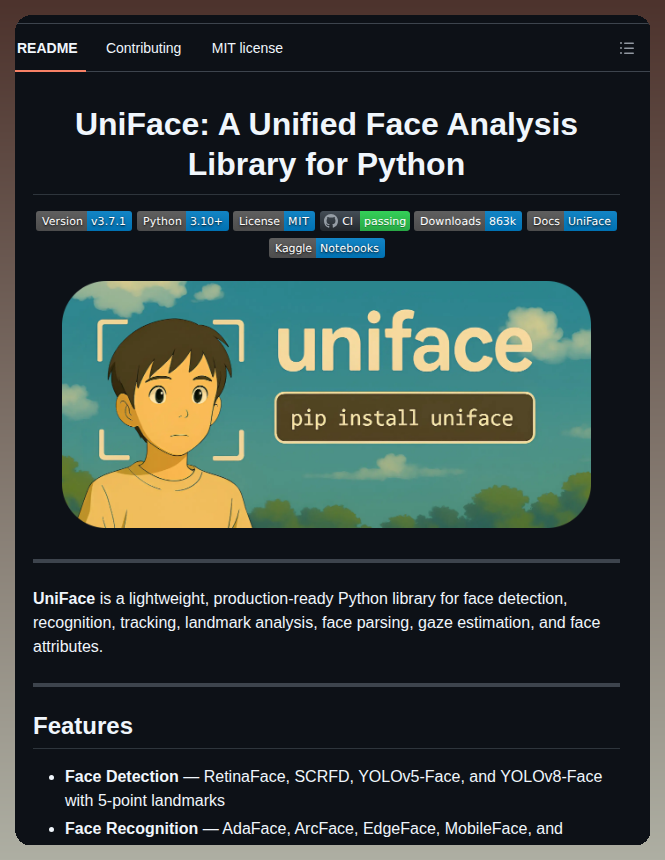
UniFace unifies face detection, recognition, tracking, landmark analysis, gaze estimation, and anti-spoofing into a single Python library with hardware acceleration.
https://t.co/3BFAUAEJoz
Open Source Face Recognition SDK detects faces, extracts facial landmarks, generates feature embeddings, and compares face similarity on-premise.
https://t.co/V7HnOlWLsP
Las buenas decisiones humanas no sobreviven al contacto con un agente si nada las hace vinculantes.
Podés escribir las mejores reglas del mundo. Si son texto en un archivo, la IA las va a pisar cuando le convenga.
Una regla que no se puede violar no es una regla. Es una sugerencia.
Lo aprendí a las malas.
Kimi K3 connected through Blender MCP turns plain English descriptions into fully editable 3D scenes with terrain, buildings, lighting, animation and all the Python scripts holding it together.
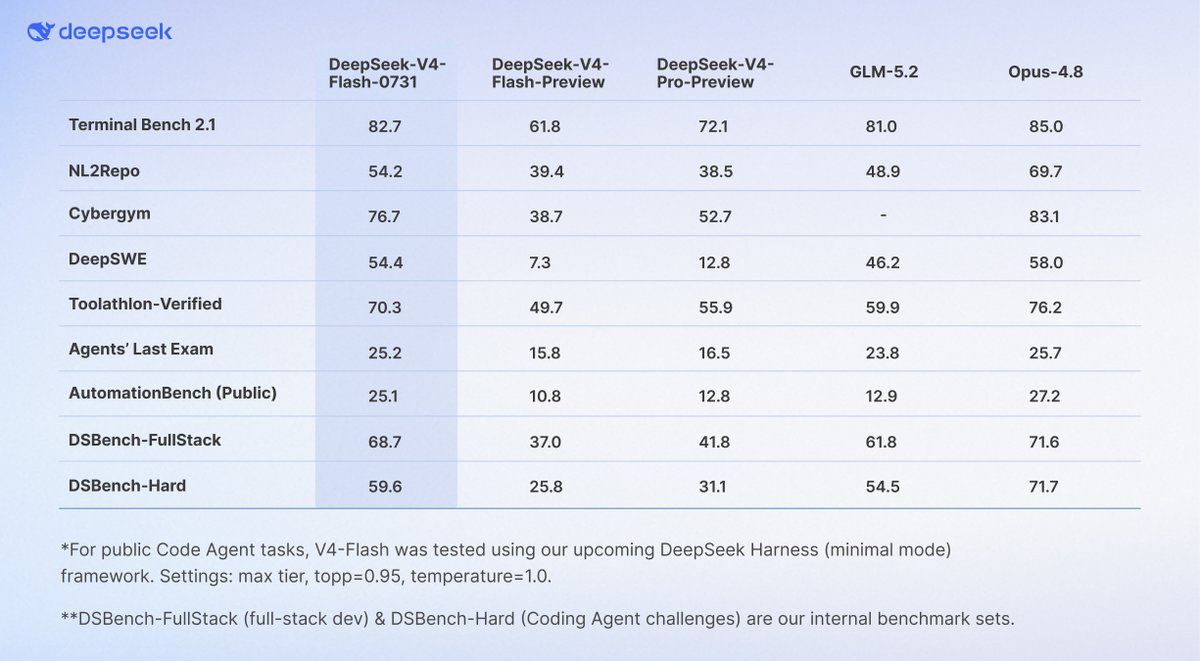
🚀 DeepSeek-V4-Flash Official API is now LIVE in public beta!
🔷 We’ve massively upgraded its Agent capabilities—benchmark scores are now far surpassing the V4-Pro-Preview. Check out the massive performance leap below! 👇
🔷 The official V4-Flash now natively supports the Responses API format and is fully adapted for Codex!
Check out the configuration details in our official API docs: https://t.co/smCwQZMeiq
I made this Three.js bookshelf inspired by the Stripe Press site. It scrolls horizontally, and you can open each book and flip through the pages.
It took quite a few prompts to get the textures and small details right.
I’m open-sourcing the code and prompt.
Demo:
https://t.co/9zJ6sfpX0v
GitHub:
https://t.co/jisHCh8lya
Inspiration:
https://t.co/qfoj8sR6n5
I keep seeing the same pattern with Three.js games, shaders, p5.js, and now 3D UI.
Give a coding agent a strong reference, the live URL, and the source repo. It can study the mechanics, recreate them, and give you a working place to experiment.
For this one, I turned a Trevor Noah-inspired book interaction into fictional manuals for Codex, Claude Code, and Cursor.
X post: https://t.co/nzdOPTXhn6
GitHub: https://t.co/IGCBXl5zw9
Original site: https://t.co/KRwqFaVaNT
This is INSANE. I had Claude Opus 5 run all day to recreate Fallout.
It generated everything you see based on ONE PROMPT from @mattshumer_. Running in browser using only @threejs.
Want to try it yourself? Check it out below.
Here's a car racing version using @mattshumer_ prompt!
https://t.co/ymu57UIheo - You can play the game here! You can control weather, lighting. Use 'WASD' for driving and 'C' to change the camera angles.
It didn't manage to one shot it after 18+ hours using Opus 5 ultracode - but with a few tweaks it did a pretty good job!
I've been using this technique for the last few weeks in my independent harnesses and the build, verify, critique loops (gauntlet loops as Matt calls it) greatly have improved final outcomes of my products.
ABot World 0.5B is out! we have now world models at home, running in real-time on consumer GPU
feed it an initial image, steer it with with your keyboard 🌎
you can run it locally or play now on spaces
▶️ https://t.co/0JUL2rRspW
Someone used Claude Code with Opus 5 to build SNOWFLOW, a browser WebGPU snow and waterbending demo with persistent terrain deformation in 9 hours.
- Full-Stack Graphics Pipeline: Synthesized custom WGSL shaders, WebGPU pipelines, and Babylon.js terrain logic from scratch.
- Interactive Terrain Deformation: Renders persistent snow trails, berms, and water-spell displacement that heal dynamically over time.
- Visual Self-Correction: Opus 5 iterated on visual polish and shader bugs directly from browser screenshots.
- 9-Hour Build Window: Delivered a production-ready WebGPU tech demo in 9 hours using ~4 million tokens.
I asked Claude 5 Opus to generate me the best game graphics it could!
I wanted to create a car on a dirt trail demo and see how good it was at crafting car graphics without any textures.
Everything you see here is 100% crafted from the model itself.