Andrew Ng just dropped a 3-hour course on how to become an AI Engineer in 2026:
• 00:00 - How to build agentic AI systems
• 04:25 - Future of AI engineering
• 23:38 - AI Prompting full course
• 2:52:17 - Creating an app with AI in 30 minutes
This 3-hour watch could replace 10 AI engineering courses on the internet.
Watch it today, then read how to run a self-improving system in the article below.
If you wanna level up as an AI builder, binge watch the talks from these 3 conferences (all freshly wrapped). You can literally learn from the best in the field from the comfort of your home.
- AI Engineer @aiDotEngineer https://t.co/zsLvuWWBMl
- Cursor Compile @cursor_ai https://t.co/EzpGKd8O4Y
- Figma Config https://t.co/m3KdubDk0i
It's crazy that all of this high-quality knowledge is freely shared on the Internet (the tickets to these conferences often cost hundreds of dollars), and I'm surprised that most of these videos only get tens of thousands of views. High-quality conference talks are massively, massively underrated!
Watching on YouTube is also arguably a better experience than attending in person: no bad audio, no crowd blocking the screen, no distractions, and you can pause to take notes
Everyone's arguing about which AI model is smartest
Meanwhile, the top 1% of Claude Code users quietly figured out something else:
The model isn't your bottleneck. Your repo is
Same model. Same prompts. One dev gets a chatbot, the other gets an autonomous engineer
The difference is a folder structure.
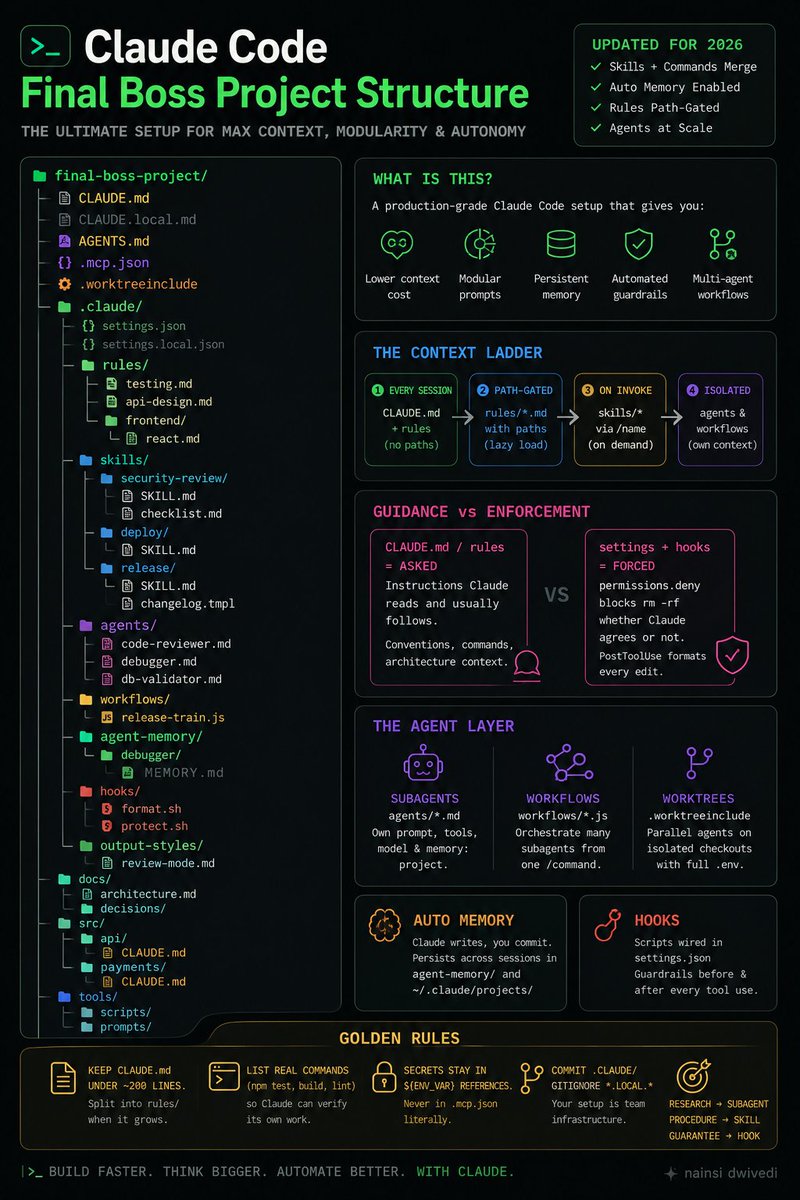
I call it the Final Boss Setup
━━━━━━━━━━━━━━━
1️⃣ The Context Ladder (this changes everything)
Stop thinking "what goes in CLAUDE.md."
Start thinking "what loads WHEN."
There are 4 rungs:
• Every session → CLAUDE.md (tiny, always in context)
• Path-gated → rules/*.md (loads ONLY when Claude touches those files)
• On invoke → skills/* (loads when a task matches)
• Isolated → agents & workflows (own context entirely)
Most people dump everything on rung 1.
Then wonder why Claude gets dumber as the project grows
You're not writing docs. You're designing a memory hierarchy
━━━━━━━━━━━━━━━
2️⃣ ASKED vs FORCED (the line that separates amateurs from pros)
CLAUDE.md and rules = ASKED.
Instructions Claude reads and *usually* follows
Hooks and settings = FORCED.
permissions.deny blocks rm -rf whether Claude agrees or not
Here's the test:
"Please run the formatter" → asked. Works 90% of the time.
PostToolUse hook that formats every edit → forced. Works 100% of the time.
Anything where 90% isn't good enough — secrets, migrations, prod — should never live in a markdown file.
Guidance for style. Enforcement for survival.
━━━━━━━━━━━━━━━
3️⃣ The Routing Rule (tattoo this somewhere)
Every recurring thing you do fits exactly one slot:
• Research → subagent (own context, reports back clean)
• Procedure → skill (the playbook, loaded on demand)
• Guarantee → hook (happens every time, no discretion)
Repeating a workflow in prompts? That's a skill you haven't written.
Reminding Claude to run tests? That's a hook you haven't wired.
Letting exploration pollute your main context? That's a subagent you haven't spawned.
━━━━━━━━━━━━━━━
4️⃣ Rules That Load Themselves
The underrated file: .claude/rules/ with path-gating.
frontend/react.md only enters context when Claude touches frontend code.
api-design.md only when it's in the API.
Your conventions follow Claude around the codebase like a senior engineer looking over the right shoulder at the right moment
Zero tokens wasted on rules that don't apply
━━━━━━━━━━━━━━━
5️⃣ Agents With Their Own Memory
The 2026 upgrade nobody's using yet:
agent-memory/ — Claude writes what it learned, you commit it
Your debugger agent remembers last month's gnarly race condition.
Next session, it starts smarter than it ended
Claude writes. You commit. The team inherits
Your AI's experience becomes version-controlled infrastructure
━━━━━━━━━━━━━━━
6️⃣ CLAUDE.md in the Danger Zones
Global context can't know that your auth module has landmines
So drop local files where the bodies are buried:
src/api/CLAUDE.md
src/payments/CLAUDE.md
Claude reads them exactly when it enters those directories
Warnings appear at the moment of danger — not 4,000 tokens earlier where they get ignored
━━━━━━━━━━━━━━━
7️⃣ The Golden Rules (from the trenches)
• CLAUDE.md under ~200 lines. When it grows, split into rules/. Bloat = missed signals.
• List REAL commands (npm test, build, lint) — so Claude can verify its own work.
• Secrets stay in ${ENV_VAR} references. Never in .mcp.json. Literally never.
• Commit .claude/, gitignore *.local.* — your setup is team infrastructure, not personal preference
━━━━━━━━━━━━━━━
Here's the shift most people miss:
A prompt improves one conversation
Structure improves every conversation, for every teammate, forever
Prompting is renting intelligence
Structure is owning it
Build the repo once and Claude stops visiting your codebase and starts living in it
Anthropic engineer:
"You're not supposed to prompt Claude. You're supposed to build a system that prompts itself."
In 45 minutes she shows exactly how to build an agent that improves itself.
Most people are still doing all of this by hand.
Watch the session, then save the guide below.
He leads engineering on Gemini at Google.
instead of keeping his Claude setup private, he open-sourced it.
Addy Osmani. That Google: Chrome DevTools lead, "Learning JavaScript Design Patterns" author.
'agent-skills' - his personal loadout. Drop-in for any project.
68,925 stars. MIT.
→ https://t.co/n7NI3Sr7uu
bookmark it. This is how your Claude setup goes pro.
Full Claude Course
Master Claude to automate repetitive tasks, build apps without coding, create real portfolio projects, and become more valuable at work.
Anthropic shared their video on a weird geek forum.
Two Anthropic engineers explain how they actually prompt Claude.
This is the best way you can spend 29 minutes.
I watched it last night. Halfway through, I got angry at myself. Two years I've been using Claude wrong.
First lecture in two years that actually changed how I work.
Watch the video. Then read the article below.
OPENAI DEVELOPER MAKING $1.7M/YEAR JUST LEAKED THE GUIDE ON HOW THEY BUILD AI SYSTEMS - AND GOT ARRESTED WITHIN THE HOUR
regular AI responds and forgets - a loop responds, learns and gets 4x better every time
Plan → Execute → Evaluate → Memory → Plan
five layers, one cycle, accumulates knowledge over time
every completed cycle produces better data - better data leads to better decisions - better decisions lead to stronger execution
the engineer no longer optimizes prompts - the engineer designs execution
5 results of Loop Engineering systems: higher output quality - fewer errors - lower cost - better safety - continuous improvement
the developer defines the goals and the system does everything else
this is the new standard for building reliable, scalable and intelligent agentic systems
Anthropic just dropped 5 workshops on building self-improving agentic systems from scratch:
00:00 - Ship your first Claude agent
36:44 - Build memory for Claude agents
1:05:06 - Make your agent autonomous
1:26:46 - Set up a proactive agent
2:03:35 - self-improving agents (tools,skills)
These 3-hours of free Claude workshops will replace 10 paid agentic courses.
Watch today, then read article below on how to build a self-improving agentic system with Fable 5.