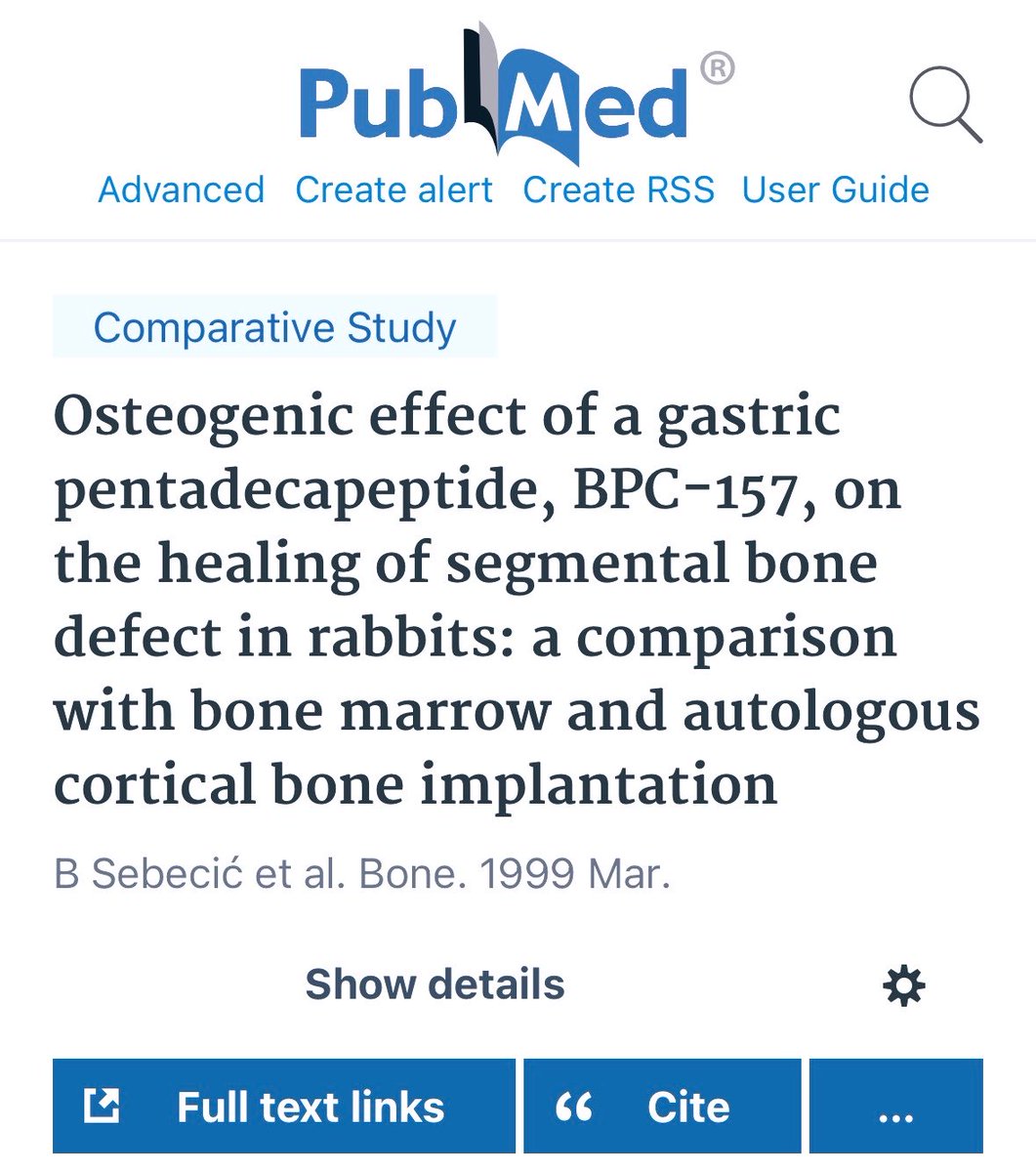
BPC-157 grew back bone that was SAWED OUT of a rabbit’s leg.
15 amino acids. your stomach already makes it.
weak joints? fractures that won’t heal? that old injury that still aches?
that’s NOT aging. that’s your body failing to rebuild.
scientists removed 0.8cm of bone. gone. controls never healed.
BPC-157 grew it back. MATCHED surgical bone grafts. (PMID: 10071911)
let that hit you.
and it also:
→ REGREW a severed nerve
→ RESTARTED a flatlined heart
→ SEALED poop leaking between organs
your surgeon harvests bone from your HIP to fill your LEG. two surgeries. $20,000+.
BPC-157 matched that. with nanograms.
nobody told you. now someone did.
🧵 the nerve study is even crazier. comments ↓
true value creation comes from one of two things: creating desire or deleting dread.
a ton of founders often confuse which one of these their business actually does.
even worse, it often doesn’t do either.
Andrej Karpathy just said your kids should ignore most of school.
"80% of education should be math, physics, CS."
Not because it's useful - because it carves grooves in the brain.
Grooves that get harder to carve the older you get.
In a pre-AGI world: it gets you a job.
In a post-AGI world: it makes you a functioning, empowered human.
Everything else? Tack it on later.
The cognitive foundation is the only foundation that survives the transition.
the era of autistic deep work is over
your agents are more autistic than you and better at deep work
welcome to the shallow work future
total ADHD dominance
okay the funniest outcome here would be that everyone use ai to write, then uses even more ai to rewrite it until it passes the detector. making it sound even worse than the real slop but now with an ai approved seal for human writing lol (which is hilarious in itself).
the financial incentive makes that at least somewhat inevitable. which means instead of reducing slop, substack could accidentally create an arms race that produces even more of it.
the other possibility is even funnier imagine if the detector reveals that a lot of supposedly human writing is indistinguishable from ai slop cuz it was already bad. either way very interested in seeing how this plays out.. fun times to be alive.
One pattern I find useful for working with LLMs is a nice long ramble session. Sometimes the LLM needs more bits to understand what you're trying to achieve, but you're too lazy to type them. In these cases I like to lean back, switch to /voice and just ramble for like 10 minutes, total mess, anything goes, full stream of consciousness. Sometimes I declare it up top, something like "switching to speech recognition sorry for any typos...". Sometimes I turn it into a small interview of a few turns. But I find that the LLMs are somehow very good at reconstructing long incoherent rambles and often their echo of your own tangle of thoughts comes out quite a bit cleaner than what you started with. The result is that you improve the mind meld and have to correct things less from that point on.
- You: "My stocks went up 10%."
- Government: "Congratulations! That's taxable."
- You: "But inflation was 8%. I only really gained 2%."
- Government: "We tax the full 10%."
- You: "You tax the inflation you created?"
- Government: "Capital gains are capital gains."
- You: "So you profit from debasing my money twice?"
- Government: "You're not an economist."
I'm a cardiologist. Everyone is sharing this study as a skin story. They're burying the part that matters.
Scientists took the aorta of a 75-year-old donor, applied a single engineered enzyme, and stripped away more than 70% of the molecular damage — bringing it down to the levels you'd see in a 30-year-old artery.
Published five days ago in Nature Communications. Revel Pharmaceuticals, with Calico and the University of Colorado.
Here's what they erased.
Sugar reacts with proteins in your body the same way heat browns bread — slowly, over a lifetime. It leaves behind a residue called CML, the most abundant advanced glycation end product in aging tissue. It welds itself onto collagen and elastin in your skin, your eye lens, and your arterial walls.
Two things follow. Your arteries stiffen. And CML latches onto a receptor called RAGE, which drives chronic inflammation — the exact fire I've been writing about for months as the engine of heart disease.
Since the 1980s this damage was considered permanent. Your body has no enzyme to remove it. Every existing approach only slows new damage from forming. Nothing touched what was already there.
So they built an enzyme that doesn't exist in nature. They screened 45,000 protein structures, then ran five rounds of directed evolution across more than 500 million variants until they had CMLase — a molecular lawnmower that oxidizes the CML off the protein and restores the original, healthy lysine underneath.
Not patched. Reversed.
Over 70% cleared from elderly arterial tissue. Over 55% from elderly skin — below the levels found in 31-year-old skin. 45-78% in lens proteins. The CEO said they expected 20% and were floored.
Arterial stiffness drives systolic hypertension, heart failure, and stroke, and I have no drug that reverses it. I can slow the process. I cannot undo it. This paper says undoing it may be possible.
The caveats are real and I won't skip them. This was done on donated tissue in a dish, not in a living person. No functional data yet — we don't know if that artery got measurably more elastic. Delivering a large enzyme deep into human tissue is a hard, unsolved problem. Clinical trials are years away.
But something considered permanent for forty years just came off human tissue.
We spent a century learning to slow aging. Someone finally figured out how to erase it.
Thank you @theallinpod@friedberg@chamath@pesottas
Andrej Karpathy just broke the entire premise of modern AI:
"Agents aren't magic. They're distillation at scale."
99.99% of your LLM's capacity is wasted on garbage data it never needed.
Small model + right tools + closed loop = terrifying capability.
In a 16-minute conversation, Karpathy reveals the full reasoning stack.
Worth more than any $500 AI course you've seen this year.
Friends are good for your health.
In case you thought that wasn’t a major concern because you’re an alpha-sigma-giga-lone-chad-wolf who don’t need no one around them…
“By far the biggest medical surprise of the past decade has been the extraordinary number of studies showing that the single biggest predictor of your psychological and physical health and wellbeing is simply the number and quality of close friendships you have.
By comparison, all the traditional factors that your doctor usually worries about on your behalf make only modest contributions.” — Robin Dunbar
Why did POTUS suddenly pivot from "unconditional surrender" to a deal at any cost in Iran?
TL/DR it's the interceptors, stupid.
- it takes Lockheed >two years and $5-15m to make a missile interceptor
- i.e., $10k drones take a $5m missile to defeat
- our forecast was that a) the population was going to rebel and b) we’d quickly take out the missile launchers
- But: Iran murdered 50k protesting citizens before our forces were in place; we didn’t defeat the launch capability as fast as expected
- we were facing down dwindling interceptor supplies
- 50% of patriots are gone and 80% of Thaad interceptors are gone. They cannot be replaced in a relevant timeframe
- if we actually ran out of defenses, US and allies in the region would be slaughtered— and the US would be facing a historic defeat
- we're already rationing interceptors, which is why our soldiers died in Jordan last night and why there are no more Patriots in Ukraine.
- in this context we try to make any deal you can — regardless of cost. Pretend it’s about gas prices if we must.
So we are losing this war. Badly. And what really lost the war was the fucked up defense supply chain that can’t make munitions in a relevant cost or timeframe — and we have no technology that defeats the enemy in an economically sustainable way.
This is why advanced anti drone and advanced missile defense is so critical. Personally I am bullish on directed energy intercept, particularly space-based directed energy.
Regardless of specific technology, we must be able to build interceptors faster and cheaper than any enemy can build offensive weapons.
Against China right now we lose. Badly. It isn’t even close.
Fortunately we are learning this lesson against Iran not against China—and there is still time to pivot and fix the US industrial base, but only barely.
Anthropic paid $1.5 billion last year for training on pirated books. The largest copyright payout in US history. A Chinese lab can train on the same shadow libraries and pay $0, because there is nothing in Beijing for an American court to seize.
Jurisdiction shapes how American models behave more than any safety philosophy does.
Run the math American labs are staring at. Statutory damages for willful infringement reach $150,000 per work. The Anthropic class covered 482,460 books. Full exposure on that single dataset: $72 billion, several times more than the company had raised in its entire lifetime when the suit was filed.
Settle, filter, refuse. Those are the only rational moves when one dataset can produce a company-ending number. And users experience every filter as stupidity. The model that says no reads as dumber than the model that says yes, even when it wins the benchmarks.
Moonshot, DeepSeek, MiniMax: all outside subpoena range. No US assets, no US discovery, no class action that reaches them. A judgment from a California court arrives in Beijing as a piece of paper.
Which creates the strangest incentive loop in tech. Every copyright case an American lab loses functions as a subsidy to a Chinese one. The authors in the Anthropic settlement got about $3,000 per book. The strategic beneficiary never appeared in court.
Elon Musk just laid out the extinction event for every company on Earth.
Musk: “One laptop with a spreadsheet can outperform a skyscraper of several hundred human computers.”
One machine. An entire building of people. No contest.
Musk: “If even a few cells in that spreadsheet were done manually, you would not be able to compete with a spreadsheet that was entirely a computer.”
One human touchpoint in a digital system doesn’t cost you a percentage. It collapses the entire advantage.
The system doesn’t degrade gracefully. It fails categorically.
That’s not an efficiency problem. That’s a law of nature.
Musk: “Companies that are entirely AI will demolish companies that are not.”
Not outperform. Not edge out. Demolish.
Every company “integrating AI” right now thinks it’s evolving. Every human still in the loop is a cell being done manually in a system that demands machine speed.
You’re not transforming. You’re building the case for your own replacement.
We spent a century measuring corporate power by headcount. Skyscrapers full of people were monuments to dominance.
That entire framework is inverting. Headcount won’t measure strength. It’ll measure how exposed you are.
The skyscraper was never the advantage. It was a workaround for not having the laptop.
Now the laptop exists.
ok this 2.2% stat just sent me down a rabbit hole.
a few more numbers i found:
> only 0.2% of U.S. households spend over $100 a month on AI
> only 1% of U.S. adults personally pay for Claude
> only 4% of U.S. adults use AI chatbots almost constantly
> only 6% of U.S. adults use Claude
> only 4.5% have ever had an AI agent complete a task for them
> only 8.3% of U.S. workers say AI lets them do work they couldn’t do before
we are still absurdly early
Friedberg: New study shows enzyme reverses skin age from 70+ years to 31
Chamath: That’s a $2T market.
Did Scientists Just Discover How to Reverse Skin Aging!?
“CML is kind of the predominant molecule that gets formed in this extracellular matrix that's driving aging, and nothing breaks it down.
So these scientists set out to try and create an enzyme, an enzyme is a protein that breaks something down, that can break down CML.
And so these guys kind of went out and they took the target, which is CML, and tried to figure out, ‘Okay, how do we actually degrade CML, clear that extracellular matrix, and reverse aging?’
They started to test it on the proteins that we would find in our body, casein, collagen, retinal proteins, which are in your eye, hemoglobin, and they were able to get rid of 52 to 97% of the CML, just degrade it away.
And then they found several sites where they were able to degrade over 90%.
And then they took actual human skin from elderly patients that had donated their skin, and they put this enzyme onto that skin, and they were able to eliminate 55% of the CML on the skin, basically reverse the skin's age down to the age of a 31-year-old, this is from greater than 70-year-old patients, just by putting this enzyme on the skin.
And so it's kind of a groundbreaking demonstration of combination of AlphaFold, what's called directed evolution, where you change the order of the DNA that changes the structure of the protein to test different proteins, do high throughput screening, and ultimately make a novel protein that doesn't exist in nature today that can do something pretty profound for human health.”
Chamath:
“It will be a trillion-dollar market. If you can create a cream…”
Friedberg:
“I mean, dude, if you could put this enzyme literally on your skin and have it absorb in…”
Chamath:
“Game over. That alone is $2 trillion.”