A starch sheath surrounds many pyrenoids to enhance CO2 fixation, but how the sheath is shaped was unknown. We discovered that the starch-branching enzyme SBE1 promotes lateral growth of starch to shape the sheath! https://t.co/So5OM2AfbW
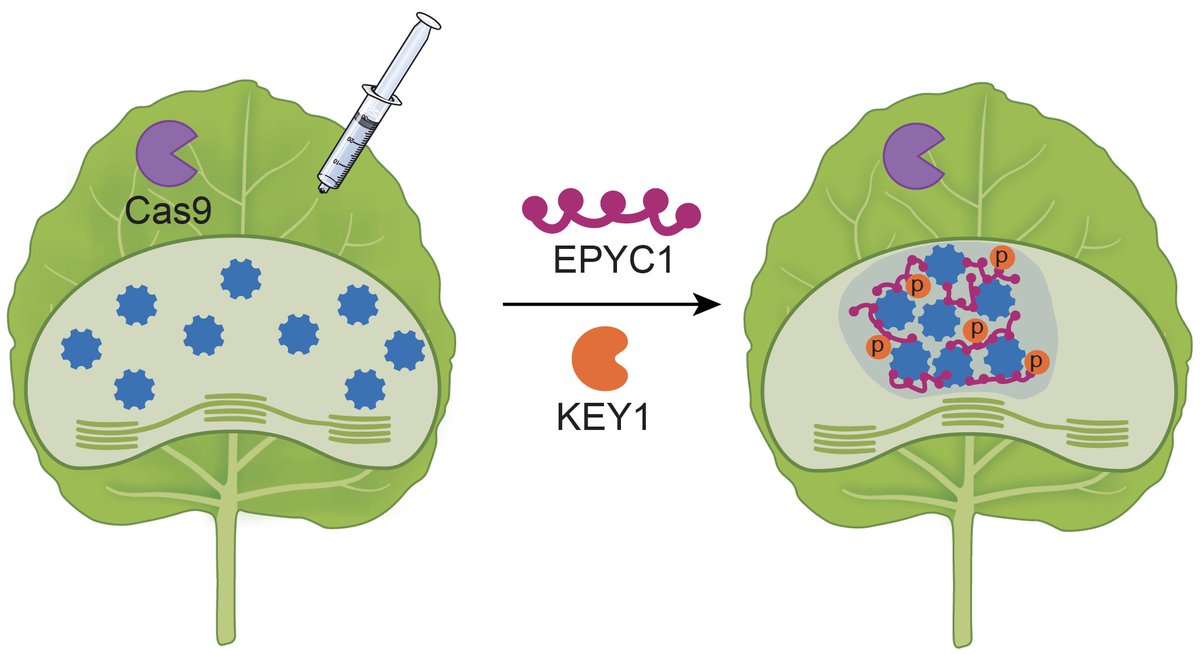
Engineering a pyrenoid into crops could boost yields, but testing components in plants takes months. To accelerate engineering, we made Nicotiana benthamiana with hybrid algal Rubisco, enabling the reconstitution of pyrenoid number regulation in a plant! https://t.co/SiVkUqvMt1
The algal pyrenoid turbocharges global CO2 fixation. Central to its function are specialized membranes that deliver CO2. We discovered that the protein RBMP2 makes these membranes—and found that the mysterious minitubules appear to enhance CO₂ delivery!
https://t.co/xPU96V5LP3
Pyrenoid tubules are essential for supercharging CO₂ fixation, but they're hard to resolve by microscopy. So, we physically expanded cells to see where different proteins go (3 examples below). The central region appears specialized for CO₂ delivery!
https://t.co/TxvlyyLvfV
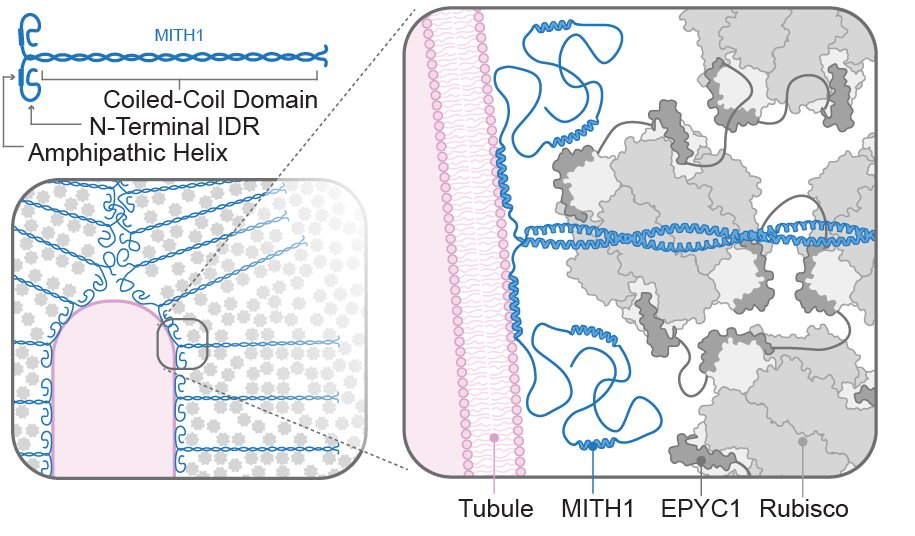
The algal pyrenoid fixes ~1/3 of global carbon, relying on a unique membrane-within-condensate architecture. How is this architecture built? We discovered that the protein MITH1 draws membranes into the pyrenoid condensate by promoting wetting! 🌿💧https://t.co/tzPIs1aHif
The US National Science Foundation (NSF) — a major funder of basic research — has restricted the flow of new research grants to a group of elite universities, Nature has learnt.
https://t.co/dUcCrJh4Dm
We genetically disconnected starch from the matrix in the algal pyrenoid!
A saga1;saga2 double mutant lacks a pyrenoid starch sheath!
Our model: SAGA1 & SAGA2 locally initiate starch on the pyrenoid surface by enriching starch precursors.
🌞🦠🔬🔌👀
https://t.co/yjBV1nAfDc
To all scientists immigrants: This is an amazing opportunity. The Vilcek family is super generous and has rewarded many immigrant scientists including Nobel Laureate @kkariko. Hope everyone eligible applies !
@hhmi_science's #FreemanHrabowski Scholars
Program offers early career faculty up to $10M over 10 yrs, + salary & benefits. Postdocs can apply too. Opens 11/3! https://t.co/8GsyrLUdq6
Alexander Ploss, Princeton’s Harry C. Wiess Professor of Life Sciences and Molecular Biology, and the co-director of the Global Health Program, was awarded a 2026 Guggenheim Fellowship in the field of medicine and health. 🥂 https://t.co/F2KsWJLAVK
Today in Nature Cell Biology, a collaborative effort across labs (Jonikas, Wingreen, Brangwynne) at Princeton discovers the key to regulating a biomolecular condensate. Congrats to first authors Shan He and Linnea Lemma! https://t.co/0MBOqKLMrr
Now published @NatureCellBio!
Kinase KEY1 controls pyrenoid condensate size throughout the cell cycle by disrupting phase separation interactions
https://t.co/u5UxgXOZtR
Algal pyrenoids—condensates that mediate ~1/3 of Earth’s CO2 fixation—change size and number as cells divide. Our data suggest a simple control mechanism: a kinase that continuously ejects material from the condensate! ☀️🌍🔬💧 #Biophysics#Photosynthesis
https://t.co/kT5C14FXXI
We genetically disconnected starch from the matrix in the algal pyrenoid!
A saga1;saga2 double mutant lacks a pyrenoid starch sheath!
Our model: SAGA1 & SAGA2 locally initiate starch on the pyrenoid surface by enriching starch precursors.
🌞🦠🔬🔌👀
https://t.co/yjBV1nAfDc