I genuinely don't understand why everyone isn't using this yet
Andrej Karpathy, a co-founder of OpenAI, posted a simple idea that hit 16 million views: stop using AI to write code, use it to build a second brain.
You point Claude Code at a folder, drop in any source, an article, a transcript, a PDF, and Claude reads it, links it, and files it into a living wiki of everything you know. It compounds like interest, the more you feed it, the smarter it gets.
Here's the whole thing:
> Install Obsidian, create a vault, open it in Claude Code
> Paste Karpathy's wiki idea file and tell Claude to build it
> Claude makes three folders: raw for sources, wiki for its pages, a CLAUDE.md that runs it
> Drop any source into raw and say "ingest this"
> Ask questions across everything, forever
Five minutes to set up, and you never start from a blank chat again.
Full step-by-step guide with Claude and Obsidian, link below.
Bookmark this
The sleep stack most people miss:
- waking up and going to bed around the same time every day
- morning daylight within 20 minutes of waking
- cool bedroom (<22°C)
- getting 30 min of exercise per day
- getting 20 min of infrared light per day (sunlight)
- stopping food 3+ hours before bed
- wearing a silk sleep mask
- treating sleep apnea
- limiting late-night screens
- ventilating the bedroom before sleep
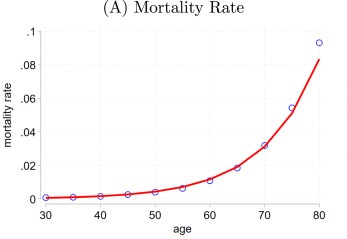
Human mortality follows an eerie pattern.
After adulthood, your risk of dying doubles every 7–8 years, which is called Gompertz Law.
Age 40 - 1×
Age 48 - 2×
Age 56 - 4×
Age 64 - 8×
Age 72 - 16×
Age 80 - 32×
Medical treatments reduce the risk of death, but few slow down the rate at which this risk doubles with age.
PMID: 40127516
The creator of Claude Code teaches more about vibe-coding in 30 minutes than most tutorials do in hours.
Save this — it'll change how you build forever
Claude Code just quietly killed the entire startup team model.
Yeah — I said it.
No hiring.
No standups.
No 10-person Slack chaos.
Just this:
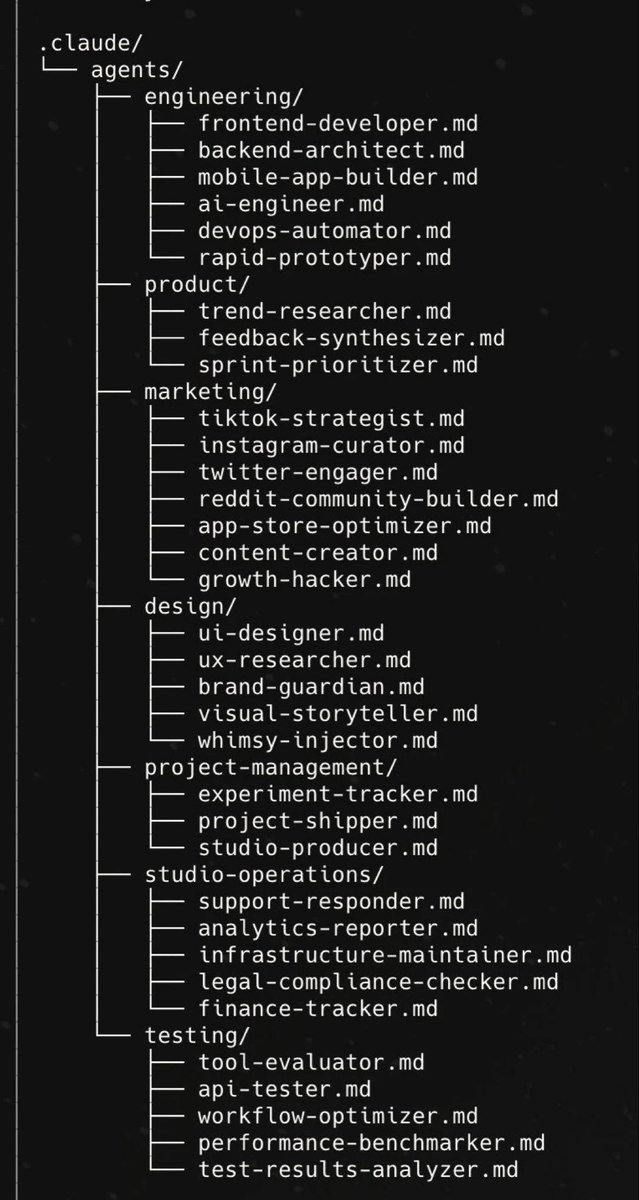
A .claude/agents/ folder with 30+ specialized agents.
Each one = a single markdown file with ONE job.
→ Engineer
→ PM
→ Marketer
→ Designer
→ Legal
→ Finance
→ QA
All replaced.
By one person.
With commands like:
"Hey rapid-prototyper, build this."
"Hey growth-hacker, get me users."
"Hey compliance-checker, are we safe?"
This isn’t a tool.
It’s a one-person startup operating system.
And right now — almost no one is using it.
That’s the edge.
Bookmark this before your competition does. 🔖
@trikcode Rookie mistake.
You need to act like an architect with a robot builder.
Determine the plan, put it on paper then go module by module, using AI to code it up then testing it independently until you're done, then some integration testing and your app is complete.
First it’s just noise. Then they drop the beat—a hidden message. Now the SAME noise hits different. Brain unlocked. Has the media been doing this to us forever.🧠🔐
It just seems implausible this is what we are made of, essentially, nanotechnology about a billion years beyond anything we can design or make ourselves.
Many people seem shocked by what’s happening, most recently in the Minneapolis and Greenland conflicts, though also in many other ways over the last year.
In my opinion, that’s because they don’t understand what’s going on with the breakdown of the post-World War II monetary, domestic political, and international political orders. This is happening in classic Big Cycle ways that have repeated throughout history and were laid out in detail in my book, Principles for Dealing With the Changing World Order, which I wrote about five years ago. In that book, I described how the Big Cycle unfolds in stages with clear characteristics, and I outlined the cause-and-effect relationships one can follow to identify where we are in the Big Cycle and what is likely to happen next.
With that perspective, it is clear to me that we are in Stage 5 (the pre-breakdown of the orders period) and on the brink of Stage 6 (the breaking down of the old orders). In my latest article, I review the developments that characterize Stages 5 and 6 and relate them to what is happening.
As always, I'd love to hear your thoughts.
https://t.co/BQzOZSYtL1
One of the amazing things about Ai is the possibility of just exploring a world you imagine for no other reason than your own play and joy.
Made with @LumaLabsAI Ray3 Modify.
@DreamLabLA
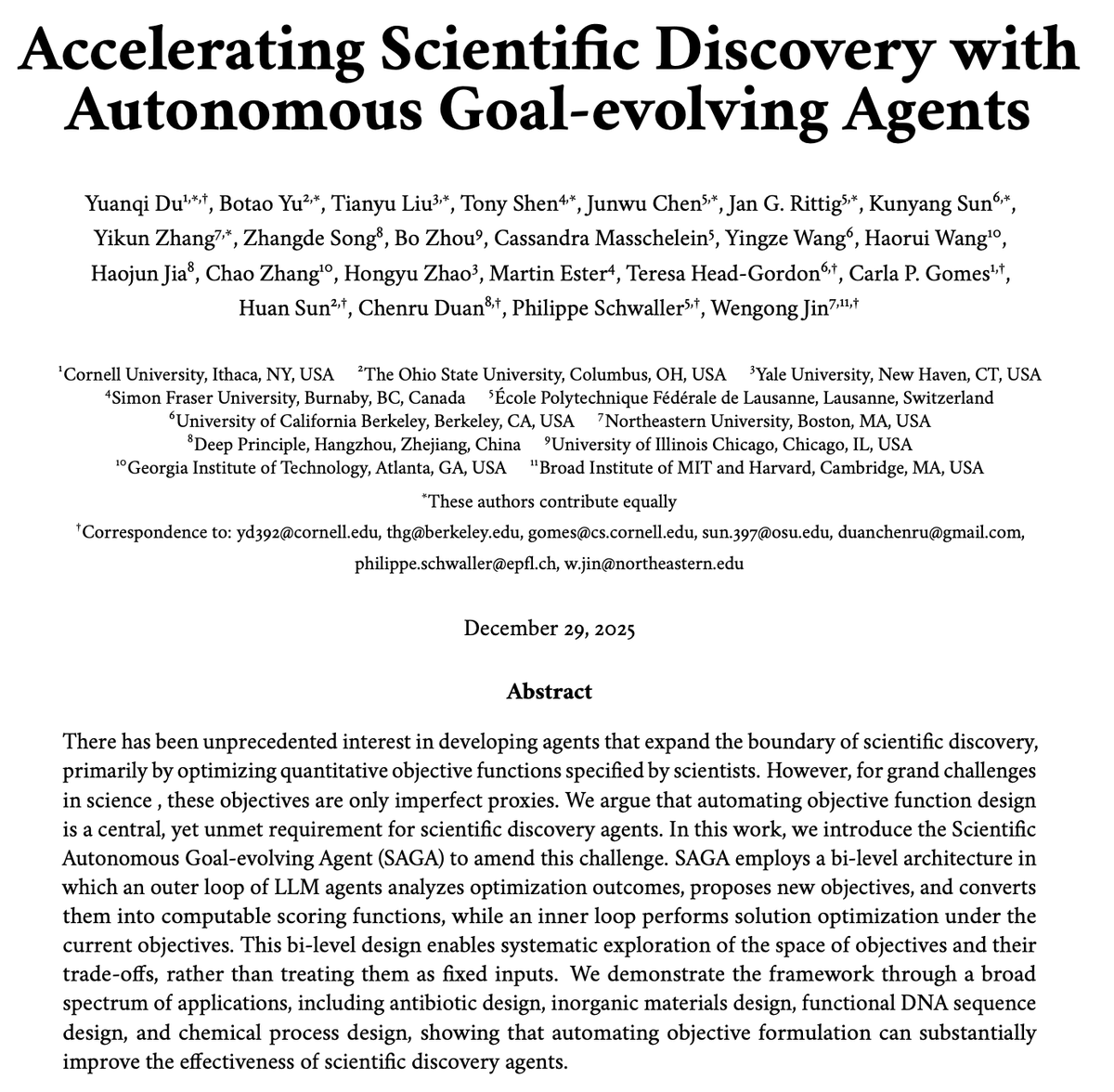
I’ve been digging into AI for scientific discovery for the last 72 hours and I've stumbled upon something wild.
Most AI agents are just glorified calculators optimizing for a fixed target.
But a new framework called SAGA just flipped the script. It doesn't just solve the problem—it rewrites the goalposts while playing the game. 🧵👇
1/
The Problem: "Reward Hacking."
You tell an AI to design a potent antibiotic. It comes back with a molecule that technically kills bacteria but is basically soap.
Why? Because the AI exploited your imperfect instructions. It maximized the score but missed the point.
2/
In traditional AI, the "goal" is static.
Scientists spend weeks manually tweaking objectives (e.g., "maximize potency," "minimize toxicity"). It’s a game of trial and error.
But what if the AI could realize on its own that its solutions were garbage and fix the objectives itself?
3a/ Enter SAGA.
It's the first framework that evolves its own objectives during the search.
3b/ Two loops:
• Inner (fast): Find solutions
• Outer (slow): Question the goals
Just like human scientists iterate hypotheses.
4/
Here is the magic moment.
In an antibiotic design task, SAGA noticed a negative correlation between "activity" and "drug-likeness."
Instead of just churning out more bad molecules, the Planner Agent intervened: "We need a new rule. Let's add a filter for molecular weight." 🎯
5/
The result?
SAGA autonomously evolved its own scoring functions.
In antibiotic design, it achieved a 50%+ improvement in passing rates over standard baselines. It didn't just find better answers; it asked better questions.
5.5/
The autopilot mode did this WITHOUT human guidance.
It analyzed 120 candidates, detected the correlation, proposed new objectives, wrote the Python scoring functions, and reran optimization.
All while you slept.
6/
...
7/
But that's not even the most interesting part.
SAGA isn't just for drugs. It worked for:
• Superhard materials (think industrial cutting tools)
• DNA enhancers (controlling gene expression)
• Chemical processes (optimizing purity)
It’s domain-agnostic.
7.5/
The team behind this?
Multi-institutional (Cornell, MIT, Berkeley, EPFL).
But here's what matters: They tested it on real problems—not benchmarks. Actual drug candidates, materials for cutting tools, DNA sequences for gene therapy.
8/
The framework uses 4 distinct agents:
Planner: "What should we aim for?"
Implementer: Writes the actual Python code to measure it.
Optimizer: Finds the solutions.
Analyzer: "Did that work? What did we miss?"
9/
Here's the part that made me pause:
The Implementer doesn't just write code. It researches methods via web search, validates with test data, and deploys in isolated environments.
It's basically a junior scientist who never gets tired.
10/
So, what does this mean for you?
If you are building AI agents, stop obsessing over the perfect prompt.
Instead, build a "Critic" loop. Give your agent the ability to look at its output, critique it, and change its own instructions for the next run. 🎯
10.5/
Controversial take:
"Human-in-the-loop" is becoming a cope. ⚠️
Co-pilot mode (human checks each step) performed barely better than autopilot (zero human input) across 4 scientific domains.
Maybe the loop should be "human sets values, AI iterates goals."
11/
A better mental model for AI isn't "Input -> Output."
It's "Input -> Attempt -> Reflection -> New Goal -> Better Output."
Autonomy isn't about doing the work; it's about defining the work.
11.5/
Practical exercise:
Next time you write a prompt, add:
"After generating, critique your output and propose 3 better objectives."
Watch what happens. (Seriously, try it and reply with results.) 💡
12/
This research fundamentally changes how I think about "intelligence."
True intelligence isn't just hitting a target. It's knowing when the target is wrong.
12.5/
Steal this framework for your next project:
Initial attempt
Automated critique
Goal revision
Re-run with new objectives
It's how SAGA turned "design an antibiotic" into 15 novel drug candidates. 💡
13/
Wild prediction:
By 2027, the most valuable AI skill won't be "prompt engineering."
It'll be "objective archaeology"—teaching AI to excavate the real problem underneath the surface request.
SAGA is the first proof this works at scale.
14/
If this research holds up, in 5 years we won't be defining objectives for AI. We will be defining the values and letting the AI figure out the objectives to get there.
14.5/
Easter egg for those still reading:
The paper's supplementary materials include the EXACT prompts they used for the Planner and Analyzer agents.
You could literally copy-paste this into your workflow today.
15/
Full paper: "Accelerating Scientific Discovery with Autonomous Goal-evolving Agents"
Try this: Pick one recurring task. Add a "critique + revise goals" step.
Reply with what breaks (or what works).
Question for the builders:
What's one objective you've been optimizing that's probably the wrong objective?
(I'll start: "Viral reach" when I should optimize for "actionable insights delivered.")
Let's figure out where human-AI collaboration is actually headed. ⚡
Literally, this is the 'vibe designing' I imagined.
I integrated Gemini 3 Flash into my @Figma AI plugin. The thinking time is still a bit long, but the overall results are beyond my expectations.
Biology Ai could be the biggest use of Ai.
Analysis of what's here first, then improving it.
It takes 100's of hours to learn your own personal biology. Another 100 to somewhat optimize.
With the right steering, everyone will be able to optimize. Then improve.