How much can you pay yourself running a small business?
ECOM FUEL, the number one ecom forum, runs an annual survey.
300+ brands, all selling widgets, from 2m a year in revenue to 200m+
Here are some learnings (from them, and me)
1- $1,000,000 a year is a lot different in ecom vs service or saas
I ran a million dollar agency.
I was making $200,000+ year one.
The margins are just better on a service business.
You bill a million, your margin is 50%.
500k in free cash flow WITH NO NEED TO INVEST IN THE FUTURE
by contrast, a million in year in ecom is often NEGATIVE margin.
2- If you are comparing Service to a Product business, the product business needs to be 5x as big to get the same amount of cash out.
Meaning, a $20,000,000 a year agency probably spits off as much cash as a $100 million dollar brand.
A well run 20m agency should have 10m in free cash.
A well run 100m brand would have 20m in EBITDA.
But that 20m needs to be kept in the business to buy inventory and keep growing.
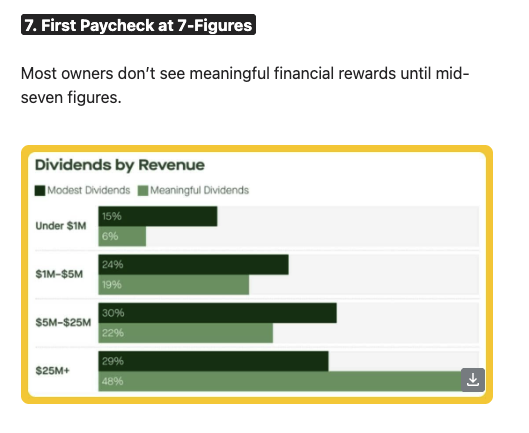
3- Its all about dividends and distrubitions.
We have lumpy businesses.
No matter what you sell, you will have 1 quarter do 40% of your revenue.
Ecom is full of sales, holidays, starts and stops.
SAAS and Services dont have this (or they try not too)
that makes taking a salary hard.
Three out of the past five years I have had to suspend my salary... AND RIDGE IS HUGE AND PROFITABLE.
But the flip side is when it rains it pours.
These business get very lean placing holiday POs and then get rich as hell in december.
Excess cash leads to distrubitons-
one time payments of cash leaving the business into your pocket.
---
Takeaways were sent in the operators newsletter and I am sure aaron will link it below
and think about joining ecom fuel
it is good
The business of sponsoring youtubers:
How much do brands pay?
Why so many VPNs?
How does it work?
Ridge has sponsored over 5,000 unique youtube channels.
We started in 2017, almost ten years ago, and we were early.
the ecosystem has changed A LOT since then, so Ill just talk about the modern landscape.
Types of sponsors-
1- Consumer physical goods.
This is us. We sell wallets. We want you to buy the wallets. The creator shares info on our wallet.
It is harmless. You do not have to buy the wallet. We wont continue to charge you. There is no subscription. But it or not or even return it.
Who else is competing in this space?
The creators own merch for one.
But beauty has really figured this out.
Its not uncommon for a beauty brand to spend 25% of their money on influencer, and youtube is a huge part.
Ridge is targeting a $7-$20 CPM (RPM, the amount of money we want to pay per 1,000 views).
Beauty is more comeptive, so they will pay 3x us.
$20 min, $60 is common.
But it is hard to run this program, build the muscle, and see a return... so thats why you dont see a lot of other non recurring physical goods companies sponsoring creators.
2- physical subscriptions.
AG1, Gruns, Factor.
They still have to make and ship stuff, but they are hoping you will stick around for years, so they will pay more to acquire a customer.
Creators dont LOVE selling subscriptions, but these sponsors arent scammy or unethical.
people need food, factor is a good option.
These guys are going to be paying like beauty.
$20-$60, with ag1 (or other competitive spaces) might pay up to $100 for the right creators.
3- digital subscriptions.
VPNs, esims, mobile games, apps.
These are the classic youtube sponsors.
New entrants include shopify, epidemic sounds, ground news.
These are the easy money.
There is always a VPN willing to sponsor any video.
Pay here is all over.
Mobile games can pay THE MOST (somehow) Ive seen offers for $100 cpms.
But it isnt uncommon for VPNs to come to the table with $30-$50 CPM offers. Same with a rocket money.
For most creators they are fine with this category- but there is some hate/shade for them.
This one category is 60% of all youtube dollars spent.
4- Taboo sponsors.
Hair loss, dick pills, therapy, crypto, gambling
Creators hate selling hair loss pills to their audience.
So these companies have to pay more
OR they have to sponsor content that other sponsors dont compete for.
The classic example is blewchew. blewchew made a hard push into comedy podcasts early, and built their business on it.
Think about stake- they run ads on any content.
They just want impressions and mind share.
they do not care about brand safe.
so they are a constant sponsor for anyone, no approvals, and that flexibility gives them a lower price.
these guys are either incredibly crafty and paying the lowest cpms (like $5) or are paying through the teeth.
we lost a deal to FTX (yes that FTX) in 2021.
We were paying a creaotr $15 per 1000 views.
They offered them $1,000 per $1,000 views.
a dollar a view.
You cant make money doing that.
turns out, ftx was stealing from people.
Thats how they made that pencil.
5- the big brand
Samsung, walmart, nike
Everyone wants these.
No one knows how to get them.
The bigger the brand, the more hand holding and approvals needed.
They have basically unlimited budget.
My wife was getting $5,000 a month from lululemon with 50k tik tok followers.
They have no real metric of success.
But thats what makes it so unpredictable.
they can spend anything, but you never know what they want or how to drive results.
black box.
have to network, get an agent, and wait.
ridge is always there, shopify is always there, surfshark VPN is there for you.
Walmart comes and goes.
This explains why you feel mentally exhausted even when you haven’t done any real work.
There is a concept called the Four Burner Theory.
Imagine your life as a stove with four burners:
1. Work
2. Health
3. Family
4. Friends
Each burner requires energy (gas).
To succeed in one area, you must turn down another.
You cannot run all four on high forever.
Energy is limited.
But this model was created before the digital age.
Today, there is a fifth burner "Information Burner."
And it is quietly draining all the other four.
Every time you scroll, it burns gas.
Every time you check a ping, it burns gas.
It feels like nothing, but it leaves you empty.
You cannot win at work if this burner is on high.
Control your feed or it will control your life.
Save this one.
We’ve been told that money is the only type of wealth.
This is a lie.
The 4 types of wealth you MUST understand:
1 Financial
2 Social
3 Physical
4 Time
Most people prioritize 1 & 2 their whole life only to realize when they're told that 3 & 4 are the most important ones.
Let’s walk through each to form a more comprehensive view of wealth:
Financial Wealth
This is the most commonly understood type of wealth.
It's generally what people mean when they say someone is wealthy.
Financial wealth is all about money—the money or financial assets that an individual has accumulated.
Social Wealth
Social wealth is about our connection to others in our respective worlds—our relationships.
True social wealth wealth is built through the cultivation of meaningful relationships.
Spend time building a T-shaped web of connectivity—broad and deep.
Build an army of mentors and friends.
Cultivate deep relationships, but also embrace the power of weak ties.
Physical Wealth
Physical wealth is about your health, fitness, and vitality.
It is perhaps the most critical—and under-appreciated—type of wealth.
Without physical wealth, it is effectively impossible to experience and enjoy the benefits of any of the other types of wealth.
Physical health is built through the long-term compounding of daily actions.
There are 3 broad buckets:
• Exercise—daily movement
• Nutrition—mostly real foods
• Sleep—good sleep habits
It's never too late to start building—or restoring—physical wealth.
Health is wealth.
Time Wealth
Time wealth is about the freedom to choose:
• How to spend your time
• Who to spend it with
• Where to spend it
• When to trade it for other types of wealth
Time wealth is also about an appreciation for the precious nature of time—of its value and importance.
Too many people fail to realize the value of this precious asset until it is gone.
Treat time as your ultimate currency—it’s all you have and you can never get it back.
NEVER let the pursuit of financial wealth rob you of your time and physical wealth.
Want to take the first step to building your own business and creating wealth?
Here's your playbook: https://t.co/BN6JaUdGCu
Things to watch-
1- creator lead brands break out
Dozens of 10-20m brands.
Harder for these to crack 100m.
But I wouldn’t launch a brand in 2026 that wasn’t creator/organic first
2- pouches.
Zyn is in.
There are 50 million young people in America addicted.
More things in the form factor of pouches will win.
3- more gummy.
I’m convinced form factor is actually most important.
We will see gummy protein- just because we have reached powder fatigue.
4- luxury comes for everything.
We have luxury in fashion and cars.
That’s about it.
We will see luxury slip into every aspect of consumer.
Erehwon was the bell weather.
Get ready for luxury tape and luxury thumb tacks. Put them next to your luxury candles and luxury soap.
5- tennis has a moment.
Pickleball and golf had big breakout years during the pandemic.
Yoga had a break out two decades ago.
Tennis will have a breakout year.
Its prep/old money aesthetic will be rethought- but Gen Z will love it
6- ugly stores go under.
I suspect we get hundreds of additional store closures.
This time hitting bigger blue chips, like a target.
I think it will be a bad year for wholesale.
ive been hanging out with founders under 22 lately living in sf/nyc and they're built different.
my observations of these young founders getting rich with AI:
1. these kids grew up watching YT creators flexing Porsches and private jets from their bedrooms. but when they looked at their own reality, they saw $200k college tuition and $45k entry-level jobs. the math didn't work. so they decided to skip the broken system entirely.
2. that economic reality shaped everything about them. they're unapologetically capitalistic in a way that reminds me of the 80s Wall Street era. pure survival capitalism. they think they need millions just to live comfortably, they look at $4,000 studio apartments in ny, and they're not wrong. tons of economic pressure for everyone right now and inflation worries.
3. so they formed group chats with other founders. their mentors are podcasts. they're plugged in and learning 24/7, treating business like a multiplayer video game they're trying to beat.
4. sam altman said something that stuck with me: older generations use ChatGPT as a Google replacement, but these kids use it as an operating system. they see this AI era as their gateway out of economic reality.
5. everything they do is optimized for virality. their startup journey reads like a Netflix documentary with built-in trailers. every product decision considers "will this clip work on X?" they reverse engineer social algorithms with their business models. it's like NELK Boys meets Spielberg meets YC demo day.
6. they build products designed to go viral on specific platforms. they'll time launches around trending topics. they'll create TikToks showcasing their SaaS tool like entertainment content.
7. some go the cash flow route, building consumer mobile apps like nikita or build saas portfolios. others raise millions in VC funding. the more the vc the better they think.
8. they document every failure, breakthrough, and late-night coding session. their businesses are performance art for the algorithm age.
9. they're not trying to fix the broken system that priced them out. they're building entirely around it. and they're winning because they accepted the new rules while everyone else is still playing by the old ones.
10. a lot will fail in public and end up working at companies. it'll be crushing. especially the ones that raise tons of vc. that's the game. but some will succeed in ways we've never seen before.
11. they think in portfolios from day one. not “this is my startup,” but “this is one bet.” apps, tools, experiments, accounts. they expect most to die and one to change their life.
12. many are hyper-capitalistic. michael douglas in wall street energy, but with claude, cursor, and viral clips instead of suspenders and cigars. theyve got big dreams and aren't afraid to go after them.
13. the same inflated world that crushed previous generations might have created the most resourceful generation of entrepreneurs we've ever seen. they are turning systemic failure into competitive advantage.
pretty genius when you think about it. the kids are alright.
Success is a choice.
It’s:
1) doing the common things better than everyone else
2) doing the things that no one else wants to do
It’s a choice to step out of your comfort zone because that is where the growth happens. It happens where you’re stretched beyond your current limits.
Success is dirty, hard work. It’s not pretty & shiny. Do hard things. Make it a habit to choose the things others refuse to do.
Marc Andreessen on product-market fit.
“You don’t have a business until you have a product that a lot of people want.”
“You can tell because the market’s pulling the product.”
“Until you have that, time spent building the business around the product is pointless.”
“Best case it’s gonna be a zombie.”
“When you have product-market fit, then you build a company around it.”
@pmarca with Business Insider in 2009: https://t.co/wTAsRM6XZI
Elon Musk just confirmed the most INSANE IPO in history.
SpaceX is going public in 2026.
$1.5 TRILLION valuation. Raising $30+ billion.
That's the biggest IPO ever made. Beating Saudi Aramco's $29 billion record from 2019.
But here's what everyone's missing:
This isn't about space tourism or Mars missions.
Elon is literally about to win the entire AI race.
And 99% of people have no idea how...
Here's the problem killing every AI company right now:
POWER.
Oracle just reported earnings.
They burned through $12 BILLION in one quarter building data centers.
Their free cash flow? NEGATIVE $10 billion.
Revenue missed estimates. Stock crashed 11%.
Microsoft, Amazon, Google all scrambling to find enough electricity for AI training.
The brutal math:
The US generates 490 gigawatts of total power.
AI is projected to need 123 gigawatts by 2035.
That's a QUARTER of the entire electrical grid. Just for artificial intelligence.
Goldman Sachs says AI energy demand could jump 165% by 2030.
There is literally not enough power on Earth to run AI at the scale these companies are promising.
Every data center needs massive cooling systems. Billions of gallons of water per year. Insane energy costs.
And the infrastructure can't keep up.
Elon's solution?
Stop building on Earth entirely.
SpaceX is building data centers in SPACE.
Not a concept. Not 10 years out. Literally starting in 2026.
They're upgrading Starlink V3 satellites to carry AI computing chips.
Each satellite gets 24/7 solar power. No clouds. No night. No weather disruptions. No grid bottlenecks.
And the insane part is that Starship can deliver 300 to 500 gigawatts of solar-powered AI satellites into orbit every single year.
At 300 gigawatts per year, the AI computing power in space would exceed the entire U.S. economy's total electricity consumption within two years.
Just from satellites. Processing in orbit.
While Oracle is begging banks for loans to finish data centers and OpenAI is stuck in circular funding arrangements with Microsoft, Elon already owns everything:
The rockets. The satellites. The launch infrastructure. The AI company (xAI).
He doesn't need to ask utilities for permission.
Doesn't need grid approvals from local governments.
Doesn't need to build nuclear plants or wait for clean energy.
He just launches.
And everyone else is scrambling to catch up:
Jeff Bezos sees it. Blue Origin announced they're building their own orbital data centers.
Google just launched "Project Suncatcher" with plans to deploy AI satellites by 2027.
Eric Schmidt, the former CEO of Google, literally BOUGHT an entire rocket company (Relativity Space) just to compete in this space.
But they're all 3+ years behind Elon.
SpaceX already has 6,000+ Starlink satellites in orbit. The infrastructure is built.
The $30 billion from the IPO?
Going straight into scaling orbital compute.
SpaceX revenue is jumping from $15 billion in 2025 to $24 billion in 2026.
Most of that from Starlink. Now add space-based AI infrastructure on top.
Here's why this matters:
Whoever controls orbital computing controls the AI revolution.
And there's only ONE company on Earth with fully reusable rockets that can launch at the scale required.
Jensen Huang, Nvidia's CEO, called space data centers "a dream."
Translation: Nvidia is screwed if Elon actually pulls this off.
Because if SpaceX succeeds, every AI company on the planet becomes Elon's customer.
OpenAI needs compute? Running on SpaceX satellites.
Google needs more capacity? Renting orbital infrastructure.
Microsoft needs power? Paying SpaceX for launch and compute access.
Elon won't just be in the AI race.
He'll own the entire track everyone else is running on.
The $1.5 trillion valuation sounds crazy until you realize what he's actually building.
It's not a rocket company. It's the infrastructure layer for the next 50 years of computing.
People calling it overvalued have no idea what's coming.
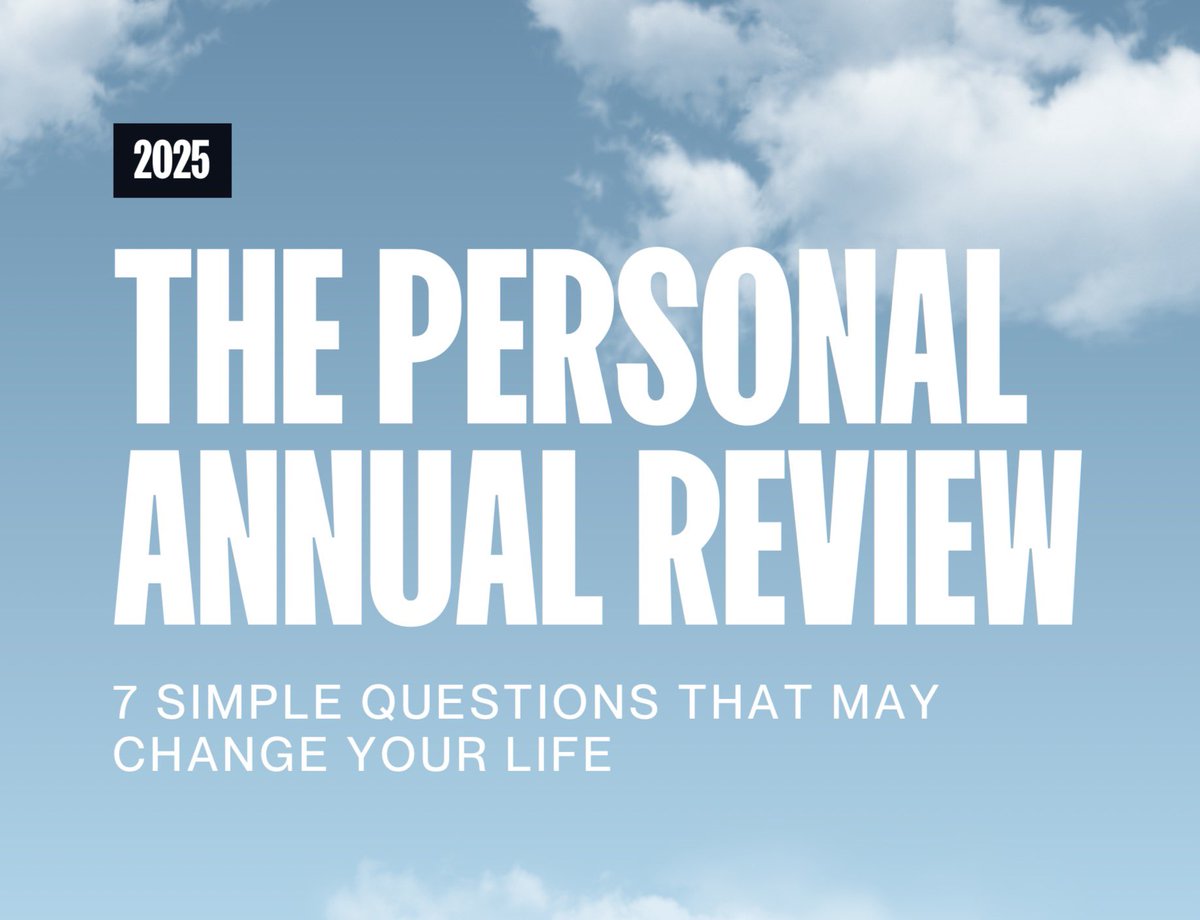
At the end of every year, I conduct a Personal Annual Review.
It's a transformative exercise everyone should do.
7 simple questions that may change your life:
(bookmark this + download the free template)
Question 1: What Did I Change My Mind On This Year?
Finding the truth is much more important than being right.
The most successful people enjoy being wrong. They lean into the feeling of being an embarrassing beginner. They embrace new information as software updates to their brains.
What did I change my mind on in 2025?
What software updates did I have this year?
Goal: Identify 2-3 key changes.
Question 2: What Created Energy This Year?
One of my strongest held beliefs is that your outcomes follow your energy.
Reflect on your calendars from the year on a macro scale.
What activities, people, or projects consistently created energy in my life? Write them down.
Did I spend ample time on these Energy Creators or did they get neglected?
Goal: Spend more time on these in 2026.
Question 3: What Drained Energy This Year?
Continue your calendar reflection, but with an inverted focus.
What activities, people, or projects consistently drained energy from my life? Write them down.
Did I allow the Energy Drainers to persist or did I manage them in real time?
Goal: Spend less time on these in 2026.
Question 4: What Were The Boat Anchors In My Life?
Boat Anchors are the people, mindsets, and actions that hold you back from your potential.
Examples:
• People who laugh at your ambition
• Self-limiting beliefs, stories, and mindsets
• Bad habits that cut into your growth
Identify the Boat Anchors that exist in your life.
Goal: Eliminate or minimize the energy you give them in 2026.
Question 5: What Did I Not Do Because Of Fear?
"We suffer more in imagination than in reality." - Seneca
One thing I've learned:
Fear comes from inexperience, not incapability. You're afraid because you haven't done it yet, not because you can't do it. Inexperience is the problem to be solved—and it's solved through having the courage to act.
The thing you fear the most is often the thing you most need to do.
Deconstruct the fears that held you back:
What was the downside if I had taken action? What was the upside if I had taken action?
Goal: Get closer to your fears in 2026.
Question 6: What Were My Greatest Hits & Worst Misses?
Your natural bias skews how you see your year:
• The optimist sees all hits
• The pessimist sees all misses
Take an objective view:
Write down your hits and your misses. Reflect on why the hits hit and the misses missed.
Goal: Develop a balanced perspective on your year.
Question 7: What Did I Learn This Year?
"When you stop learning you start dying." - Albert Einstein
It's easy to lose sight of your progress and growth when you're zoomed in. The final question pushes you to zoom out and reclaim your perspective.
Take your time on this one. Reflect on the other questions from the exercise.
Write down what you've learned.
Goal: Identify 5-10 transformative learnings.
***
The Personal Annual Review is a life changing exercise.
Experience + Reflection = Growth
Download a beautiful (and free!) Personal Annual Review template to conduct your own here: https://t.co/0tjZum9GMT
In 2026, Venture Capital will eat Private Equity
It used to be that venture capital and private equity lived on two separate planets:
VC = San Francisco
PE = New York
They targeted completely different universes of companies:
--> PE - people heavy biz services, stable/low growth, predictable cashflows
--> VC - tech-forward, high growth, high risk, massive TAM
What was the playbook for B2B VC backed startups?
--> Grow to unicorn scale by selling to other early adopter tech companies, then Fortune 500s
XX> SMB and mid-market services - think field services, IT staffing, accounting, construction, recruiting - were always tough to sell into for startups
Why?
-->Thin margins, high labor costs, and small IT budgets
>> But as AI eats labor, these businesses are in play <<
There are 3 ways where VC and PE are colliding:
1/ Private Equity funds will become channel partners for startups.
PE funds are focused on financial engineering and cost optimization. Startups building AI products and services can sell across their portfolio to automate the backoffice and uplevel sales and marketing. PE funds have made AI their #1 strategic priority and have hired central leaders to oversee their portfolio adoption efforts
2/ PE portfolio pages are a startup idea menu
Private equity will often buyout vertical software companies whose TAM didn’t allow venture scaled returns. As software evolves from data storage and collaboration to agents taking action and completing work, AI should massively expand the TAM for these categories. Founders will set their sights on unseating these legacy incumbents backed by private equity. All they have to do is look at their portfolio pages for category ideas
3/ AI Rollups
This is one of the most direct ways that VC is eating PE
VC backed AI platform businesses are not just selling software but acquiring legacy business services companies to own the value chain end to end.
As an example, our @speedrun company AgentAstra is acquiring freight forwarding services businesses with mostly debt and integrating AI deeply into their operations
These companies aim to increase margins by at least 2x and make them “AI native”
tl;dr - While the west coast, Patagonia-wearing VCs and the east coast, PE suits used to live in different universes, in 2026 with AI, I believe, those worlds converge